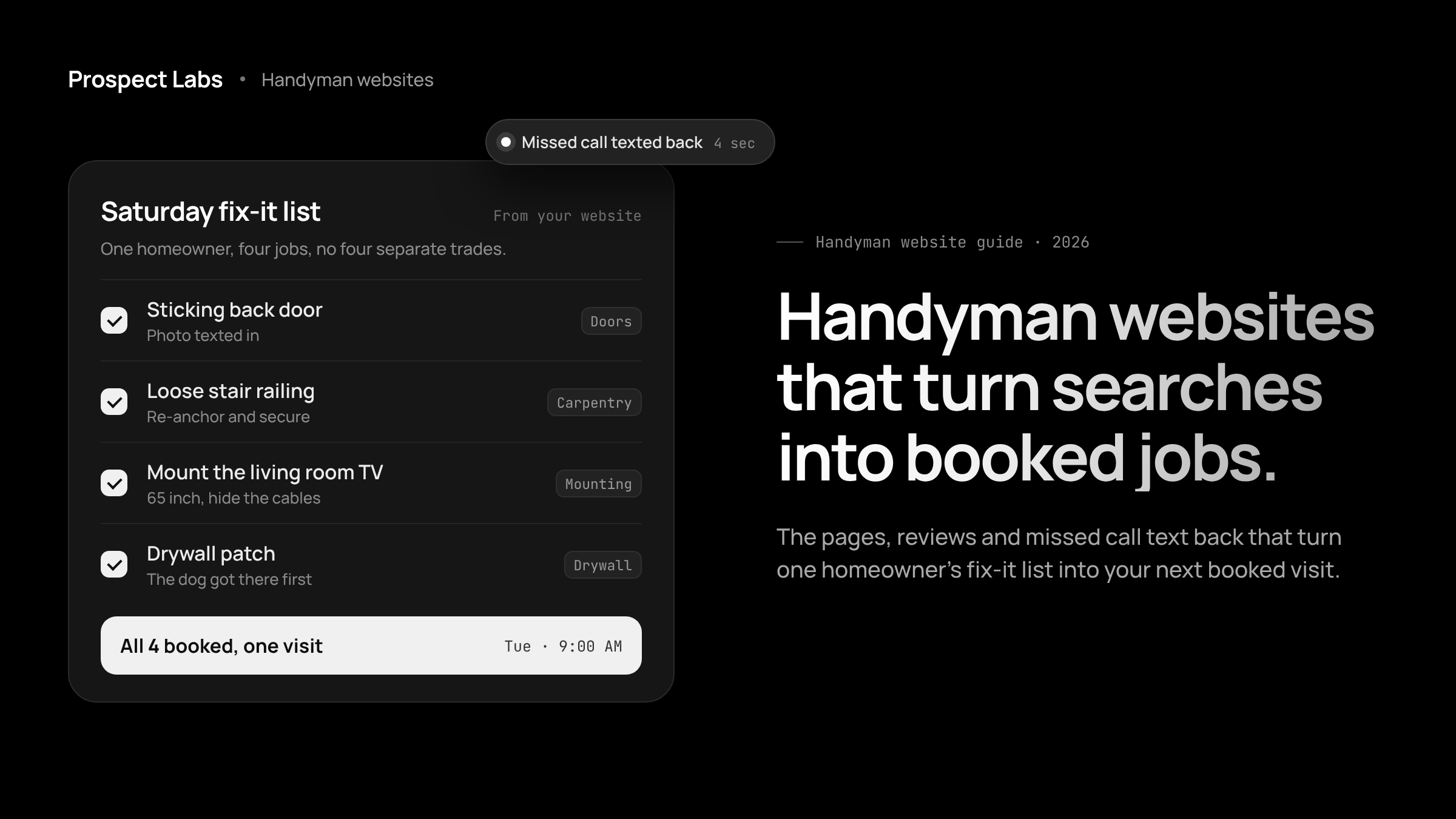

It’s Saturday morning. A homeowner has a list on the fridge: a sticking back door, a loose railing, a TV that needs mounting and a patch of drywall the dog chewed through. Nobody wants to call four different trades for that. They want one person who can knock out the whole list.
So they search “handyman near me,” tap the first few results and start comparing. One site has a phone number buried at the bottom. Another hasn’t been updated since 2019. The third shows real photos, lists every small job they take on, has 60 recent reviews and lets them text a photo of the door in one tap. Guess who gets the job.
That’s the whole story of handyman websites. Your site isn’t a brochure anymore. It’s the place a homeowner decides, in about a minute, whether you’re the person they trust inside their house. This guide covers what a handyman website needs, which pages actually earn calls, how local SEO fits in, what it costs, and why the system behind the site matters more than the design on top of it.
What is a handyman website?
Quick answer: A handyman website is a small business site built to turn local searches into booked repair jobs. The best handyman websites list every service clearly, show the towns you cover, display recent reviews, load fast on a phone and give homeowners a one tap way to call, text or request a quote.
A handyman business is different from a single trade contractor. You sell range. One customer needs a faucet swapped, the next wants shelves hung, the next needs a whole punch list done before a house sale. Your website has to make that range easy to scan, without looking like a business that does everything badly.
It also has to do one more job most handyman websites skip: catch the lead when you can’t. You’re on a ladder, under a sink or driving between jobs for most of the day. A good site keeps working while your hands are full.
Why do handyman websites matter in 2026?
Homeowners now check you online before they ever hear your voice. Even a neighbor’s referral gets Googled. These numbers show how much of the hiring decision happens on a screen.
| What homeowners do | The number | What it means for your site |
|---|---|---|
| Search “handyman near me” | About 201,000 US searches a month | Demand is there. The question is whose site catches it. |
| Read reviews for local businesses | 97% of consumers | Reviews belong on your site, not just your Google profile. |
| Skip businesses with fewer than 20 reviews | 47% of consumers | A thin review count quietly costs you jobs. |
| Require 4.5 stars or higher | 31%, up from 17% a year earlier | The bar keeps rising, so asking after every job matters. |
| Want reviews from the last 3 months | 74% of consumers | Old reviews don’t count for much. You need a steady flow. |
| Use AI tools like ChatGPT for local recommendations | 45%, up from 6% in 2025 | Clear service pages help AI tools understand what you do. |
Sources: search volume from MarketKeep’s handyman keyword data; review figures from BrightLocal’s Local Consumer Review Survey 2026 (1,002 US consumers), as summarized by Cloutly and SHNO.
The takeaway is simple. A handyman website that only looks good is solving the wrong problem. It has to prove you’re trustworthy fast, then make contacting you effortless.
What does every handyman website need?
Every handyman website needs seven things: a clear service list, a visible service area, real job photos, recent reviews, a fast mobile layout, a one tap way to reach you and a way to catch the leads you miss. Miss any one and visitors drift to the next result.
- A service list homeowners can scan in seconds. Name the actual jobs: drywall repair, TV mounting, furniture assembly, door and lock repair, light fixture installs, caulking, gutter cleaning, punch lists for home sellers. “General repairs” tells nobody anything.
- Your service area, spelled out. List the towns and neighborhoods you cover. Homeowners want to know you’ll actually come out, and Google uses those signals too.
- Real photos of real work. Before and after shots of a patched wall or a rebuilt fence gate beat stock photos every time. Add a photo of you or your crew. People are letting you into their home.
- Recent reviews, front and center. Show your Google rating near the top and pull your best recent reviews onto the homepage. Our guide on how contractors get more Google reviews covers how to keep them coming.
- A mobile layout that loads fast. Most handyman searches happen on a phone, often while the problem is right in front of them. Big buttons, short pages, no slow sliders.
- One obvious next step. A tap to call button and a tap to text button on every page. Texting matters for handyman work, because “here’s a photo of the leak” is easier than describing it.
- A safety net for missed calls. If a call rings out while you’re working, the caller should get a text back from your business right away. This one feature separates websites that look nice from websites that book jobs.
Trust details round it out: your license or registration where your state requires it, proof of insurance, how long you’ve been in business and whether you offer a workmanship guarantee.
Which pages should a handyman website have?
A handyman website should have a homepage, individual service pages, a service area page, a reviews or work gallery page, an about page and a contact page. Separate service pages matter most, because each one can rank for its own search.
| Page | What it does | What to put on it |
|---|---|---|
| Homepage | Answers “can you help me, and how do I reach you?” in five seconds | Top services, towns served, star rating, text and call buttons |
| Service pages | Ranks for specific searches like “drywall repair” or “TV mounting” | What’s included, typical job photos, FAQs, a quote request |
| Service area page | Tells homeowners and Google where you work | Towns, ZIP codes or a simple map, travel or minimum charge if any |
| Reviews and gallery | Proves the quality of your work | Before and after photos, written reviews, job types |
| About page | Builds trust before a stranger lets you in | Your story, photo, years in business, insurance, guarantee |
| Contact page | Makes reaching you effortless | Phone, text, short form, hours, response time promise |
Keep the menu short. Five or six items is plenty. A homeowner with a leaking faucet is not going to dig through a dropdown with 30 links.
Why don’t most handyman websites get calls?
Most handyman websites don’t fail because of bad design. They fail because nothing happens after a homeowner lands on them. The site waits, the homeowner doesn’t, and the job goes to whoever answers first.
Here’s how a typical lost handyman job plays out:
| Time | What happens |
|---|---|
| 10:14 AM | Homeowner searches “handyman to fix sticking door” |
| 10:15 AM | Lands on your site, likes your photos, taps to call |
| 10:15 AM | You’re halfway through a bathroom fan install. The call rings out. |
| 10:17 AM | No voicemail. They call the next handyman on the list. |
| 10:18 AM | That handyman picks up and books Tuesday |
| 1:30 PM | You call back. They’ve already hired someone. |
Four minutes. That’s all it took. And you’d never know the job existed unless you scrolled through missed calls later.
The usual leaks look like this:
- Missed calls with no follow up. Callers rarely leave voicemails. They just dial the next name.
- No easy way to text. Many homeowners would rather send a photo than talk through a problem.
- Reviews that stop coming. Happy customers mean to leave one. Without a reminder, most never do.
- Past customers forgotten. The person whose deck you fixed in spring has a gutter problem in fall. If they can’t remember your name, they search again. Our post on referral marketing for contractors digs into this one.
Handyman website vs marketing system: what’s the difference?
A handyman website shows your business. A marketing system works your leads. The site is one piece, and the tools connected to it are what turn a visit into a booked job and a finished job into the next one.
| The moment | Just a website | Website plus a marketing system |
|---|---|---|
| A homeowner visits | They look around and leave if the next step isn’t obvious | They text you in one tap, straight to your phone |
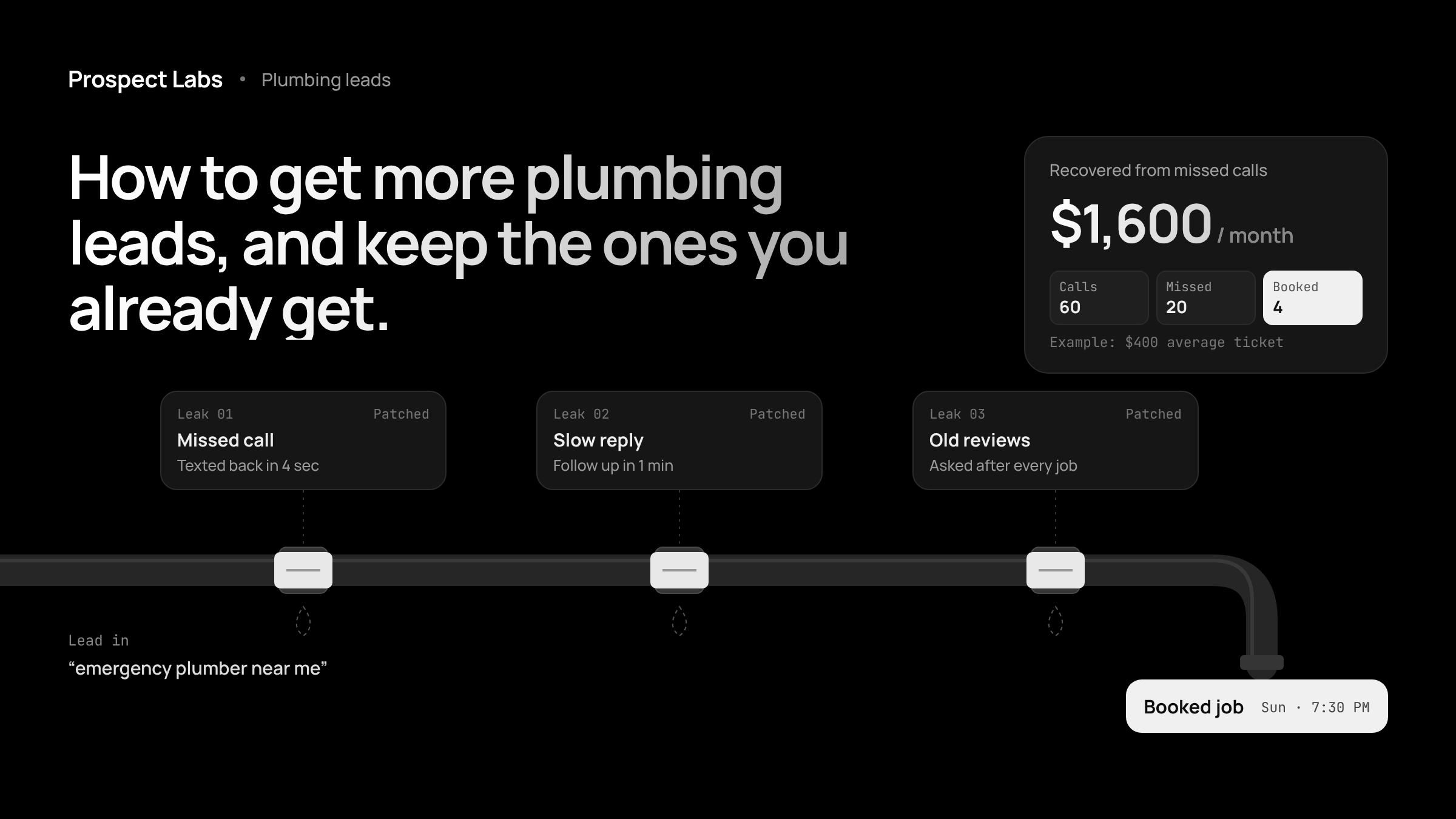
| You miss a call | It rings out | They get a text in your business name within seconds |
| A quote goes quiet | Nobody notices | Automatic follow ups keep the conversation alive |
| The job is finished | You forget to ask for a review | A review request goes out, with polite reminders |
| Six months later | They’ve forgotten your name | A return customer campaign brings them back |
This is exactly how Prospect Labs builds handyman websites. The site is built mobile first around what a homeowner needs to decide, and it sits at the front of a connected set of tools we set up and maintain for you:
- Missed call text back, so every caller hears from you before they try someone else
- A 5 star review funnel that asks after every job and follows up automatically
- Automated lead follow up for quotes and enquiries that go cold
- Referral and return customer campaigns you switch on with one button
- An all in one inbox for texts, web messages and Facebook and Instagram DMs
- A dedicated business phone line, separate from your personal number
- Local SEO with keyword research, on page work and ongoing updates
You can see the full breakdown in the Prospect Labs marketing system. Handyman is one of the 22 trades we build for, and the setup works the same way for any business that gets called out to a home. For the bigger picture across trades, read our guide to home service marketing.
How do handyman websites rank on Google?
Handyman websites rank on Google through three connected signals: a complete Google Business Profile, service pages that match what homeowners type, and a steady flow of recent reviews. The website and the profile work together, so weakness in one drags down the other.
- Google Business Profile. Pick “Handyman” as your primary category, add secondary categories that fit your real work, set your service area, upload job photos often and answer every review.
- One page per core service. A page about drywall repair can rank for drywall repair. A homepage that mentions it once in a list usually can’t. Use the words homeowners use, like “fix a hole in the wall,” not just trade terms.
- Clear location signals. Mention the towns you serve naturally on your service and area pages. Keep your business name, phone and service area consistent everywhere you’re listed.
- Speed and structure. Fast pages, clean headings, image alt text and LocalBusiness schema all help search engines and AI tools read your site.
- Reviews that keep coming. Review count, rating and recency are strong local ranking factors, and they’re what homeowners check first.
If you want the full playbook, our guide to local SEO for contractors walks through each step. SEO takes months, not days. Anyone promising page one next week is selling something else.
How much do handyman websites cost?
A handyman website costs anywhere from under $20 a month to over $13,000 up front, depending on who builds it and what comes with it. The bigger question is what you’re paying for: a page that sits there, or a system that answers leads.
DIY website builders like Wix and Squarespace are the cheapest route. Plans start below $20 a month, but you’re the designer, the copywriter and the SEO person, usually at 10 PM after a full day of jobs.
Freelancers and agencies cost far more up front. One US benchmark puts a handyman website at $1,750 to $5,800 with a freelancer and $4,350 to $13,750 with an agency. That often covers the build only. Updates, hosting and anything that follows up leads tend to cost extra, so the site slowly goes stale.
Monthly website and marketing systems spread the cost out and keep the site maintained. Prospect Labs pricing is $297 a month plus a one time setup fee that depends on design level. That covers the website, missed call text back, review funnel, lead follow up, campaigns, inbox, business phone and local SEO, month to month, with 30 days’ notice to cancel.
A quick gut check: if your average handyman ticket is $300, one extra booked job a month covers the system. Every job after that is margin. That’s simple arithmetic on your number, not a promise of results.
What mistakes do handyman websites make most often?
The most common handyman website mistakes are hiding the phone number, listing services too vaguely, using stock photos, ignoring mobile users and having no plan for missed calls. Each one is small. Together they quietly send work to competitors.
- Phone number only in the footer. Put call and text buttons at the top of every page, and keep them visible as people scroll.
- “We do it all” with no specifics. Homeowners search for specific jobs. Name them.
- Stock photos of smiling models in hard hats. Homeowners can spot them instantly. Your own photos, even from a phone, build more trust.
- No service area. If a visitor can’t tell whether you come to their town, they leave.
- Reviews that are years old. A five year old testimonial looks like a business that stopped getting customers.
- A contact form that goes nowhere. If form submissions land in an inbox you check once a week, the lead is already gone.
- No follow up after a quote. Many homeowners just need a nudge. Silence usually means “not yet,” not “no.”
Handyman websites FAQ
Do handymen really need a website if most work comes from referrals?
Yes. Referred customers still look you up before they call. A working website with recent reviews and an easy way to text you is what turns that referral into a booked job instead of a “maybe later.”
What should a handyman website include?
A handyman website should include a clear list of services, the towns you serve, real job photos, recent reviews, tap to call and tap to text buttons, and a way to respond automatically when you miss a call.
How long does it take to build a handyman website?
A DIY site can go up in a weekend if you have the time. A professionally built site usually takes one to four weeks. Prospect Labs builds the website and the full system in 7 to 10 days after one onboarding form.
Can a handyman website rank on Google without a physical shop?
Yes. Most handymen work from home or a van. You can set up a Google Business Profile as a service area business, hide your home address and still rank for the towns you cover.
What’s the best platform for a handyman website?
The best platform is the one that stays updated and connects to how you handle leads. WordPress, Wix and Squarespace all work. What matters more is speed, mobile layout, service pages and what happens after someone reaches out.
How do I get more reviews on my handyman website?
Ask right after every job, while the customer is happy, using a direct link to your Google review page. Send one polite reminder if they don’t respond. An automated review funnel does this for you every time.
Should my handyman website show prices?
Showing starting prices or a minimum service charge filters out tire kickers and builds trust. Exact prices are hard for handyman work, so ranges or “starting at” figures work well for common jobs like TV mounting or furniture assembly.
The bottom line on handyman websites
The best handyman websites aren’t the flashiest ones. They’re the ones that make a homeowner feel safe letting you in, show exactly what you fix, and never let a missed call turn into a lost job.
You can piece that together yourself with a website builder, a review app, a texting tool and a lot of evenings. Or you can have it built once and maintained for you.
That’s what Prospect Labs does. We build your handyman website as the front end of a complete system: missed call text back, review requests, lead follow up, campaigns and local SEO, all running from your phone. See how the process works, browse examples of our work, or check how we approach other trades in our general contractor marketing guide.
Ready to stop losing jobs while you’re on the ladder? Book a free strategy call. In 60 minutes we’ll review your current site, show you the system running on live accounts and give you a free design preview. If it isn’t a fit, we’ll tell you straight.