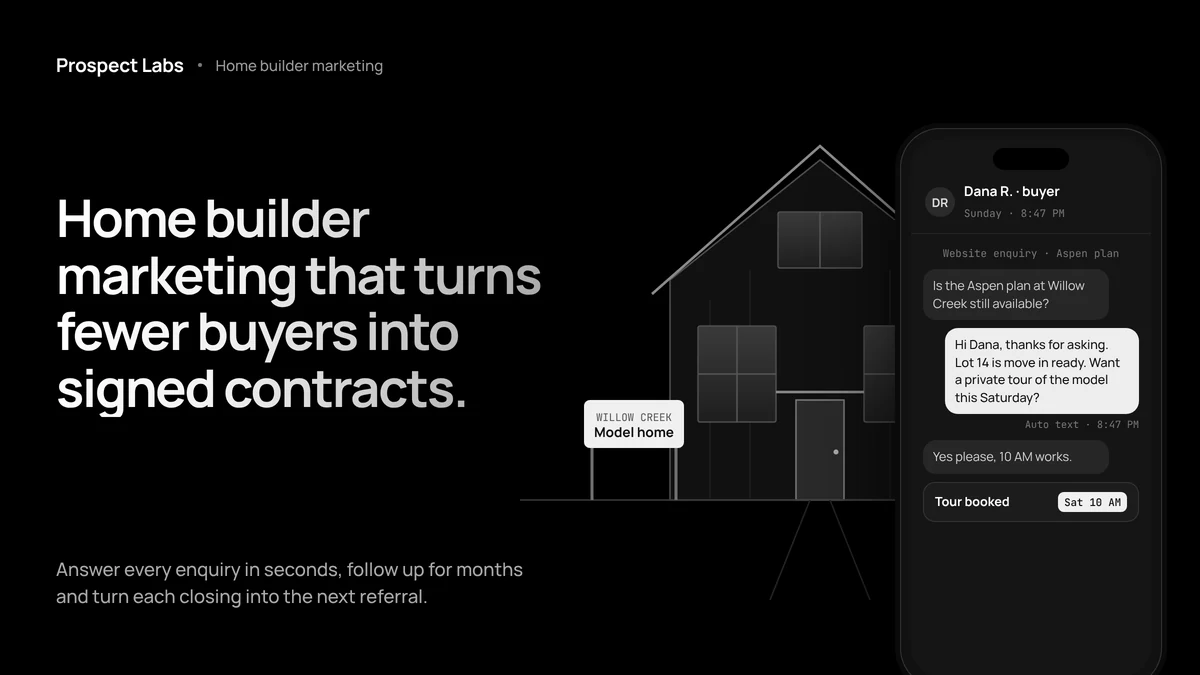

A couple sits at the kitchen table on a Sunday night, scrolling new homes on their phone. Mortgage rates are back above 7%. The builder across town just announced a rate buydown. They like one of your floor plans, so they send a quick question through your website and then wait to see how you treat them. Home builder marketing is everything that happens between that first scroll and the signed purchase agreement.
Quick answer: Home builder marketing is the system a builder uses to reach buyers online, earn their trust and turn enquiries into signed contracts. It connects a conversion focused website, local SEO, reviews, fast lead response, long cycle follow up, agent relationships and referrals into one process.
Here’s the hard part about 2026. Buyer traffic is the lowest builders have reported in more than a decade, so most builders can’t fix their year by buying more leads. The ones still signing contracts are converting the buyers who do show up. They answer fast, they follow up for months, and they give people proof that they’re safe to trust with the biggest purchase of their lives.
This guide covers how marketing works for production, semi custom and custom home builders, the numbers that matter right now, the seven stages that take a buyer from first search to closing day, and the channels and metrics worth your money.
What Is Home Builder Marketing?
Home builder marketing is the set of channels and processes a residential builder uses to generate qualified buyer leads and convert them into contracts. That might be a spec home, a lot in a new community or a custom home on land the buyer already owns. It covers your website, search visibility, reviews, advertising, agent outreach, follow up and referrals.
It’s different from marketing a service trade because of three things: price, time and trust. A new home is usually the largest purchase a family ever makes. The decision often takes months. And the buyer has to believe you’ll still pick up the phone during the warranty period, not just during the sales process.
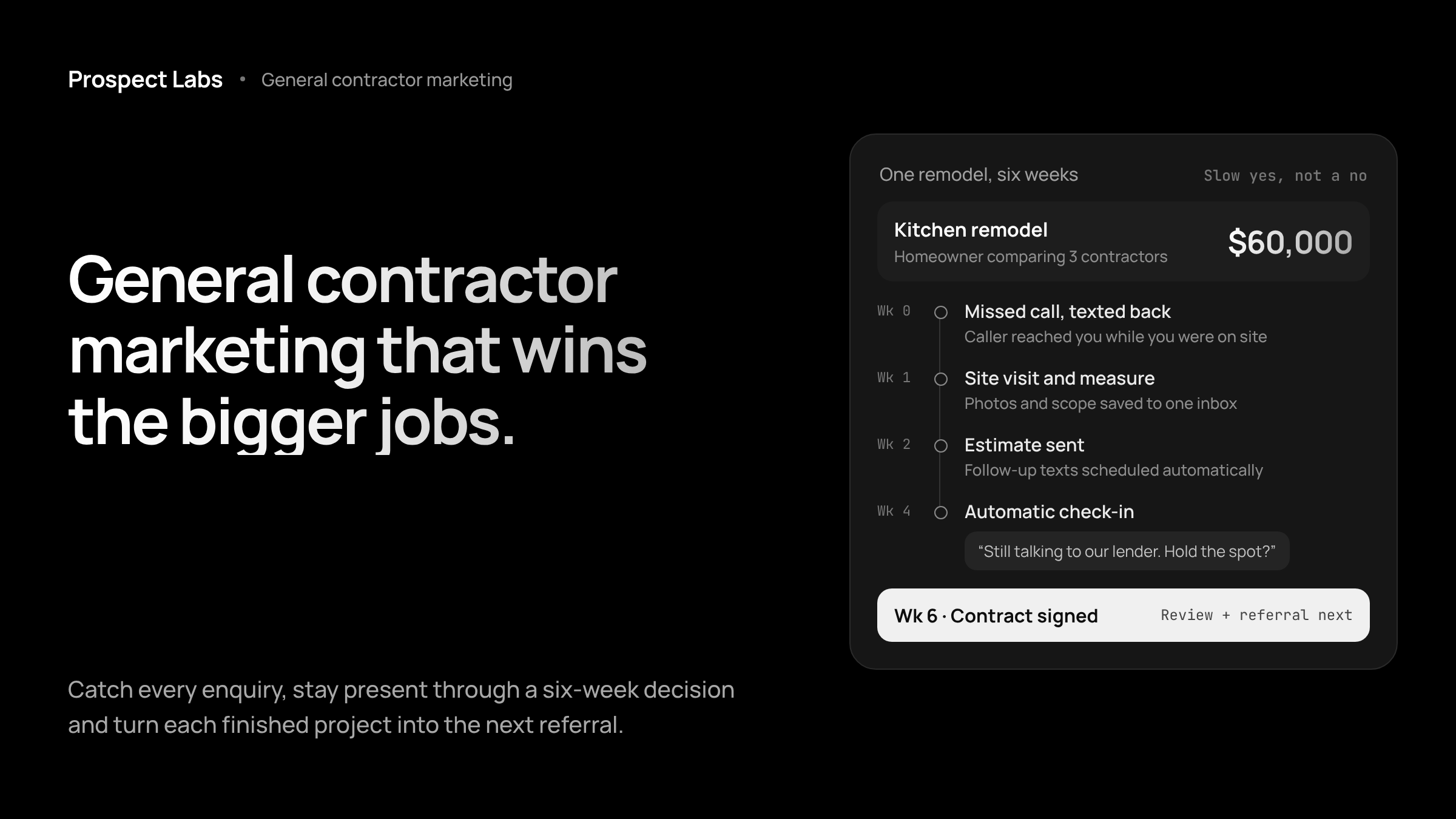
If you also take on remodels and additions, our guide to general contractor marketing covers that side of the business. This post stays focused on new construction.
Home Builder Marketing in 2026: What Do the Numbers Say?
Builders are competing for a smaller pool of active buyers and paying for it with price cuts and incentives. That makes conversion, not lead volume, the lever that matters most this year.
| What the data shows | Figure | Source |
|---|---|---|
| NAHB/Wells Fargo Housing Market Index, October 2026 | 29, the lowest reading since June 2012 | Inman |
| Prospective buyer traffic index, October 2026 | 18, the lowest since April 2012 outside the pandemic’s onset | NAHB via finanzen.at |
| Builders cutting prices, October 2026 | 43%, the highest share since 2020, with an average cut of 6% | RISMedia |
| Builders using sales incentives | 65%, the 19th straight month at 60% or more | HousingWire |
| Mortgage rates in October 2026 | Above 7% | Mortgage Professional America |
| Buyers who found the home they bought on the internet | 52% | NAR 2025 Profile via RESPA News |
| First time buyers’ share of purchases | 21%, a record low, with a median age of 40 | NAR |
| Buyers who purchased through an agent | 88% | NAR 2025 Profile via WRE News |
| Firms contacting a lead within an hour vs an hour later | Nearly 7 times as likely to qualify the lead | Harvard Business Review |
| Consumers who read reviews for local businesses | 97% | BrightLocal 2026 |
| Consumers using AI tools for local recommendations | 45%, up from 6% in 2025 | BrightLocal 2026 |
| Calls to home services businesses that go unanswered | 27% | Invoca |
Three things stand out for a home builder.
- Every enquiry is worth more. When buyer traffic sits at a 14 year low, a lost lead isn’t one of hundreds. It might be one of a handful you get this month.
- Discounting is the expensive way to sell. With 43% of builders cutting prices by an average of 6%, the builder who converts better can protect margin instead of matching every cut. On a $400,000 home, 6% is $24,000.
- Agents still sit in the middle. Since 88% of buyers purchase through an agent, production and spec builders need to market to agents as well as to buyers.
How Does Marketing Differ for Production, Semi Custom and Custom Builders?
The system underneath is the same for every builder. What changes is what you sell, who buys it and how long the decision takes, and that shapes every message you put out.
| Factor | Production builder | Semi custom builder | Custom and build on your lot |
|---|---|---|---|
| What you sell | Move in ready and to be built homes in a community | Set floor plans with a menu of upgrades | A one of a kind home designed around the buyer |
| Typical buyer | First time and move up buyers, often with an agent | Move up buyers who want some choice | Established buyers who own land or are buying it |
| Decision time | Weeks to a few months | A few months | Often six months or longer, design included |
| Key marketing asset | Inventory listings, community pages, virtual tours | Floor plans, options pricing, model homes | Portfolio, build process, client stories |
| What wins the deal | Price, incentives, availability, location | Value, flexibility, finish quality | Trust, design fit, communication |
| Biggest leak | Slow replies to listing enquiries | Buyers stalling during selections | Long silences between design meetings |
Most builders sit somewhere between these columns. A small builder might sell a few spec homes a year while also building custom homes on clients’ lots. Give each buyer type its own page and its own message instead of mixing them on one “Our Homes” page.
The 7 Stage Home Builder Marketing Strategy
A home builder marketing strategy works when it covers all seven stages, from the first search to the referral after closing. Most builders invest heavily in one or two and wonder why the rest leak. Here’s how each stage of our seven stage contractor marketing system applies to new construction.
Stage 1: Get found where buyers search
Buyers start with searches like “new homes in [town]”, “custom home builder near me” or “build on your lot [county]”. If you don’t appear in the map results, the organic listings and the new construction portals, you never make the shortlist.
- Google Business Profile. Choose “Home builder” or “Custom home builder” as your primary category, list every town or county you build in, and post finished homes with photos and the location.
- Community and area pages. Build one page per community and one per area where you build on clients’ land. A page called “Custom Homes in Williamson County” beats a generic “Where We Build” page.
- New construction portals. Keep inventory homes current on Zillow New Construction, NewHomeSource and Realtor.com. Stale listings with sold homes cost you trust.
- AI answers. With 45% of consumers now asking AI tools for local recommendations, clear community pages, consistent business details and recent reviews help assistants understand what you build and where.
We go deeper on rankings in our guide to local SEO for contractors.
Stage 2: Turn the visit into confidence
A buyer looking at a $450,000 home isn’t browsing your website for fun. They’re looking for reasons to trust you and reasons to cross you off the list. Give them the first and remove the second.
- Floor plans with square footage, bedrooms and a “starting from” price
- Real photos, video and 3D tours of finished homes, not only renderings
- A clear list of what’s included and what counts as an upgrade
- Your build process and timeline, from contract to closing day
- Your warranty, explained in plain language
- Licensing, insurance and memberships such as your local home builders association
- Reviews that mention the build experience, not just the finished house
- One obvious way to ask a question on every page
If your site gets compliments but not appointments, read our breakdown of a contractor website that actually wins jobs.
Stage 3: Capture every enquiry, even when you’re on site
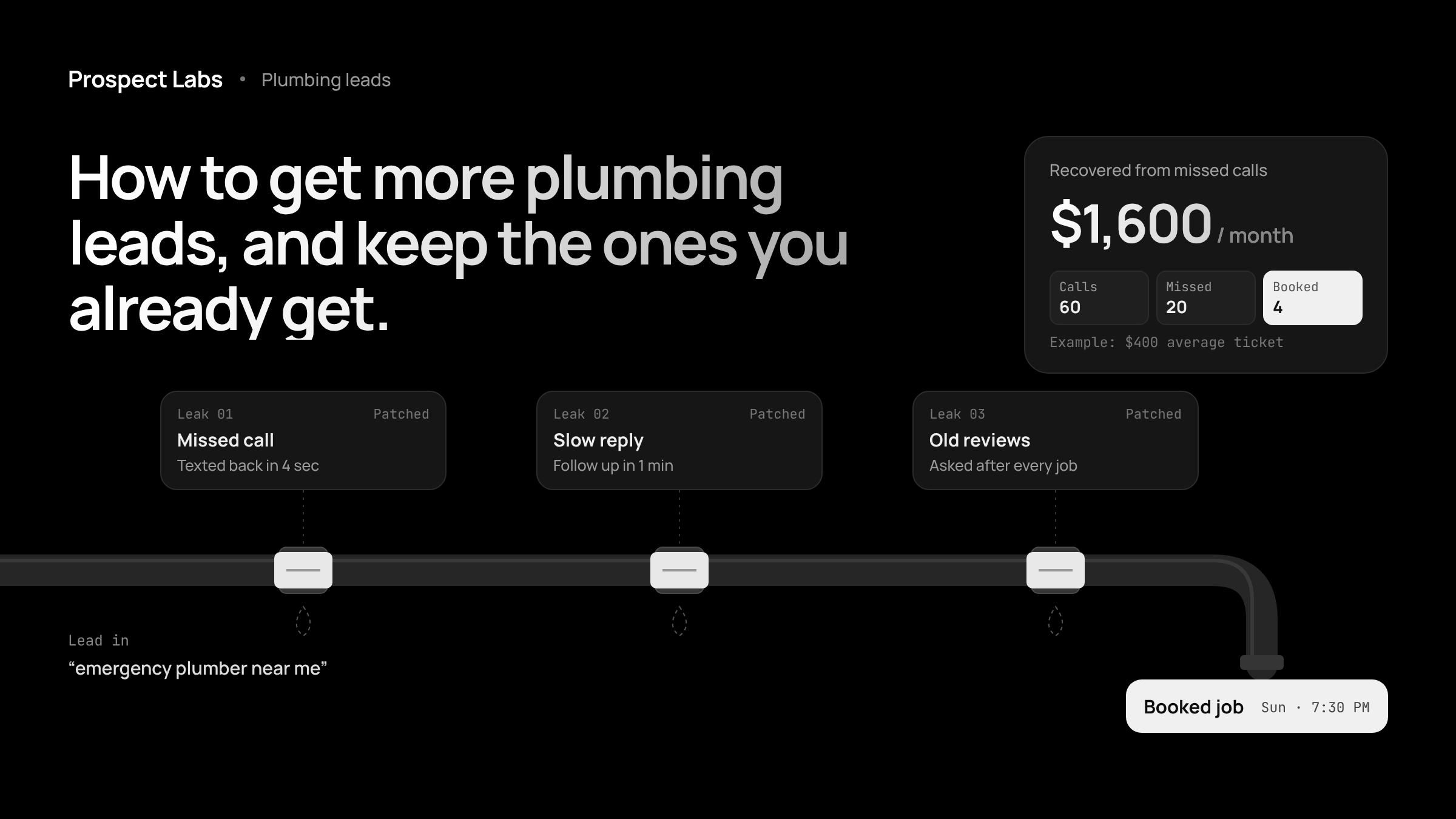
Builders and superintendents spend the day on job sites, at walkthroughs and in meetings with trades. A buyer calls about an inventory home, the phone rings out, and they move on to the next listing. Across home services, 27% of calls already go unanswered, and Harvard Business Review found firms that reach a lead within an hour are nearly 7 times as likely to qualify it as firms that wait even one more hour.
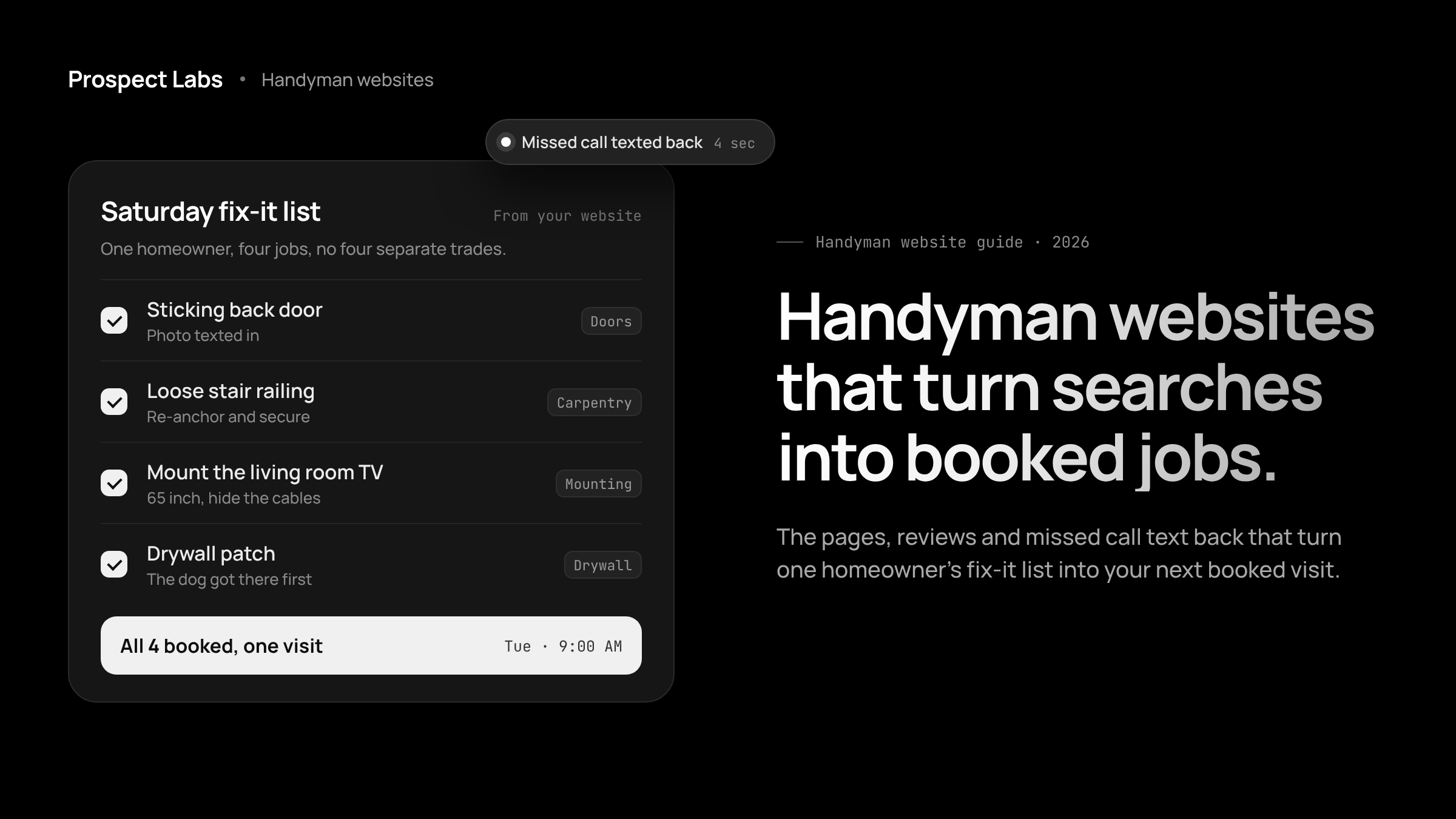
Two fixes do most of the work. Add a one tap text option to every floor plan and listing page, because many buyers would rather text a question than make a call. Then set up missed call text back, which sends an instant text in your business name whenever you can’t answer. The buyer hears from you before they call the builder down the road.
Stage 4: Sort every enquiry into one inbox
Builder leads arrive from everywhere: website forms, Zillow, NewHomeSource, Facebook and Instagram messages, agent emails, model home sign in sheets and Parade of Homes visitors. When those live in six places, the serious buyer gets lost behind the curious one.
Put every channel into one inbox on your phone and tag each lead by buyer type and timeline. It’s the same principle we cover in our home service marketing guide: you can’t follow up on what you can’t see.
Stage 5: Follow up through a long, uncertain decision
This stage matters more for home builders than for almost any other business. Buyers wait on rates, wait to sell their current home and compare incentives across three communities. Silence usually means “not yet”, not “no”.
Automated follow up keeps you present without you having to remember. A good sequence checks in after a model home visit, after a plan and price sheet goes out, when rates move, when a new inventory home is released and when an incentive starts or ends. The builder who is still politely in touch in month four often signs the buyer the faster quoter lost in week two.
Stage 6: Close, deliver and earn the review
Ask for a review at closing, while the keys are still new, and again after the family has lived in the home for a few weeks. Most happy buyers mean to leave one and forget. A one click request with gentle reminders closes that gap.
Freshness matters too. BrightLocal found 74% of consumers focus on reviews from the last three months, so a builder who closes a dozen homes a year needs every one of those closings turned into a review. Our guide shows how to get more 5 star Google reviews without awkward asks.
Stage 7: Grow through referrals, agents and past buyers
Your next contract is often sitting in your closed sales list. Past buyers tell friends, coworkers and family who are thinking about building. Agents who had a smooth closing with you bring their next buyer back.
Run simple referral campaigns to past buyers, give agents early notice of new inventory and incentives, and check in on each home’s one year anniversary. Our guide to referral marketing for contractors shows how to make referrals happen on purpose.
Which Home Builder Marketing Channels Are Worth Your Money?
The channels worth your money are the ones you own and that keep paying after you stop spending: your website, Google Business Profile, reviews and buyer list. Paid channels fill gaps quickly, but they rent attention instead of building it.
| Channel | How you pay | Speed to results | Who owns it | Best use for a builder |
|---|---|---|---|---|
| Website and SEO | Monthly or project fee | Months, then compounding | You | The foundation every other channel points to |
| Google Business Profile | Free, plus your time | Weeks | You | Map results for builder searches |
| Google reviews | Free, needs a process | Ongoing | You | Trust and map rankings at once |
| New construction portals | Listing fees or subscription | Days to weeks | The portal | Exposure for inventory and community homes |
| Google Ads (search) | Per click | Days | High intent searches like “new homes in [town]” | |
| Meta ads (Facebook, Instagram) | Per impression or click | Days | Meta | Promoting inventory homes and open houses locally |
| Agent partnerships | Cooperating commission | Weeks to months | Shared | Reaching the 88% who buy through an agent |
| Model homes and Parade of Homes | Build and entry costs | Event based | You | In person trust for production and semi custom |
| Email and text to your list | Almost free | Immediate | You | Announcing inventory, incentives and new phases |
| Referrals and past buyers | Almost free | Immediate | You | Your highest closing, lowest cost source |
A simple rule: every paid click should land somewhere that can capture the buyer, answer them fast and follow up. Paying for traffic that lands on a page with no easy next step is how builders convince themselves that marketing doesn’t work.
How Should Home Builders Market Price Cuts and Incentives?
Lead with the monthly payment the buyer cares about, not the discount you’re giving away. A buyer comparing two $420,000 homes cares less that one builder took $15,000 off and more about what each home costs them every month.
- Send it to warm buyers first. The people already in your follow up sequence are the most likely to act on a new incentive.
- Give agents a one page sheet. Make it easy for them to explain the offer to their buyers.
- Tie deadlines to something real. A quarter end, a phase release or a rate lock window feels honest. A countdown that resets every week doesn’t.
- Avoid constant price drops on listings. Repeated cuts can signal that a home has a problem. One clear offer usually works harder than five small ones.
Which Home Builder Marketing Metrics Should You Track?
Track the numbers that connect spend to signed contracts. Website traffic and likes are nice to know, but they don’t tell you whether marketing is paying for itself.
| Metric | What it tells you | Where to look |
|---|---|---|
| Cost per lead by channel | Which sources bring enquiries cheaply | Ad platforms, portal invoices, your inbox |
| Speed to first response | How fast buyers hear from you | Your inbox and phone logs |
| Lead to appointment rate | How many enquiries become model visits or design meetings | Your CRM or inbox tags |
| Appointment to contract rate | How well your sales process closes | Your sales records |
| Marketing cost per contract | What each signed home really costs you to win | Total spend divided by contracts |
| Review velocity | Whether your reputation stays fresh | Google Business Profile |
| Referral and agent share of sales | How much business comes from relationships | Your sales records |
6 Home Builder Marketing Mistakes That Cost You Contracts
The most expensive mistakes aren’t about ad budgets. They happen after a buyer shows interest.
- Showing renderings but no real homes. Buyers want proof you’ve built what you’re selling.
- Hiding every price. A “starting from” price filters out the wrong buyers and builds trust with the right ones.
- Letting portal leads sit. A Zillow enquiry answered tomorrow is often an enquiry lost today.
- Following up once after the model visit. Long decisions need patient, regular contact.
- Ignoring agents. Most buyers have one, and agents steer them toward builders who make closings easy.
- Forgetting buyers after closing. Your past buyers are your cheapest source of reviews and referrals.
How Prospect Labs Helps Home Builders Sell More Homes
Prospect Labs builds marketing systems for contractors that cover all seven stages, not just the website. For a home builder, that means one connected setup that keeps selling while you’re on a job site:
- A mobile first website built around your floor plans, finished homes and reviews
- Missed call text back in your business name
- Automated lead follow up for long buying decisions
- A 5 star review funnel with polite reminders
- Referral and past buyer campaigns you switch on with one click
- Every call, text and DM in one inbox, plus a dedicated business line
- Local SEO with ongoing updates
Do the maths on one home. Say you sell a $450,000 home with a 10% net margin. That’s $45,000 per home. A marketing system at $297 a month costs about $3,564 a year. Winning one extra contract a year covers it many times over. These are example numbers, not a promise of results, so plug in your own.
The whole system goes live in 7 to 10 days, month to month with no long term contract. You can see recent builds to get a feel for the work, or book a strategy call and we’ll look at your website, reviews and how enquiries are handled today. If we’re not the right fit, we’ll tell you what we’d do instead.
Home Builder Marketing FAQs
What is the best marketing for home builders?
The best marketing for home builders combines a website with real homes and clear pricing, a strong Google Business Profile, steady recent reviews, fast replies to every enquiry and patient follow up. Referrals from past buyers and agents usually close at the highest rate and lowest cost.
How do home builders get more leads?
Home builders get more leads by ranking for searches like “new homes in [town]”, keeping inventory current on new construction portals, building community and area pages, collecting recent reviews and working with local agents. Converting the leads you already get is often faster than finding new ones.
How much should a home builder spend on marketing?
There’s no single right number. Start with your margin per home, then work out how many extra contracts a year your marketing needs to win to pay for itself. Track marketing cost per contract, and favor owned channels that keep working after the spend stops.
Does SEO work for home builders?
Yes. Buyers search for new homes, communities and custom builders by town and county. Local SEO puts you in front of them at that moment. Results take months, depend on local competition and grow with fresh reviews and useful community pages.
How do custom home builders find clients?
Custom home builders find clients through referrals, a portfolio driven website, Google searches like “custom home builder near me”, relationships with architects, land agents and lenders, and local events such as Parade of Homes. Patient follow up matters because design decisions take months.
How long does home builder marketing take to work?
Faster response and better follow up can win back buyers within weeks, because they convert leads you already get. SEO and review growth usually take several months to show in rankings. Results depend on your market, your reputation and how consistently you use the system.