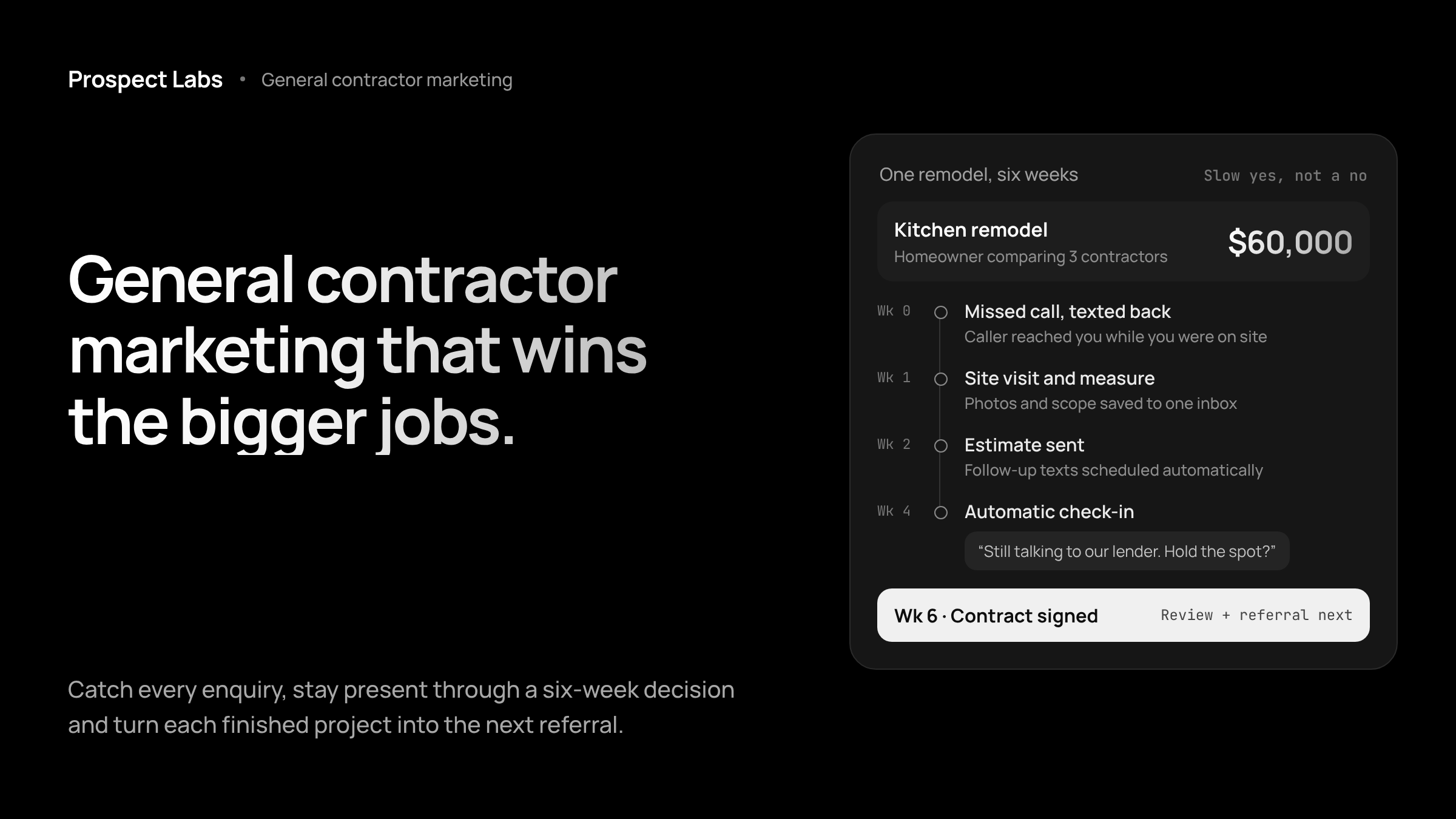

A homeowner planning a $60,000 kitchen remodel doesn’t choose a general contractor the way they choose a pizza place. They search Google, read reviews, scroll through past projects, call two or three companies, and then wait to see who gets back to them and who feels safe enough to hand the keys to. General contractor marketing is everything you do to make the shortlist, and then to be the name that gets the signature.
Quick answer: General contractor marketing is the system a general contractor uses to get found online, earn trust and turn enquiries into signed projects. It joins a conversion focused website, local SEO, Google reviews, fast lead response, follow up and referrals into one process.
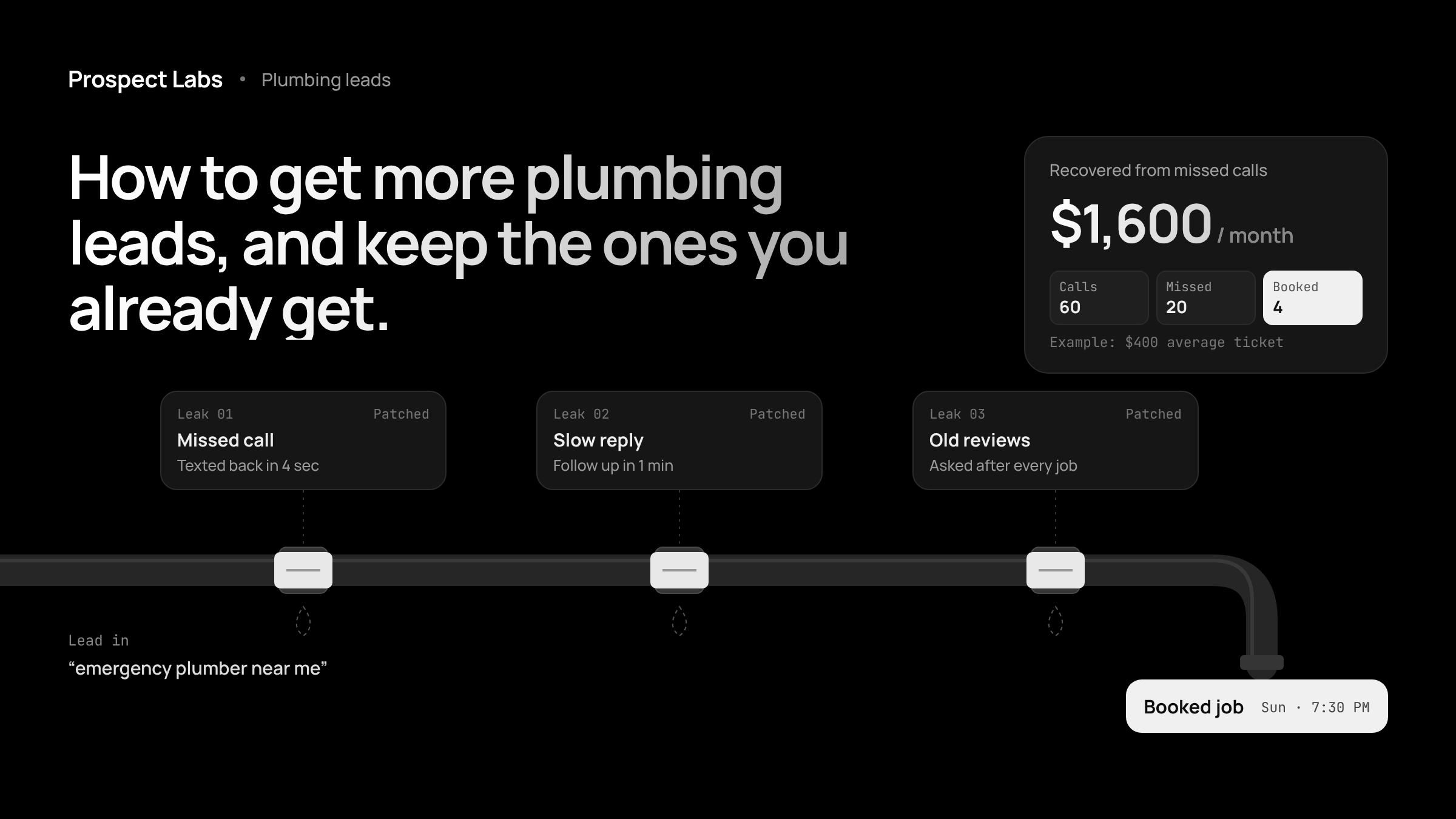
Here’s the uncomfortable part. Most general contractors don’t actually have a lead problem. They have a leak problem. The enquiries come in, but the call goes unanswered while you’re walking a job site, the quote request sits in an inbox for three days, and the happy client from last spring never gets asked for a review. The work goes to someone who simply replied faster.
This guide walks through what makes marketing for general contractors different from other trades, the numbers that matter in 2026, and the seven stages that turn a stranger into a signed contract and then into a referral. It’s written for residential GCs and remodelers first, with a section on what changes when you chase commercial work.
Why Is Marketing for General Contractors Different From Other Trades?
Marketing for general contractors is different because the jobs are bigger, the decision takes longer and the buyer is trusting you with their home and their savings. A plumber sells a fix for today. A general contractor sells a project that might run for months and cost more than a car.
That changes what your marketing has to do. A roofer with a leak call needs to be found and answer fast. You need to be found, answer fast, and then stay credible across weeks of site visits, estimates, design changes and second opinions from a spouse or a lender.
| Factor | Typical service trade (plumbing, HVAC) | General contractor |
|---|---|---|
| Typical job value | A few hundred to a few thousand dollars | Tens of thousands to six figures |
| Decision time | Hours or days | Weeks or months |
| Who decides | Usually one person | Couples, families, lenders, sometimes an HOA |
| What wins the job | Speed and availability | Trust, portfolio, communication, then price |
| Proof buyers look for | Star rating and response time | Reviews, project photos, licensing, insurance, references |
| Cost of one lost lead | One service call | Potentially a season’s profit |
The last row is the one to sit with. When a single remodel is worth $40,000 or more, one missed call or one forgotten follow up isn’t a small leak. It can be the difference between a full schedule and a slow quarter.
This is also why a pretty website on its own rarely moves the needle. If you’ve ever wondered why your site gets compliments but not contracts, we covered that in detail in our guide to building a contractor website that actually wins jobs.
Residential first, but not residential only
For most small and midsize general contractors, the steady work comes from homeowners: kitchens, bathrooms, additions, basements, whole home renovations and storm or insurance work. That’s where search, reviews and fast response do the heavy lifting. Commercial work runs on a different engine, which we’ll get to further down.
General Contractor Marketing in 2026: The Numbers That Matter
The short version: homeowners are still spending on remodeling, but growth is flattening, buyers are pickier about reviews, and a growing share of them now ask AI tools for recommendations. In a slower market, the contractor with the better system takes a bigger slice of a pie that isn’t getting much bigger.
| What the data shows | Figure | Source |
|---|---|---|
| US homeowner spending on remodeling and repair, Q1 2026 | $521 billion, up 2.0% year over year | Harvard JCHS, LIRA |
| Projected growth in remodeling spending by 2027 | Slowing to 0.5% | Harvard JCHS press release |
| Consumers who read reviews for local businesses | 97% | BrightLocal Local Consumer Review Survey 2026 |
| Consumers who require 4.5 stars or higher | 31%, up from 17% a year earlier | BrightLocal 2026 |
| Consumers who only care about reviews from the last three months | 74% | BrightLocal 2026 |
| Consumers who expect owners to respond to reviews | 89% | BrightLocal 2026 |
| Consumers using ChatGPT or other AI tools for local recommendations | 45%, up from 6% in 2025 | BrightLocal 2026 |
| Calls to home services businesses that go unanswered | 27% | Invoca |
Three things jump out for a general contractor.
- Flat demand rewards the efficient. When the overall remodeling market grows slowly, you don’t win by waiting for more leads. You win by converting more of the leads you already get.
- Reviews now expire. A pile of five year old reviews doesn’t reassure a homeowner who only trusts the last three months. You need a steady trickle, not a one time push.
- One in four calls is a gamble. If roughly a quarter of calls to home service businesses go unanswered, and you’re on a site most of the day, your number is probably higher.
The 7 Stage General Contractor Marketing Strategy
A strong general contractor marketing strategy covers seven stages, from the first search to the referral that follows a finished project. Most contractors invest in one or two of these and wonder why the others leak. Here’s how each stage of our seven stage contractor marketing system applies when the jobs are large and the decisions are slow.
Stage 1: Get found when homeowners search
Homeowners start with searches like “general contractor near me”, “kitchen remodel [your town]” or “home addition contractor”. If you don’t show up in Google’s map results and the organic listings below them, you’re not on the shortlist.
What moves the needle for a general contractor:
- Google Business Profile. Choose “General contractor” as your primary category, then add the specific services you sell, like kitchen remodeling, bathroom remodeling and home additions. Post finished projects with photos and the town name.
- Service and service area pages. One page per core service and one per key town you serve. A page titled “Basement Finishing in Naperville” will beat a generic “Our Services” page every time.
- Review volume and freshness. Reviews are a ranking signal in the map results as well as a trust signal. More on that in Stage 6.
We go deeper on all of this in our guide to local SEO for contractors. One newer layer to watch: with 45% of consumers now asking AI tools for local recommendations, clear service pages, consistent business details and plenty of recent reviews also help assistants like ChatGPT understand who you are and what you do.
Stage 2: Turn the visit into confidence
A homeowner about to spend $50,000 visits your website looking for reasons to trust you, and reasons to rule you out. Give them the first and remove the second.
- A portfolio of real projects with before and after photos, the town, the scope and, where you can, the budget range
- Your license number, insurance and any bonding, stated plainly
- Reviews that mention the type of project they’re considering
- A clear explanation of how your process works, from first visit to final walkthrough
- One obvious way to start the conversation on every page
Stage 3: Capture every enquiry, even when you can’t answer
This is where most general contractors bleed money. You’re on a roof, in a crawlspace or meeting a client, and the phone rings out. Most people won’t leave a voicemail. They’ll call the next name on the list.
Two fixes do most of the work. First, a one tap text option on your website, because plenty of homeowners would rather text a photo than explain a project on the phone. Second, missed call text back, which sends an instant text in your business name whenever you can’t pick up. The caller hears from you before they dial your competitor.
Stage 4: Sort leads into one inbox
General contractors get enquiries from everywhere: calls, website forms, Facebook messages, Instagram DMs, Houzz, Nextdoor and old fashioned texts from a neighbor of a past client. When those live in five apps, something gets missed.
Put every channel into one inbox on your phone. You’ll answer faster, and you’ll stop losing the $80,000 addition enquiry that came through Instagram while you were checking email.
Stage 5: Follow up through a long sales cycle
This stage matters more for general contractors than for almost any other trade. A homeowner might take six weeks to decide, collect three estimates and go quiet while they talk to their lender. Silence usually means “not yet”, not “no”.
Automated follow up keeps you in the conversation without you having to remember. A good sequence checks in after the site visit, after the estimate goes out, and at sensible intervals after that. The contractor who’s still politely present in week five often wins the job the faster quoter lost in week two.
Stage 6: Book the job and earn the review
Once the project is done, ask for a review while the client is still excited about their new kitchen. Most happy clients fully intend to leave one and then forget. A one click request with a couple of gentle reminders closes that gap.
Given that 31% of consumers now want 4.5 stars or higher and 74% focus on reviews from the last three months, this can’t be a once a year push. Our guide shows how contractors get more 5 star Google reviews without awkward asks. And reply to every review, good or bad, because 89% of people expect you to.
Stage 7: Grow through referrals and past clients
Your cheapest next project is sitting in your client list. Past clients remodel again, and they talk to neighbors who are planning the same thing. A simple referral campaign, a check in on the one year anniversary of a project, or a seasonal note about the next upgrade keeps your name at the front of their mind.
If referrals already carry your business, good. That’s proof of quality work. Our guide to referral marketing for contractors shows how to make them happen on purpose instead of by luck.
Which General Contractor Marketing Channels Are Worth Your Money?
The channels worth your money are the ones you own and that keep paying after you stop spending: your website, your Google Business Profile, your reviews and your client list. Paid channels can fill gaps quickly, but they rent attention rather than build it.
| Channel | How you pay | Speed to results | Who owns the result | Best use for a GC |
|---|---|---|---|---|
| Website and local SEO | Monthly or project fee | Months, then compounding | You | The foundation everything else points to |
| Google Business Profile | Free, plus your time | Weeks | You | Map pack visibility for “near me” searches |
| Google reviews | Free, needs a process | Ongoing | You | Trust and map rankings at the same time |
| Local Services Ads | Per lead | Days | Topping up enquiries in a slow month | |
| Google Ads (search) | Per click | Days | Targeting high value projects like additions | |
| Lead marketplaces (Angi, Thumbtack) | Per lead, often shared | Days | The platform | Testing a new service area, with caution |
| Houzz | Profile plus optional paid plan | Weeks | Shared | Design led remodels and kitchen or bath work |
| Social media (Facebook, Instagram) | Free or paid boosts | Weeks | Shared | Showing projects in progress and finished |
| Referrals and past clients | Almost free | Immediate | You | Your highest closing, lowest cost source |
| Yard signs and truck wraps | One time cost | Ongoing | You | Neighborhood awareness while a job is running |
A useful rule: every paid channel should send people somewhere that can capture them, answer them and follow up. Paying for clicks that land on a site with no easy next step, then letting the call ring out, is how contractors convince themselves that “marketing doesn’t work”.
Do the maths on one project
Say your average residential project is worth $40,000 and your margin after materials and subs is 15%. That’s about $6,000 in profit per job. A marketing system costing $297 a month runs about $3,564 a year. Winning one extra project a year that you’d otherwise have lost covers it, with room to spare. That’s simple arithmetic on example numbers, not a promise of results, so plug in your own.
How Does Commercial General Contractor Marketing Differ?
Commercial general contractor marketing relies far more on relationships and qualifications than on search. Developers, property managers and facility owners rarely find a GC by typing into Google. They find you through bid invitations, architects, past performance and prequalification.
If you want a share of commercial work, the priorities shift:
- Bid platforms and plan rooms. Get listed and active on services like Dodge Construction Network, BuildingConnected and ConstructConnect, where owners and construction managers post projects.
- Relationships with specifiers. Architects, engineers, commercial real estate brokers and property managers send repeat work to contractors who make them look good.
- A capability statement and case studies. Show square footage, schedule, budget, safety record, bonding capacity and the types of buildings you deliver.
- Industry presence. Membership in groups like the Associated General Contractors of America (AGC), local builder associations and LinkedIn activity all build familiarity before the bid.
Your website still matters here. It’s where a developer checks you out after your name comes up in a meeting. The difference is that it needs to answer “can they handle this project?” rather than “will they show up on time to my house?”.
6 General Contractor Marketing Mistakes That Cost You Projects
The most expensive general contractor marketing mistakes aren’t about ad budgets. They’re about what happens after someone shows interest.
- Treating the website as the whole plan. A site that looks great but can’t capture a text, answer a missed call or follow up is a brochure, not a sales tool.
- Relying on voicemail. Callers increasingly hang up instead of leaving a message, especially after hours.
- Following up once, then giving up. Long decisions need patient, regular contact. One email after the estimate isn’t a follow up process.
- Asking for reviews only when you remember. Reviews from two years ago don’t help much when most buyers only trust the recent ones.
- Buying shared leads as your main source. When the same homeowner is sold to four contractors, you’re in a race to the bottom on price.
- Forgetting past clients. The people who already trusted you with $50,000 are the easiest to win again, and the most likely to refer you.
How Prospect Labs Helps General Contractors Win More Work
Prospect Labs builds marketing systems for contractors that cover all seven stages, not just the website. For a general contractor, that means one connected setup that keeps selling while you’re on a job site:
- A mobile first website built around your projects, reviews and a one tap way to get in touch
- Missed call text back in your business name
- Automated lead follow up for long sales cycles
- A 5 star review funnel with polite reminders
- Referral and return customer campaigns you switch on with one click
- Every call, text and DM in one inbox, plus a dedicated business line
- Local SEO with ongoing updates
It’s one price for the whole system, live in 7 to 10 days, month to month with no long term contract. You can see recent contractor builds to get a feel for the work.
If you’d like to see where your own leads are leaking, book a strategy call. We’ll look at your current website, your reviews and how calls are handled today, and give you a straight answer on whether we’re a fit. If we’re not, we’ll tell you what we’d do instead.
General Contractor Marketing FAQs
What is the best marketing for general contractors?
The best marketing for general contractors combines a strong Google Business Profile, a website that shows real projects, a steady flow of recent reviews and fast follow up on every enquiry. Referrals from past clients usually close at the highest rate and cost the least.
How do general contractors get more leads?
General contractors get more leads by ranking in Google’s map results for their services and towns, publishing service area pages, collecting recent reviews and making it easy to text or call. Converting more of the leads you already get is often faster than finding new ones.
How much should a general contractor spend on marketing?
There’s no single right number. Start with the value of one project and your margin, then work out how many extra jobs a year a marketing investment needs to win to pay for itself. Owned channels like your website and reviews keep paying after the spend stops.
Does SEO work for general contractors?
Yes. Homeowners search for terms like “general contractor near me” and “kitchen remodel” plus their town. Local SEO puts you in front of them at that moment. Results take months, depend on local competition and grow with fresh reviews and useful service pages.
How long does it take to see results from general contractor marketing?
Faster response and follow up can win back jobs within weeks, because they convert leads you’re already getting. SEO and review growth usually take several months to show in rankings. Results depend on your market, your reputation and how consistently you use the system.