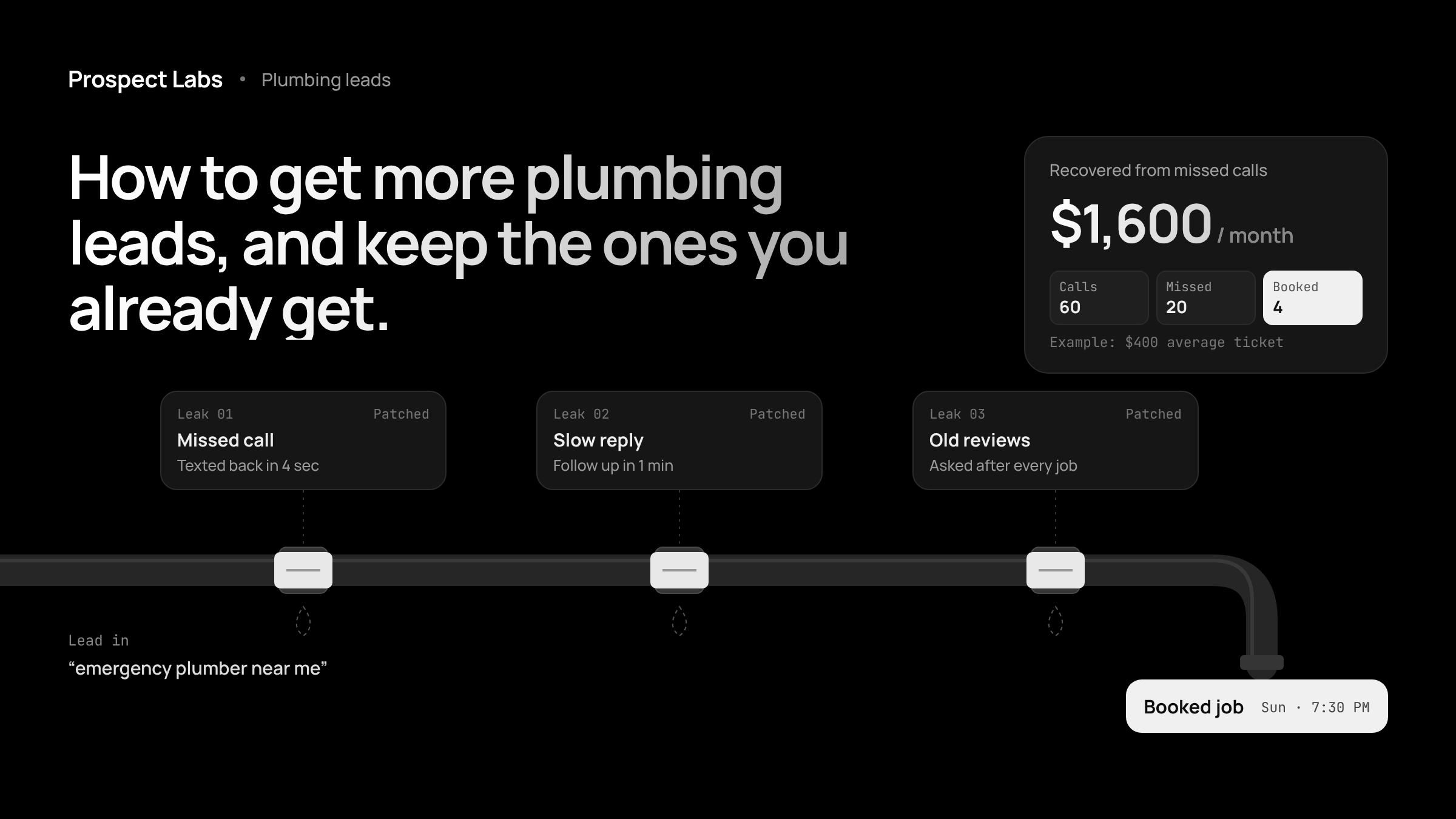

It is 7:15 on a Sunday night. A homeowner in your service area is standing in an inch of water because the supply line under the kitchen sink just let go. They search “emergency plumber near me,” tap the first number they see, and it rings. And rings.
If that number was yours and you were under a house on another job, the lead is gone. Not because your marketing failed. It worked perfectly. The homeowner found you. The leak happened after that.
Most advice on how to get more plumbing leads starts with spending more: more ads, more directories, more pay per lead platforms. This guide starts somewhere cheaper. First we close the gaps where plumbing leads already slip away, then we look at the channels worth adding once your system can catch what they send.
Quick answer: To get more plumbing leads, first stop losing the ones you have by answering or texting back every missed call, replying within minutes, and collecting fresh Google reviews. Then add channels in order of intent: Google Business Profile, Local Services Ads, Google Ads, and referrals from past customers.
Why do plumbing companies lose leads they already paid for?
Plumbing companies lose leads after the homeowner finds them, not before. Calls go unanswered while technicians are on jobs, callbacks come too late, and thin or old reviews push searchers to the next listing. Fixing these leaks is the cheapest way to get more plumbing leads.
The numbers back this up. In a Service Direct study of 94 US home service businesses, owners estimated they answered 97% of calls. The real answer rate was 66%. Invoca found that 27% of calls to home services businesses go unanswered, and fewer than 3% of callers sent to voicemail leave a message.
Plumbing makes this worse than most trades. A burst pipe, a sewer backup or a dead water heater is urgent, so the homeowner will not wait. They call the next name on Google.
| Where the lead leaks | What the homeowner does | What fixes it |
|---|---|---|
| You miss the call | Calls the next plumber within minutes | Missed call text back in your business name |
| You reply hours later | Has already booked someone else | Instant auto reply plus a follow up sequence |
| Your reviews are old or few | Picks the plumber with recent five star reviews | A review request after every job |
| Your website has no easy next step | Leaves without calling | One tap text and call buttons on mobile |
| You never contact past customers | Forgets your name by the next repair | Referral and return customer campaigns |
Every row above is a lead you already earned. That is why Prospect Labs builds a contractor website as one part of a full marketing system, not as a standalone brochure.
How do you stop missed calls from costing you plumbing jobs?
You stop missed calls from costing jobs by making sure every unanswered call gets an instant text in your business name. The caller hears from you before they dial a competitor, and you can reply when your hands are free.
You cannot answer the phone with a torch in one hand and a fitting in the other. Nobody expects you to. What the homeowner expects is a sign that someone heard them. A short text does that:
“Hi, this is Ridgeline Plumbing. Sorry we missed your call, we are on a job right now. What is going on and what is the address? We will get back to you shortly.”
That one message changes the outcome. Instead of a silent ring and a lost job, you get a conversation you can pick up ten minutes later, often with a photo of the problem already in your inbox.
A few other habits close the gap further:
- Use a dedicated business line so work calls never mix with personal calls and every missed call is logged.
- Route after hours calls to an answering service or an on call tech if you offer emergency plumbing.
- Check your real answer rate once a month. Most owners guess high, as the 97% versus 66% gap above shows.
Our missed call text back is built into every Prospect Labs system for exactly this reason. Plumbers spend much of the day where a phone simply cannot be answered.
How fast should a plumber respond to a new lead?
A plumber should respond to a new lead within minutes, and within the hour at the very latest. Homeowners with an active leak contact several plumbers at once, and the first one to reply usually books the job.
The best known research on response time comes from the Harvard Business Review study “The Short Life of Online Sales Leads.” It audited 2,241 US companies. Only 37% replied to a web lead within an hour, and 23% never replied at all. A companion analysis found that firms replying within an hour were about seven times more likely to reach a decision maker than firms that waited longer.
That study covered many industries and it is not new, so treat the exact ratio as a guide. The direction is what matters, and in plumbing it is even sharper. Nobody with water on the floor waits a day for a quote.
Speed is half the job. Persistence is the other half. Many leads go cold simply because nobody followed up a second time. A simple sequence keeps them warm:
| When | Message | Goal |
|---|---|---|
| Within 1 minute | Auto reply confirming you got their request | Stop them calling the next plumber |
| Within 15 minutes | Personal text or call from you or the office | Get the address, problem and a photo |
| Same day | Follow up if there is no reply | Book the visit or send the estimate |
| Day 2 to 3 | Short check in on the estimate | Answer questions, handle price concerns |
| Day 7 | Final friendly nudge | Close the loop or learn why they chose someone else |
With automated lead follow up, the first and last steps run on their own. You only step in when the homeowner replies.
Do Google reviews really bring in more plumbing leads?
Yes. Reviews decide which plumber gets the call when a homeowner compares three listings on their phone. A steady flow of recent five star Google reviews raises your click rate, supports your Google Business Profile ranking and makes your phone ring more often.
According to BrightLocal’s Local Consumer Review Survey 2026, 97% of US consumers read reviews for local businesses. The same survey reports that about two in three consumers now want at least a four star rating before they will consider a business, and that recent reviews count far more than old ones.
For a plumber, that means two things. A 4.9 rating from 2022 looks stale next to a 4.7 with reviews from last week. And a handful of reviews will not hold up against a competitor with 300.
The fix is not complicated, it is just consistent:
- Ask every happy customer, every time, right after the job is done.
- Send a text with a direct link to your Google review page. One tap, no searching.
- Send a polite reminder a few days later if they have not left one.
- Reply to every review, good or bad, in a calm and specific way.
- Mention the service and town in your reply when it fits naturally, such as a water heater install in Plano.
If asking feels awkward, our guide on how to get more Google reviews covers the exact wording contractors use. The Prospect Labs review funnel sends the request and the reminders for you, so it happens after every single job, not only on the good days.
What should a plumbing website have to turn visitors into leads?
A plumbing website turns visitors into leads when it answers four questions within seconds on a phone: what you fix, where you work, why to trust you, and how to reach you now. Everything else is decoration.
Most plumbing sites look fine and do very little. They have a logo, a stock photo of a wrench and a phone number buried in the footer. The homeowner with a backed up drain does not want to read your history. They want to know you handle drains in their town and that someone will answer.
Here is what a plumbing website needs to convert:
| Element | Why it matters to a homeowner | Common mistake |
|---|---|---|
| Click to call and click to text buttons | Lets them reach you in one tap from a phone | Number only shown in the footer |
| Service pages for each job type | Matches searches like “water heater repair” or “drain cleaning” | One generic “Services” page |
| Service area pages by city | Shows you work where they live | Listing towns in a single paragraph |
| Recent Google reviews on the page | Proves you are trusted right now | Three testimonials from years ago |
| Emergency availability | Tells urgent callers you can come today | Hours hidden or unclear |
| Fast mobile load | Keeps impatient visitors from leaving | Heavy images and sliders |
| Licensing and insurance details | Answers the safety question before they ask | Missing entirely |
Notice that most of these also help you rank. Service pages and service area pages give Google clear signals about what you do and where. Our guide to local SEO for contractors walks through how those pages work together.
If your current site cannot start a conversation with a visitor, it is a brochure, not a lead source. You can see how we build websites for contractors as part of a complete system.
Which lead channels work best for plumbers?
The best lead channels for plumbers are the ones that reach homeowners at the moment of need: Google Business Profile, Google Local Services Ads, and Google Ads. Lead marketplaces and social media can fill gaps, but you rent those leads rather than own them.
Once your calls, follow up and reviews are tight, every channel you add works harder. Here is how the main options compare for a US plumbing company:
| Channel | How you pay | Speed to first leads | Who owns the lead | Best for |
|---|---|---|---|---|
| Google Business Profile | Free, your time | Weeks to months | You | Every plumber, the foundation of local search |
| Local SEO and service area pages | Time or agency fee | Months | You | Steady, compounding organic leads |
| Google Local Services Ads | Per lead | Days | You, after the first contact | Emergency and high intent jobs |
| Google Ads (search) | Per click | Days | You | Specific high value jobs like repiping or water heaters |
| Angi, Thumbtack, Yelp ads | Per lead or per click | Days | Shared with other pros | Filling a slow season or a new area |
| Facebook and Nextdoor | Free posts or paid ads | Weeks | You | Neighborhood trust and seasonal offers |
| Referrals and past customers | Little or nothing | Ongoing | You | The highest trust, lowest cost leads |
Google Business Profile
Your Google Business Profile is the listing that shows up in the map pack when someone searches “plumber near me.” Fill in every service, set an accurate service area, choose “Plumber” as the primary category, add real job photos, and post updates regularly. Reviews feed straight into it.
Google Local Services Ads
Local Services Ads sit above everything else on the results page and carry a Google verification badge. You pay for leads, not clicks, and Google ranks you partly on reviews and how quickly you respond. That is one more reason the leak fixes above come first.
Google Ads
Search ads let you target exact jobs and towns, such as “tankless water heater install Austin.” Point each ad to a matching service page, not your homepage, and track calls so you know which keywords book jobs.
Lead marketplaces
Angi, Thumbtack and similar platforms send leads fast, but the same homeowner is often sent to several plumbers at once. Whoever replies first tends to win. If you use them, speed is everything, and you should treat them as a top up rather than your main source.
How can past customers become your cheapest source of plumbing leads?
Past customers become your cheapest lead source when you stay in touch after the job. A homeowner who trusted you with a water heater will call you for the next leak, recommend you to neighbors, and leave a review, as long as they remember your name.
Plumbing is a repeat purchase. Water heaters wear out, drains clog again, fixtures get replaced during remodels, and older homes need repiping. Yet most plumbers never contact a customer again after the invoice is paid.
A few simple campaigns change that:
- Seasonal reminders, such as a winter pipe freeze checklist in the fall or a water heater flush reminder each year.
- Referral asks sent a week or two after a job, when the customer is still happy.
- Return customer offers for maintenance plans, inspections or fixture upgrades.
- Neighbor notes after a job, letting nearby homes know you were working on their street.
Invoca reports that 76% of consumers will stop doing business with a company after a single bad experience. The flip side is true too. A good experience, followed by a friendly reminder, keeps you as their plumber for years.
We cover the full playbook in referral marketing for contractors. Prospect Labs clients switch these campaigns on with one button.
How do you know which plumbing leads are worth paying for?
You know which plumbing leads are worth paying for by tracking every lead from its source to a booked job and its invoice value. Without that link, you are guessing which channel works and which one just makes the phone ring.
Start with four numbers each month:
| Metric | What it tells you |
|---|---|
| Leads by source | Which channels actually bring enquiries |
| Answer rate | How many calls a person or auto text responded to |
| Booking rate | How many leads turned into scheduled jobs |
| Revenue by source | Which channels pay for themselves |
Here is a simple worked example. The numbers are illustrative, so swap in your own.
Say you get 60 calls a month and miss 20 of them. If half of those missed calls were new customers, that is 10 possible jobs. Book even four of them at a $400 average ticket and you recover $1,600 a month, without spending another dollar on ads.
That is why the order in this guide matters. Plug the leaks, then measure, then spend. Service Direct estimated that the average home service business could see up to 54% more new business simply by answering every inbound call, with no extra marketing budget.
Frequently asked questions about plumbing leads
What is the fastest way to get more plumbing leads?
The fastest way is to stop losing leads you already get. Add missed call text back and reply to every enquiry within minutes. For new volume, Google Local Services Ads and search ads can send calls within days.
Should plumbers buy leads from Angi or Thumbtack?
They can, as a top up. These leads are often shared with other plumbers, so you need to reply first to win them. Leads from your own website, Google profile and referrals are cheaper over time and belong only to you.
How many Google reviews does a plumbing company need?
There is no fixed number, but you should aim to match or beat the top three plumbers in your local map pack. Recent reviews matter more than total count, so ask after every job.
Is SEO worth it for a small plumbing business?
Yes. Local SEO and service area pages bring leads you do not pay for per click. It takes months to build, so pair it with a strong Google Business Profile and fast follow up while it grows.
What is a good response time for plumbing leads?
Aim for under five minutes during working hours, with an instant automatic text for anything you cannot answer. Homeowners with urgent plumbing problems often contact several companies and book whoever replies first.
Can a website alone generate plumbing leads?
A website alone rarely does. It needs to be found through local SEO and Google, make contact easy on mobile, and be backed by follow up and reviews. Think of it as the front end of a lead system.
Get more plumbing leads without working more hours
You do not need to be a marketer to get more plumbing leads. You need a system that catches every call, replies while you are on the job, asks for reviews after every visit and brings past customers back.
That is what Prospect Labs builds for plumbers and 20+ other trades. A mobile first website, missed call text back, automated follow up, a review funnel, referral campaigns, a business line and ongoing local SEO, all for one monthly price on a month to month plan. If you want the bigger picture first, read our guide to home service marketing.
On a 60 minute call we will look at how your calls are handled today, show you the system running on live accounts and tell you straight whether it fits.