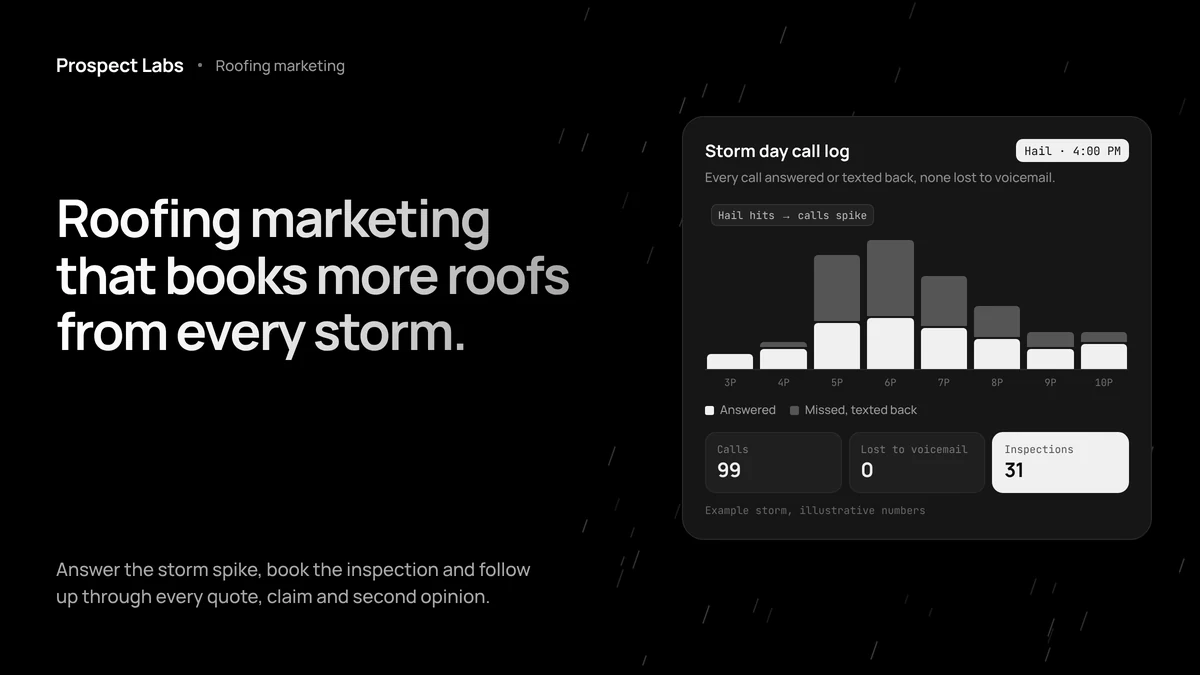

A hailstorm rolls through town at 4 PM. By 6 PM, half the street is on a ladder or on Google, searching “roof inspection near me” and calling whoever shows up first. By the weekend, the door knockers have arrived, the yard signs are going up, and three roofers are sitting at the same kitchen table. Roofing marketing decides whether you’re one of the three, and whether you’re the one who gets the signature.
Quick answer: Roofing marketing is the system a roofing company uses to get found by homeowners and property managers, prove it can be trusted with a five figure job, answer every enquiry fast and follow up until the job is inspected, signed and reviewed.
Here’s what most roofers don’t hear from their marketing company. The problem usually isn’t a lack of leads. It’s what happens to them. The call that rings out while you’re on a pitch. The inspection request that sits in an inbox until Monday. The homeowner who got three quotes, went quiet and signed with the roofer who simply checked in twice.
This guide covers why marketing for roofers works differently from other trades, the 2026 numbers that matter, the seven stages that turn a search into a signed roof, and what changes when you sell retail reroofs, storm restoration or commercial work. Every section is written for owners who would rather be on the roof than in a marketing dashboard.
Why Is Marketing for Roofers Different From Other Trades?
Marketing for roofers is different because demand arrives in waves, the job is expensive, and the buyer often can’t see the problem they’re paying to fix. A plumber’s customer can see the leak. A roofer’s customer is trusting you to climb up, tell the truth and not inflate the claim.
That creates three pressures no other trade feels in quite the same mix. Weather creates sudden spikes in demand that reward the fastest responder. Insurance adds a third party to the sale. And storm chasers from out of state make homeowners suspicious of every roofer, including the honest local ones.
| Factor | Typical service trade (plumbing, HVAC) | Retail roofing | Storm restoration | Commercial roofing |
|---|---|---|---|---|
| Typical job value | Hundreds to a few thousand dollars | $10,000 to $25,000 replacements | Replacement, often insurance funded | Five to seven figures |
| What triggers demand | A breakdown | Roof age, a sale, a visible leak | Hail and wind events | Leaks, budgets, maintenance plans |
| Decision time | Hours or days | Two to six weeks | Days after the storm, then the claim | Months, often a bid process |
| Who decides | One person | Couple or family | Homeowner plus insurance adjuster | Owner, property or facility manager |
| What wins the job | Speed and availability | Trust, inspection, clear quote | Speed, local proof, claim help | Relationships, safety record, warranties |
| Biggest marketing risk | Missed calls | Losing a three quote comparison | Being lumped in with storm chasers | Never getting invited to bid |
Retail, storm and commercial roofing each need their own playbook, which we cover further down. What they share is that a roofing website on its own rarely closes anything. If yours gets traffic but not inspections, our guide to building a contractor website that actually wins jobs shows what’s missing. The same logic runs through our guide to general contractor marketing, where long decisions also punish slow follow up.
Roofing Marketing in 2026: The Numbers That Matter
The short version: roofs are getting more expensive to replace, hail is damaging more of them, and the market is crowded with more roofing companies every year. Homeowners compare, check reviews and demand an inspection before they sign, so the roofer with the better process wins more of the same storm.
| What the data shows | Figure | Source |
|---|---|---|
| US roofing contractors market size, 2026 | $92.5 billion | IBISWorld |
| Roofing contractor businesses in the US | About 109,000, growing 3.4% a year since 2021 | IBISWorld |
| Share of the US roofing market that is replacement work | 81.65% in 2025 | Mordor Intelligence |
| Average residential roof replacement cost | $17,631 in 2025 (repairs averaged $4,699) | Verisk 2026 US Roof Report |
| Homeowner hail damage claims recorded | 835,058 in 2025 | Verisk via Leader’s Edge |
| Roofing claims designated catastrophe hail | 33% in 2025, up from 19% in 2021 | Verisk via Insurance Business |
| States with 20% or more of roofs hit by severe hail | 16 in 2025, up from 12 in 2024 | Verisk 2026 US Roof Report |
| Roofing homeowners who plan to compare three or more quotes | 67% | Roofing Contractor |
| Homeowners who won’t hire a roofer without an inspection first | 74% | Roofing Contractor, 2026 |
| Homeowners hiring a roofer for the first time | 63% | Roofr |
| Consumers who read reviews for local businesses | 97% | BrightLocal 2026 |
| Consumers using ChatGPT or other AI tools for local recommendations | 45%, up from 6% in 2025 | BrightLocal 2026 |
| Calls to home services businesses that go unanswered | 27% | Invoca |
Four things stand out for a roofing company.
- Every lead is worth more than it used to be. With the average replacement near $17,600, one missed call can cost more than a month of marketing.
- Storms are spreading. Sixteen states saw at least a fifth of their roofs hit by severe hail in 2025. Storm restoration is no longer a Texas and Oklahoma story.
- First time buyers need hand holding. When nearly two in three homeowners have never hired a roofer, a clear process explained on your website beats a long list of shingle brands.
- The inspection is the real conversion. If 74% won’t hire without one, your marketing goal isn’t “get a quote request”. It’s “book the inspection”.
The 7 Stage Roofing Marketing Strategy
A complete roofing marketing strategy covers seven stages, from the first search after a storm to the referral that follows a finished roof. Most roofers pay for one or two stages and lose jobs in the rest. Here’s how our seven stage contractor marketing system applies to a roofing company.
Stage 1: Get found when your town searches for a roofer
Homeowners search “roofer near me”, “roof leak repair [town]” and “hail damage roof inspection”. If you don’t appear in Google’s map pack and the organic results under it, you’re not on the shortlist.
- Google Business Profile. Set “Roofing contractor” as your primary category. Add services like roof replacement, roof repair, storm damage repair and gutter installation. Post finished roofs with the town name every week.
- Service and service area pages. One page per core service and one per town you work in. “Roof Replacement in Plano” will outrank a generic “Services” page every time.
- Storm landing pages. When hail hits a ZIP code you serve, publish a page about that storm, what to check and how to book an inspection.
- Fresh reviews. Review count and recency feed map rankings as well as trust.
We go deeper in our guide to local SEO for contractors. With 45% of consumers now asking AI tools for local recommendations, consistent business details and clear service pages also help ChatGPT and similar assistants understand what you do and where.
Stage 2: Turn the visit into trust
A first time roof buyer lands on your site worried about two things: cost and being ripped off. Answer both before they ask.
- Real roofs you’ve finished, with before and after photos, the town and the material
- Your license number, insurance and manufacturer certifications such as GAF, Owens Corning or CertainTeed
- Warranty details in plain English, including workmanship warranty length
- A simple explanation of your process: inspection, photos, quote, install, cleanup, final walkthrough
- Financing options, since many homeowners start without a budget
- One obvious button to book an inspection on every page
Stage 3: Capture every enquiry, even from the roof
You can’t answer a phone while tearing off shingles, and most callers won’t leave a voicemail. They’ll call the next roofer.
Two fixes do most of the work. A one tap text option on your website lets homeowners send a photo of the damage instead of explaining it on a call. And missed call text back sends an instant text in your business name the moment you can’t pick up. After a storm, when call volume jumps overnight, this alone can save a season’s worth of jobs.
Stage 4: Sort every lead into one inbox
Roofing leads arrive from calls, web forms, Facebook, Instagram, Nextdoor, door knocking sheets and texts from a past customer’s neighbor. Spread across five apps, the hottest storm lead gets buried. One inbox on your phone keeps every conversation in one place, so nobody waits until Monday.
Stage 5: Follow up through quotes, claims and second opinions
Roofing decisions stall for reasons that have nothing to do with you: the adjuster hasn’t visited, a spouse wants another quote, the bank is reviewing financing. Silence usually means “not yet”.
Automated follow up checks in after the inspection, after the quote, after the adjuster meeting and at sensible gaps after that. With two in three homeowners comparing three quotes, the roofer still politely present in week three often wins the job the fastest quoter lost.
Stage 6: Book the roof and earn the review
Ask for a review the day the crew finishes and the yard is clean, while the homeowner is still relieved. A one click request with a few gentle reminders turns good intentions into five stars. Our guide shows how contractors get more 5 star Google reviews without awkward asks. Reply to every review, because buyers read your replies as closely as the stars.
Stage 7: Grow through referrals and past customers
A roof lasts 20 years or more, so repeat business looks different for roofers. It comes from gutter work, annual inspections, the next property and, above all, neighbors. A roof going up is the best advertisement on the street, and the homeowner who just paid for it is your warmest referral source. Our guide to referral marketing for contractors shows how to make that happen on purpose.
How Does Marketing Change for Retail, Storm and Commercial Roofing?
Retail roofing marketing wins on trust and a clear quote, storm restoration wins on speed and local proof, and commercial roofing wins on relationships and qualifications. Most roofing companies do at least two of these, so the same system has to serve all three.
Retail roofing: the planned replacement
Retail buyers have an aging roof, a home sale coming up or a leak they’ve ignored too long. They aren’t in a rush, so they research, compare and wait.
- Publish honest cost content: what drives price, typical ranges by material, what financing looks like
- Show the inspection process with photos, because 74% of homeowners want one before hiring
- Send quotes that are clear and itemized, since unclear pricing is a top reason homeowners walk away
- Run seasonal campaigns to past inspection leads who didn’t buy last year
Storm restoration: the race after the hail
After a hail or wind event, demand spikes in specific neighborhoods for a few weeks. The winners respond first and look unmistakably local.
- Be ready before the storm. Have storm landing page templates, review requests and a text follow up sequence built in advance, so you only swap the town and date.
- Lead with local proof. Your address, years in town, local reviews and photos of roofs on nearby streets separate you from out of state storm chasers.
- Explain the claim, honestly. Homeowners want to know how inspections, adjusters and deductibles work. Explain the process clearly and never promise to cover a deductible, which is illegal in a number of states.
- Answer at volume. Missed call text back and one inbox matter most here, when dozens of calls can arrive in one afternoon.
- Follow the claim timeline. Automated check ins after the adjuster visit keep you in the job while paperwork moves.
Commercial roofing: the long relationship
Commercial roofing buyers rarely find a roofer through a Google search. Property managers, facility managers, building owners and general contractors hire roofers they already know or who come through a bid.
- Get active on bid platforms and with local general contractors who sub out roofing
- Build relationships with property management firms, and join groups like BOMA, IFMA or your state roofing association
- Publish case studies with square footage, roof system (TPO, EPDM, modified bitumen, metal), timeline and safety record
- Offer preventive maintenance agreements, which turn one job into recurring revenue and first call on replacements
Your website still matters in commercial. It’s where a facility manager checks you out after your name comes up in a meeting, so it needs to answer “can they handle our building?” quickly.
Which Roofing Marketing Channels Are Worth Your Money?
The roofing marketing channels worth your money are the ones you own: your website, Google Business Profile, reviews and customer list keep producing after you stop spending. Paid channels fill gaps fast, but you’re renting attention you lose the day the budget ends.
| Channel | How you pay | Speed to results | Who owns the result | Best use for a roofer |
|---|---|---|---|---|
| Website and local SEO | Monthly or project fee | Months, then compounding | You | The foundation every other channel points to |
| Google Business Profile | Free, plus your time | Weeks | You | Map pack visibility for “roofer near me” |
| Google reviews | Free, needs a process | Ongoing | You | Trust and map rankings at once |
| Local Services Ads | Per lead | Days | Topping up leads with the Google Guaranteed badge | |
| Google Ads (search) | Per click | Days | Targeting storm ZIP codes and replacement searches | |
| Lead marketplaces (Angi, Thumbtack) | Per lead, often shared | Days | The platform | Testing a new area, with caution |
| Facebook and Nextdoor | Free or paid boosts | Weeks | Shared | Neighborhood proof and storm awareness |
| Door knocking and yard signs | Labor and printing | Immediate | You | Working streets around active jobs and storms |
| Referrals and past customers | Almost free | Immediate | You | Highest closing, lowest cost source |
One rule ties the table together. Every paid click or door knock should send people somewhere that can capture them, answer them and follow up. Paying for leads that land on a site with no easy next step, then letting the call ring out, is how roofers decide “marketing doesn’t work”.
Do the maths on one roof
The average residential roof replacement cost $17,631 in 2025, according to Verisk. Say your margin after materials, labor and overhead is 20%. That’s roughly $3,500 profit per roof.
A marketing system at $297 a month costs $3,564 a year. Win one extra roof a year that you would otherwise have lost to a missed call or a forgotten follow up, and it has paid for itself. Two roofs and it’s paying you. That’s arithmetic on example numbers, not a promise of results, so plug in your own.
6 Roofing Marketing Mistakes That Cost You Roofs
The costliest roofing marketing mistakes happen after a homeowner shows interest, not before.
- Treating the website as the whole plan. A good looking site that can’t take a text, answer a missed call or follow up is a brochure.
- Waiting for the storm to get organized. Roofers who build storm pages and follow up sequences in advance answer first. Everyone else scrambles.
- Following up once. Quotes, claims and second opinions take weeks. One email after the quote isn’t a follow up process.
- Asking for reviews only when you remember. Old reviews don’t reassure a first time buyer comparing three roofers this week.
- Building the business on shared leads. When the same homeowner is sold to four roofers, you’re competing on price before you’ve even inspected the roof.
- Forgetting the street. Every finished roof is surrounded by neighbors with roofs the same age. Not marketing to them leaves the easiest jobs on the table.
If you run more than one trade, the same patterns show up across the board, which we cover in our guide to home service marketing.
How Prospect Labs Helps Roofing Companies Book More Jobs
Prospect Labs builds a complete contractor marketing system that covers all seven stages, so your marketing keeps working while you’re on the roof. For a roofing company, that means:
- A mobile first roofing website built around finished roofs, reviews and a one tap way to book an inspection
- Missed call text back in your business name, so storm calls never ring out
- Automated follow up that stays with homeowners through quotes and insurance claims
- A 5 star review funnel with polite reminders
- Referral and return customer campaigns you switch on with one click
- Calls, texts and DMs in one inbox, plus a dedicated business line
- Local SEO with ongoing updates and service area pages
One monthly price for the whole system, live in 7 to 10 days, month to month with no long term contract. Browse our recent contractor builds to see the work.
Want to know where your roofing leads are leaking? Book a strategy call. We’ll review your website, your reviews and how calls are handled today, then give you a straight answer on whether we’re the right fit.
Roofing Marketing FAQs
What is the best marketing for roofing companies?
The best marketing for roofing companies combines a strong Google Business Profile, a website that shows real local roofs, a steady flow of fresh reviews and fast response to every enquiry. Referrals and neighbors of finished jobs usually close at the highest rate and lowest cost.
How do roofers get more leads?
Roofers get more leads by ranking in Google’s map pack for their services and towns, publishing service area and storm pages, collecting recent reviews and making it easy to text a photo of damage. Converting more existing leads is often faster than buying new ones.
How much should a roofing company spend on marketing?
There’s no single right number. Start with your average roof value and margin, then work out how many extra roofs a year your marketing needs to win to pay for itself. Owned channels like your website and reviews keep paying after spending stops.
Does SEO work for roofing companies?
Yes. Homeowners search “roofer near me”, “roof repair” and “hail damage inspection” with their town name. Local SEO puts you in front of them at that moment. Results take months and depend on local competition, your reviews and useful service pages.
How do roofing companies market after a storm?
Roofing companies market after a storm by publishing a storm specific landing page, posting local proof on Google and social media, answering every call or text immediately and following up through the insurance claim. Preparing templates before storm season is what lets you move first.
How long does roofing marketing take to work?
Faster response and follow up can win back jobs within weeks because they convert leads you already get. SEO and review growth usually take several months to show in rankings. Results depend on your market, reputation and how consistently you use the system.