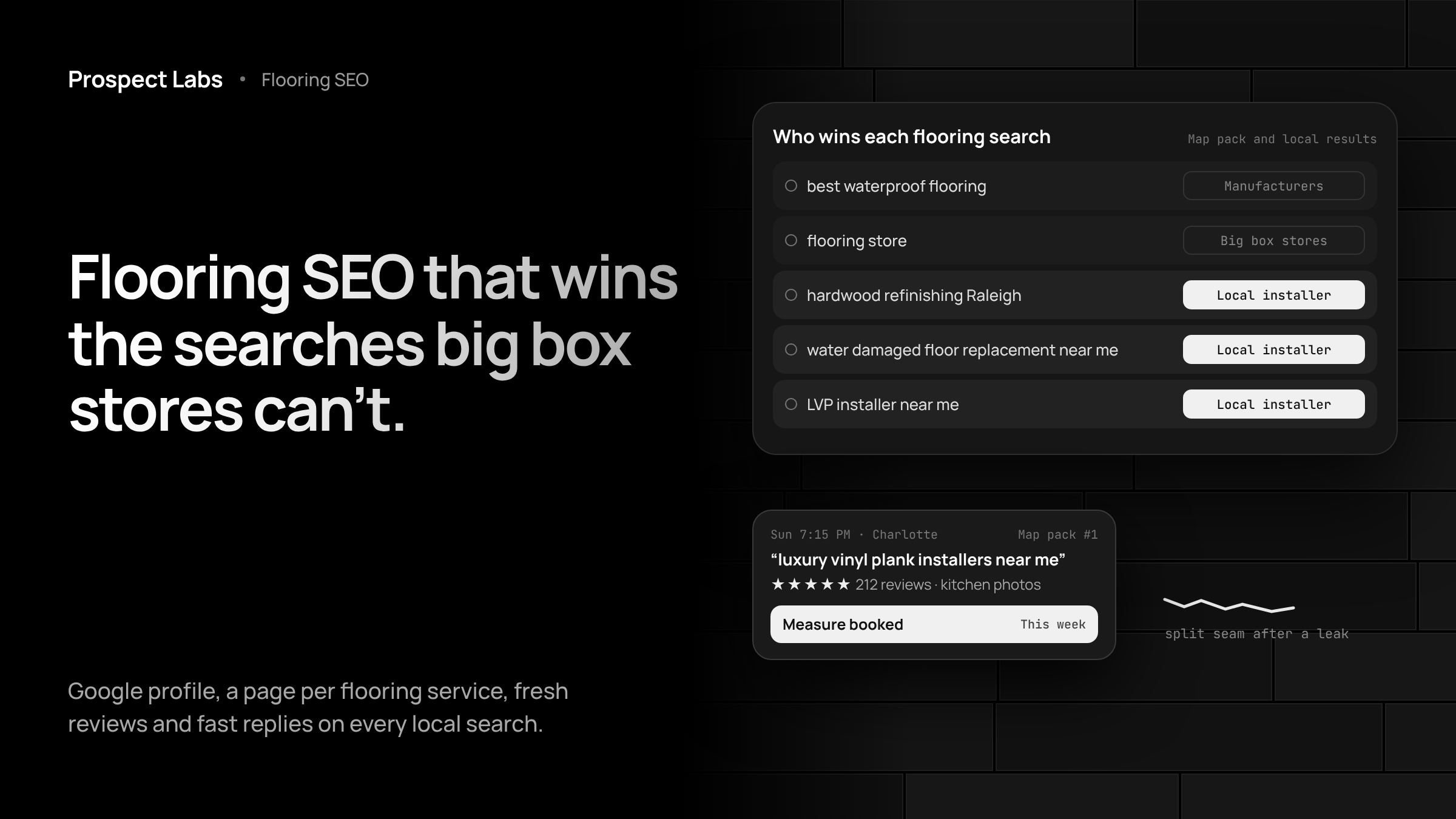

It’s 7:15 on a Sunday evening in Charlotte. A homeowner is kneeling on her kitchen floor, looking at the laminate seam that finally split after the dishwasher leak. She picks up her phone and types “luxury vinyl plank installers near me.”
Google shows her three flooring companies in the map pack. One has 212 reviews and photos of finished kitchens. One has 14 reviews. One has no photos at all. She taps the first, scrolls for a minute, and sends a message asking about a measure this week.
There are dozens of flooring companies across Mecklenburg County. To her, only three existed, and only one got the job. That gap is what flooring SEO is about.
Quick answer: Flooring SEO is the work of getting a flooring contractor or showroom found on Google Maps and in local search results when homeowners look for an installer. It runs on a complete Google Business Profile, one page per flooring service, steady reviews and a website that turns visits into booked measures.
What is flooring SEO?
Flooring SEO is search engine optimization built around how people actually shop for floors. They search by material (“hardwood floor refinishing”), by room (“bathroom tile installation”), by problem (“water damaged laminate replacement”) and by place (“flooring store in Plano”).
Good flooring SEO covers three places on Google at once:
- The map pack, the three businesses shown on a map for local searches. This is driven mostly by your Google Business Profile, your distance from the searcher and your reviews.
- Local organic results, the blue links under the map. These are driven mostly by your website: service pages, city pages and the links pointing to them.
- AI answers, the summaries in Google’s AI results and tools like ChatGPT. These pull from the same signals: your website, your listings and what others say about you.
If you want the website side of this in depth (what a flooring site needs to turn sample shoppers into measured rooms), read our guide to flooring website design. This post stays on the ranking side.
Why is flooring SEO harder than SEO for other trades?
Flooring SEO is harder because you compete with national retailers, manufacturers and directories, not just other local installers. A plumber mostly fights other plumbers. A flooring company fights Floor & Decor, Lowe’s, Home Depot, brand sites like Shaw and Mohawk, plus Houzz, Angi and Yelp.
The money involved explains why. Floor Covering Weekly reports that Floor & Decor grew sales 5.1% to $4.69 billion in 2025, while Lowe’s flooring sales were $4.1 billion. Those companies spend heavily to own broad searches like “vinyl plank flooring” or “flooring store.”
You don’t beat them on those searches. You beat them on searches with a place and a job attached, where a local installer is the better answer:
| Search type | Example | Who usually wins | Your best play |
|---|---|---|---|
| Product research | “best waterproof flooring” | Manufacturers, big box blogs | Skip, or answer it in a FAQ |
| Broad category | “flooring store” | Big box stores, directories | Map pack through your Google Business Profile |
| Service plus city | “hardwood refinishing Raleigh” | Local specialists | A dedicated service page and city page |
| Problem plus place | “water damaged floor replacement near me” | Whoever answers fast | Service page plus fast reply on calls and texts |
| Installer only | “LVP installer near me” | Local installers | A page built only for install labor |
Material trends matter too. Floor Covering News found rigid core (SPC and WPC) made up $4.972 billion of the $8.587 billion resilient flooring category in 2025, and SPC alone was about 15% of all US flooring sales. If LVP and SPC are most of your installs, those materials deserve their own pages, not one line on a generic “Services” page.
What does Google look at when ranking flooring companies?
Google ranks flooring companies in the map pack mainly on relevance, distance and prominence. In practice that means your Google Business Profile category, how close you are to the searcher and how many good reviews you have. Your website matters most for the organic links below the map.
The Whitespark Local Search Ranking Factors survey, as summarized by BrightLocal, puts it plainly. Map pack rankings lean most on primary category, proximity and keywords in the business name. Local organic rankings lean most on dedicated pages for each service, local relevance of the content and the quality of links pointing to the site.
| Ranking signal | What it means for a flooring company | What to do this month |
|---|---|---|
| Primary category | “Flooring contractor” and “Flooring store” rank for different searches | Pick the one that matches most of your revenue, add the other as secondary |
| Proximity | You rank best near your verified address | Build city pages for towns you serve beyond it |
| Reviews | Count, rating, recency and what customers mention | Ask after every install, and ask them to name the material and room |
| Service pages | One page per job type beats one long “Services” page | Separate pages for LVP, hardwood, refinishing, tile, carpet |
| Content relevance | Pages that mention your towns, homes and jobs | Add real job photos with captions naming the town and material |
| Links | Mentions from local and industry sites | Supplier dealer locators, builders, realtors, local news |
How should a flooring company set up its Google Business Profile?
A flooring company should treat its Google Business Profile as its most important page, because it is often the first thing a homeowner sees. Google says customers are 2.7 times more likely to consider a business reputable when they find a complete profile. Yet BrightLocal’s 2026 small business report found 85% of small businesses have a profile and only 35% actively maintain it.
Work through this list:
- Primary category. Choose “Flooring contractor” if you mostly install at customers’ homes, or “Flooring store” if you run a showroom. Add secondary categories like “Tile contractor,” “Carpet installer” or “Wood floor refinishing service” only where you actually do that work.
- Business name. Use your real name exactly as it appears on your signage. Stuffing “Best Flooring Installers Charlotte” into the name breaks Google’s rules and can get the profile suspended.
- Service area. List the cities and ZIP codes you really travel to. Keep it realistic; a service area across half the state rarely helps.
- Services. Add each service with a short description: LVP installation, engineered hardwood installation, sand and refinish, tile installation, carpet installation, subfloor repair, stair treads.
- Photos. Upload finished rooms every week, labeled by material and town. Before and after photos of refinishing jobs perform especially well.
- Questions and answers. Seed common questions yourself: Do you move furniture? Do you remove old flooring? Do you offer shop at home samples?
- Hours and messaging. If messaging is on, someone has to answer within minutes, not tomorrow morning.
Which pages does a flooring website need to rank?
A flooring website needs one page for each service you want to rank for, plus one page for each important city you serve. Dedicated service pages are the top local organic ranking factor in the Whitespark survey, and they also give AI tools a clear page to quote.
| Page | Example slug | Target search |
|---|---|---|
| Service: LVP and SPC | /luxury-vinyl-plank-installation/ | LVP installation near me |
| Service: hardwood installation | /hardwood-floor-installation/ | hardwood floor installers [city] |
| Service: refinishing | /hardwood-floor-refinishing/ | floor refinishing near me |
| Service: tile | /tile-installation/ | bathroom tile installer [city] |
| Service: carpet | /carpet-installation/ | carpet installation [city] |
| City page | /flooring-contractor-raleigh/ | flooring contractor Raleigh |
| Cost guide | /flooring-installation-cost/ | cost to install LVP per square foot |
Each service page should answer the questions a homeowner asks before booking: what it costs per square foot in your area, how long the job takes, whether furniture moving and old floor removal are included, what the warranty covers and what the room looks like after. Add photos from real jobs, three to five reviews that mention that service and one clear next step.
City pages only work when they say something true about that city. Mention the neighborhoods you work in, the home styles you see there (slab foundations, older oak floors, basements), and show jobs from that town. A page that swaps “Durham” for “Cary” and changes nothing else will not rank for long. We cover the same approach for other trades in handyman SEO and landscaping SEO.
How many reviews does a flooring company need?
A flooring company should aim for at least 20 recent Google reviews, then keep adding a few every month. BrightLocal’s research shows why that number matters:
| Review fact | Figure | Source |
|---|---|---|
| Consumers who read reviews for local businesses | 97% | BrightLocal, 2026 |
| Consumers who won’t use a business with fewer than 20 reviews | 47% | BrightLocal, 2026 |
| Small businesses with fewer than 20 Google reviews | 47% | BrightLocal, 2026 |
| Consumers who rejected a business for a review reason | 65% | BrightLocal, 2026 |
| Consumers who visit the website after reading positive reviews | 54% | BrightLocal, 2026 |
Flooring has a natural review moment: the day the last plank goes down and the homeowner walks the room in socks. That’s when to ask, with a link that opens the review form in one tap. A review that says “They installed LVP in our kitchen and hallway in two days” helps you rank for those words. A generic “Great job!” helps less.
If asking feels awkward or keeps slipping, automate it. The Prospect Labs system sends a one click review request when the job closes, then polite reminders for a few weeks until the customer follows through.
Do citations and backlinks still matter for flooring SEO?
Citations and backlinks still matter, but they are support work, not the main event. Citations are listings of your name, address and phone on sites like Yelp, Bing Places, Apple Business Connect, the BBB, Houzz and Angi. They need to match your Google profile exactly, because 62% of consumers say they would avoid a business after finding incorrect information online.
The best flooring backlinks come from relationships you already have:
- Dealer locator pages on manufacturer sites for the brands you carry
- Home builders and remodelers who sub out flooring to you
- Realtors and property managers who send you turnover jobs
- Local news or community pages that covered a project or sponsorship
- Your distributor’s “find an installer” listing
How long does flooring SEO take to work?
Most flooring companies see Google Business Profile gains within one to three months and steady organic rankings in six to twelve months. The exact pace depends on your market, your competition, how old your site is and how fast reviews come in. Anyone promising page one in 30 days is guessing.
| Timeframe | What usually happens |
|---|---|
| Month 1 | Profile fixed, categories and services set, citations cleaned up, review requests running |
| Months 2 to 3 | More map pack views and calls for nearby searches, first service pages indexed |
| Months 4 to 6 | Service and city pages start ranking for longer searches like “hardwood refinishing [city]” |
| Months 6 to 12 | Broader rankings, more reviews than most local rivals, leads from towns beyond your address |
What flooring SEO mistakes cost the most jobs?
The costliest flooring SEO mistakes are the ones that waste a ranking you already earned. Watch for these:
- One “Services” page for everything. Google can’t tell whether you’re the right answer for tile, LVP or refinishing.
- Showroom category on an install only business (or the reverse). You show up for the wrong searches.
- Stock photos. Homeowners can tell, and Google learns nothing about your work or your towns.
- Reviews that stopped in 2023. Recency counts. A profile with 80 old reviews can lose to one with 30 fresh ones.
- No prices anywhere. Clear pricing is one of the top three things consumers weigh when picking a business, per BrightLocal’s 2026 research. A “from $X per square foot installed” range beats silence.
- Missed calls. The ranking works, the phone rings, nobody answers, and the homeowner taps the next company.
What happens after a flooring company starts ranking?
Ranking only gets you the visit; speed gets you the job. BrightLocal found that 75% of consumers choose a local business in under 30 minutes, 28% in under five, and 72% look at three businesses or fewer. A homeowner who calls you from the map pack while you’re on your knees laying tile will not wait until 6 PM.
That’s why SEO alone is half a system. The other half answers missed calls with a text in your business name, follows up quotes that went quiet and asks every finished job for a review, which feeds the next ranking. Prospect Labs builds websites and marketing systems for contractors that do all of it from one phone, from $297 a month with no long contract. You can see the full breakdown on our pricing section or look at live builds in Our Work.
If your flooring company shows up on page two, or shows up and still loses the measure, book a strategy call. We’ll look at your Google profile, your reviews and how calls are handled today, and tell you straight what’s costing you jobs.
Frequently asked questions about flooring SEO
What is the best Google Business Profile category for a flooring company?
Use “Flooring contractor” if most of your revenue comes from installing at customers’ homes, and “Flooring store” if you sell from a showroom. Add the other as a secondary category, along with tile or refinishing categories only for work you actually do.
Can a local flooring company outrank Home Depot or Floor & Decor?
Yes, for local service searches. Big box stores win broad product searches, but a local installer with a strong Google profile, dedicated service pages and recent reviews often wins searches like “hardwood refinishing near me” or “LVP installer [city]” in the map pack.
How much does flooring SEO cost?
Flooring SEO usually costs a few hundred to a few thousand dollars a month in the US, depending on market size and how much content and link building is included. Prospect Labs includes local SEO in its system from $297 a month, plus a one time setup fee.
Do flooring companies need a blog for SEO?
A blog helps, but service pages come first. Write posts that answer real buyer questions, such as cost per square foot, LVP versus hardwood for kitchens, or how long refinishing takes, and link each one to the matching service page.
How do I get more Google reviews for my flooring business?
Ask on the day the job is finished, send a direct review link by text, and follow up once or twice if they don’t leave one. Ask customers to mention the material and room, which helps you rank for those searches.