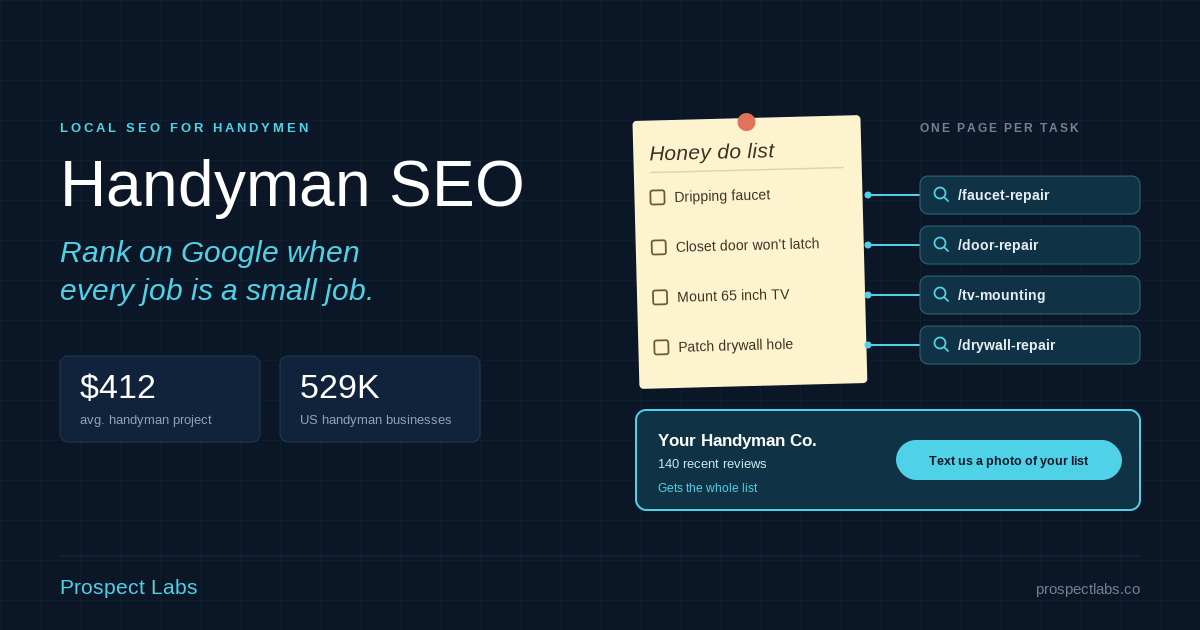

It’s 8:40 on a Saturday morning. A homeowner in Columbus is standing in the hallway with a list on the fridge: a dripping bathroom faucet, a closet door that won’t latch, a 65 inch TV still in the box, and a fist sized hole in the drywall nobody wants to talk about.
She isn’t going to call four different trades. She types “handyman near me” and looks at the three businesses in the map pack. One has 11 reviews from 2021. One has no website. The third shows 140 recent reviews, a page that lists TV mounting, drywall repair and door repair by name, and a button that says “Text us a photo of your list.”
That third handyman gets the whole list, and probably the next list too.
That is what handyman SEO comes down to. Not tricks. Not stuffing “handyman” into every sentence. It is making sure Google, and the homeowner, can see exactly which small jobs you do, where you do them, and how fast you answer.
Quick answer: Handyman SEO is the work of getting a handyman business to show up on Google when local homeowners search for repair and odd job help. It covers your Google Business Profile, a page for each task you offer, pages for the towns you serve, steady reviews and a fast mobile website.
Below, we break down how handyman SEO works, what pages and signals matter, what it costs compared with lead apps, and the mistakes that keep good handymen invisible. If you serve more than one trade, our guide to contractor website design covers the shared basics.
What Is Handyman SEO?
Handyman SEO is local search engine optimization built for a handyman business. It helps your Google Business Profile and website rank for searches like “handyman near me,” “TV mounting service” and “drywall repair in [town],” so homeowners call or text you instead of a competitor or an app.
It has three working parts:
- Your Google Business Profile, which decides whether you appear in the map pack, the three business listings shown above the regular results.
- Your website, which proves you do the specific job the homeowner searched for and gives them a fast way to reach you.
- Your reputation, meaning the number, recency and wording of your Google reviews.
When all three agree with each other, Google trusts you more. When they contradict each other, for example a different phone number on your site and your profile, you slip down the list.
Why Is SEO Different for a Handyman Than for Other Trades?
Handyman SEO is different because you sell dozens of small, unrelated tasks instead of one big service. A roofer ranks for roofing. A handyman has to rank for faucet repair, TV mounting, door repair, drywall patching and furniture assembly, often against apps that list the same tasks.
Three things make the handyman market its own animal:
The job list is wide, and every task is its own search. Homeowners rarely search “handyman services” when they know what’s broken. They search the task: “ceiling fan installation,” “caulk bathtub,” “fix sticking door.” Each of those is a separate chance to be found.
The ticket is small, so your cost per lead has to be small too. According to HomeAdvisor’s cost guide, the average handyman project costs homeowners about $412. You can’t pay $80 for a shared lead on a $150 job and stay profitable. That makes free organic traffic far more valuable to a handyman than to a remodeler.
You compete with apps, not just other handymen. Taskrabbit, Thumbtack and Angi all rank for handyman searches. Taskrabbit’s own cost guide puts its average around $38 an hour, while the national range runs $50 to $125. You win against an app by showing what the app can’t: your face, your local reviews, your licenses and a direct line to you.
How Crowded Is the Handyman Market on Google?
The handyman market is large and highly fragmented. IBISWorld counts roughly 529,000 US handyman businesses averaging under three employees each, which means most competitors are solo operators with thin online presence. A handyman who does SEO properly can stand out quickly.
| What matters | The figure | Source |
|---|---|---|
| Handyman businesses in the US (2026) | About 529,000 | IBISWorld |
| US handyman industry revenue (2026) | $365.4 billion | IBISWorld |
| Average employees per handyman business | 2.9 | IBISWorld |
| Average handyman project cost | About $412 (from 93,986 reported projects) | HomeAdvisor |
| National handyman hourly range | $50 to $125 | Taskrabbit cost guide |
| Consumers who read reviews for local businesses | 97% | BrightLocal, 2026 |
| Mobile visits abandoned when a page takes over 3 seconds | 53% | Google via Marketing Dive |
Read that table as a handyman owner and two things stand out. The market is huge, but it is split into hundreds of thousands of tiny businesses, so there is no giant brand locking up your town. And because the average job is a few hundred dollars, the handyman who gets found without paying per lead keeps far more of every invoice.
How Do You Set Up a Google Business Profile for Handyman Searches?
Set your primary category to Handyman, add every task you offer as a listed service, mark your service area by town, upload real job photos every week, and keep your name, phone and hours identical to your website. Then ask every customer for a review.
Your Google Business Profile is the single biggest lever in handyman SEO, because most “near me” searches end in the map pack. Get these right:
Primary category: Handyman. Add secondary categories only for work you actually do and are allowed to do in your state, such as Carpenter or Drywall Contractor.
Services: list each task by name. TV mounting, drywall repair, door repair, faucet replacement, ceiling fan installation, furniture assembly, caulking, deck repair, gutter cleaning. Google uses this list to match task searches.
Service area: list towns, not a 50 mile circle. If you work from home, hide your address and list the towns you actually drive to.
Photos: before and after, every week. A patched wall, a mounted TV with hidden wires, a rebuilt step. Fresh photos signal an active business.
Consistency: same name, phone and hours everywhere. Your profile, your website, Yelp, Nextdoor and Angi should all match exactly.
Which Pages Should a Handyman Website Have?
A handyman website should have one page for each major task group, one page for each main town you serve, plus a homepage, reviews page, about page and contact page. Separate task pages let Google match “TV mounting near me” to a page that is actually about TV mounting.
Most handyman websites have one “Services” page with 30 bullet points. Google can’t rank one page for 30 different jobs. Split it up:
| Page | What it answers for the homeowner | Searches it can rank for |
|---|---|---|
| Homepage | Who are you, where do you work, how do I reach you? | handyman + town |
| TV mounting | Can you hide the wires and mount it today? | TV mounting service, TV wall mount installation |
| Drywall repair | Can you make that hole disappear? | drywall repair, drywall patch near me |
| Door and window repair | Can you fix a door that sticks or won’t lock? | door repair, sticking door fix |
| Minor plumbing | Can you replace my faucet or toilet parts? | faucet replacement, running toilet repair |
| Fixture and fan installation | Can you swap a light or ceiling fan? | ceiling fan installation, light fixture install |
| Assembly | Can you put this furniture together? | furniture assembly service |
| Carpentry and trim | Can you fix trim, shelves or a rotted step? | trim repair, deck board replacement |
| Honey do list page | Can you knock out my whole list in one visit? | handyman for small jobs, home repair list |
| Service area pages (one per town) | Do you actually work in my town? | handyman + town name |
| Reviews | Do people like working with you? | handyman reviews + town |
Two rules make these pages work. First, write about the job the way a homeowner would describe it, including the problem, the usual time on site and what you bring. Second, make every town page genuinely local: neighborhoods you cover, the age of homes there, common fixes, and a review from a customer in that town. A copied page with the town name swapped helps nobody.
The same page by page logic runs through our HVAC website design and roofing website design guides.
How Do Reviews Affect Handyman Rankings?
Reviews affect handyman rankings directly through Google’s prominence signal and indirectly through clicks. A handyman with steady, recent reviews that mention specific tasks and towns ranks higher in the map pack and gets chosen more often once there.
Homeowners are letting a stranger into their house, often while they’re at work. Reviews are how they decide. BrightLocal’s 2026 survey found 97% of consumers read reviews for local businesses, and 74% only care about reviews from the last three months.
That changes the goal. Ten reviews this quarter beat a hundred from three years ago. The easiest way to keep them coming is to ask at the moment the customer is happiest, which is right after the job, with a one click link sent by text. A short reminder a few days later catches the people who meant to and forgot.
Reviews that say “Mike mounted our TV and hid every cable in Dublin” carry task and town words that help you rank for those exact searches. You can’t write reviews for customers, but you can ask them to mention what you did.
Do Licensing Rules Affect Handyman SEO?
Yes. Licensing rules decide which services you can legally promote. Many states cap the dollar value or type of work an unlicensed handyman can do, so advertising electrical, plumbing or structural jobs you aren’t licensed for can bring complaints, fines and lost trust.
Rules differ by state and sometimes by city. California, for example, limits unlicensed handyman jobs to under $1,000 in combined labor and materials. Other states require a registration or a home improvement license above a set job value. Before you build a page for any service, check your state contractor board.
Used well, licensing is an SEO asset. If you hold a license, insurance or a bond, put it on every page and in your Google Business Profile. Homeowners comparing you with an app worker notice it.
How Does a Handyman Show Up in AI Search Results?
A handyman shows up in AI answers from ChatGPT and Google AI Overviews by having clear, specific pages that state which tasks you do, in which towns, with proof such as reviews and licenses. AI tools pull from the same signals Google uses for local rankings.
More homeowners now ask an AI assistant “who’s a good handyman in Plano for small jobs?” before they open Google Maps. The businesses that get named have a few things in common: consistent details across the web, task pages with direct answers near the top, and plenty of recent reviews. Short, plain sentences such as “We mount TVs, patch drywall and fix doors in Plano, Frisco and Allen” are easy for a machine to quote.
Handyman SEO vs Lead Apps: Which Should You Pay For?
Handyman SEO costs more time up front but builds leads you own. Lead apps deliver jobs faster but charge per lead or per job and share the homeowner with competitors. Most handymen do best using apps short term while SEO builds a steady flow of direct calls.
| Channel | How you pay | Who owns the customer | Best for |
|---|---|---|---|
| Handyman SEO (website + Google Business Profile) | Time or a monthly service | You | Long term, low cost per job |
| Google Local Services Ads | Per lead | You, after the first contact | Fast calls with the Google Guaranteed badge |
| Angi and HomeAdvisor | Per lead, often shared | Shared with other pros | Filling gaps in a slow month |
| Thumbtack | Per lead | Shared until hired | Testing new task types |
| Taskrabbit | Commission on the job | The platform | New handymen building a track record |
The math is simple. When the average job is a few hundred dollars, every dollar you don’t spend on a shared lead goes straight to your margin. SEO is the channel that gets cheaper the longer you run it.
What Are the Most Common Handyman SEO Mistakes?
The most common handyman SEO mistakes are one generic services page, a service area set as a giant circle, old or few reviews, stock photos, a phone number that differs across listings, advertising work you aren’t licensed for, and no reply when calls are missed.
| Mistake | What it costs you | The fix |
|---|---|---|
| One page listing 30 services | Google can’t match you to task searches | A page for each main task group |
| Service area set as a 50 mile radius | You show up nowhere strongly | List the towns you actually serve |
| A handful of old reviews | Homeowners pick the busier looking pro | A review request after every job |
| Stock photos | You look like an app listing | Real before and after photos |
| Different phone numbers across sites | Google trusts your listing less | One name, number and hours everywhere |
| Promoting unlicensed work | Complaints and lost trust | Only list services your state allows |
| Calls go to voicemail | The homeowner calls the next handyman | An instant text reply when you miss a call |
What Happens After a Homeowner Finds You?
After a homeowner finds you, the job is won or lost on speed. The best handyman businesses capture the request with a one tap text, reply instantly when a call is missed, follow up until it’s booked, and ask for a review when the work is done.
This is where most handyman SEO advice stops, and where most handymen lose the job. You’re on a ladder with a drill in one hand. The phone rings. By the time you call back, the homeowner booked someone else.
The fix is a system, not more hustle:
- Found. The homeowner finds you in the map pack, a task page or an AI answer.
- Visit. Your site loads fast and shows the exact job they need.
- Capture. They tap to text a photo of their list.
- Respond. If you miss the call, a text goes out in your business name right away.
- Follow up. If they go quiet, automatic follow ups keep the conversation alive.
- Book. The visit gets scheduled.
- Grow. A review request goes out after the job, and a reminder brings them back with the next list.
That’s the marketing system for contractors we build at Prospect Labs. Plumbers deal with the same missed call problem, which we break down in our guide on how to get more plumbing leads, and painters face similar small ticket math in how to advertise a painting business.
Ready to See What Your Handyman Business Is Missing on Google?
Your next honey do list is already being typed into a phone somewhere in your town. The question is whether it lands with you or with an app.
At Prospect Labs, we build website design and marketing systems for contractors, including handymen, with local SEO, missed call text back and a review funnel built in. Plans start at a flat monthly price with no long term contract. You can see sites we’ve built on our work page.
Book a strategy call and we’ll look at your Google profile, your reviews and how calls are handled today. If it isn’t a fit, we’ll tell you straight.
Handyman SEO FAQs
How long does handyman SEO take to work?
Most handymen see Google Business Profile improvements within a few weeks of fixing categories, services and reviews. Website rankings for task and town pages usually take three to six months, depending on local competition and how established your domain is.
Do I need a website if I have a Google Business Profile?
Yes. Your profile gets you into the map pack, but your website is where Google and homeowners confirm which tasks you do and where. A site with task pages ranks for far more searches than a profile alone.
What keywords should a handyman target?
Target task keywords such as TV mounting, drywall repair and door repair, each paired with your town names, plus “handyman near me” and “handyman in [town].” Task searches show clearer intent and usually face less competition.
Should a handyman use Google Local Services Ads?
Local Services Ads can bring fast calls and show the Google Guaranteed badge. They work best alongside SEO, since homeowners often check your website and reviews before calling. Track cost per booked job, not cost per lead.
How many reviews does a handyman need to rank?
There’s no fixed number. What matters is having more recent reviews than the handymen around you, with new ones arriving every month. Reviews that mention specific tasks and towns help most.
Can I do handyman SEO myself?
You can handle the basics: your Google Business Profile, photos and review requests. Task pages, town pages, site speed and schema take more time. Many handymen do the profile themselves and hand the website and follow up system to a provider.
Does handyman SEO work for one person businesses?
Yes, and it often works best for them. With about 2.9 employees per business on average, most of your competitors are small too. A solo handyman with a clear website and steady reviews can outrank larger companies in their own towns.