
Quick answer: Landscaping SEO is the work of getting a landscaping or lawn care company found on Google Maps, Google search and AI tools when homeowners in its service area look for services like lawn mowing, landscape design, sod installation or spring cleanup, then turning those visits into calls, texts and booked jobs.
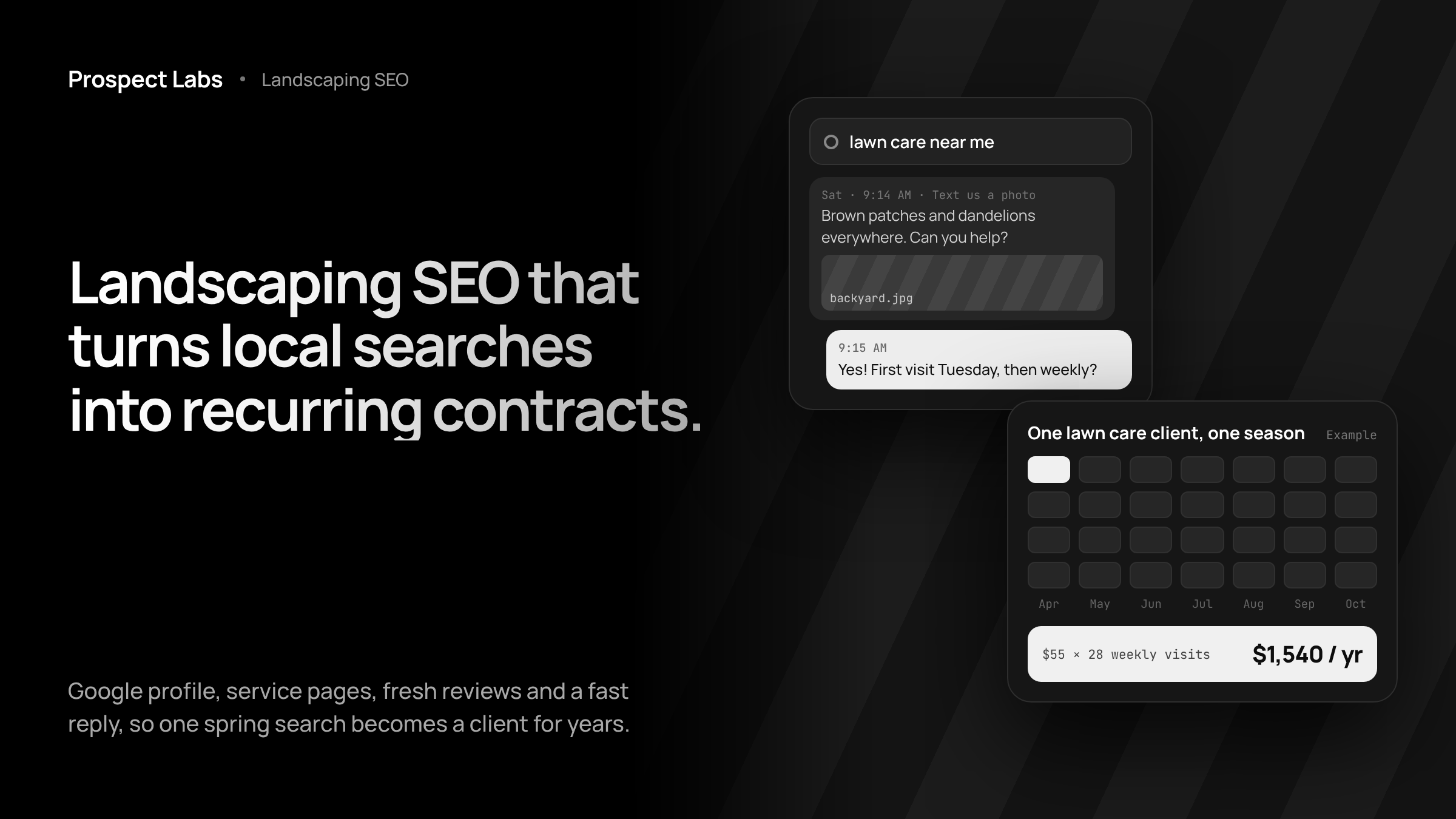
It’s the first warm Saturday in April in Charlotte. A homeowner walks out back with her coffee and finds a lawn that’s half brown patches, half dandelions. She pulls out her phone and types “lawn care near me.” Three companies show up in the map pack. One has 140 reviews, photos from a street she recognizes and a button that says “Text us.” She sends a photo of the yard. By lunch she has a quote and a first visit booked for Tuesday. The other two companies never knew she existed.
That’s landscaping SEO in one scene. It isn’t about chasing traffic or ranking for clever phrases. It’s about being one of the three names your town sees when they finally decide the yard needs help, and making it easy for them to reach you once they do. Get that right in spring and a single search can turn into a mowing client who pays you every week for years.
This guide covers how homeowners search for landscapers, what the 2026 numbers say, how to set up your Google Business Profile and website, how reviews and AI search fit in, and how long it all takes. If you also build patios and walls, our guide to hardscaping marketing covers that side of the yard, and local SEO for contractors walks through the setup every trade shares.
What Is Landscaping SEO and How Is It Different From Regular SEO?
Landscaping SEO is local SEO shaped around how people buy outdoor services. It targets service plus town searches, leans heavily on your Google Business Profile and reviews, and has to win two very different buyers: recurring lawn care customers and one time design and installation clients.
A plumber mostly serves one kind of moment: something is broken. A landscaper serves two. One homeowner wants someone to mow, edge and fertilize every week from April to October. Another wants a new front yard with plants, mulch beds, lighting and an irrigation system. They search differently, decide at different speeds and judge you on different proof. Good landscaping SEO builds a path for each.
| Lawn care and maintenance buyer | Design and installation buyer | |
|---|---|---|
| Typical searches | lawn care near me, lawn mowing service, weed control, aeration and overseeding | landscape designer near me, front yard landscaping, sod installation, irrigation installation |
| How fast they decide | Days. Often the first company that replies | Weeks to months. They compare portfolios and quotes |
| What the job is worth | Smaller ticket, paid every week or month | Bigger ticket, paid once, often with a phase two later |
| What wins them | Reviews, clear pricing, fast reply, reliable schedule | Real project photos, a clear design process, reviews about similar projects |
| Best page type | A service page per maintenance service, plus service area pages | Project galleries and a page per installation service |
Landscaping SEO in 2026: What the Numbers Say
The landscaping market is huge, crowded and made up mostly of small crews. Homeowners read more reviews than ever, expect them to be recent, and are starting to ask AI tools for recommendations. That rewards landscapers whose Google profile, website and reviews all tell the same strong story.
| What the data shows | Figure | Source |
|---|---|---|
| Size of the US landscaping services market | $176.7 billion in 2026 | IBISWorld |
| Landscaping businesses in the US | 556,238 in 2026 | IBISWorld |
| Employees at the average landscaping business | 2.5 | IBISWorld |
| Consumers who read reviews for local businesses | 97% | BrightLocal Local Consumer Review Survey 2026 |
| Consumers who “always” read reviews | 41%, up from 29% a year earlier | BrightLocal 2026 |
| Consumers using AI tools for local business recommendations | 45%, up from 6% in 2025 | BrightLocal AI report |
| Consumers using Google for local recommendations | 71%, down from 83% in 2025 | BrightLocal 2026 |
| Consumers who start their first local search on Google Search | 52% | BrightLocal Consumer Search Behavior 2026 |
| Most important local pack ranking factor | Primary Google Business Profile category (1st of 187 factors) | Whitespark Local Search Ranking Factors 2026 |
| Outdoor renovators hiring a professional | 71% | Houzz Outdoor Trends Study 2026 |
Three things stand out for a landscaping company.
- You’re competing with a lot of small crews. With more than half a million landscaping businesses and an average of 2.5 employees each, most of your competitors are too busy mowing to do SEO well. That’s an opening, not a wall.
- Reviews are now a gate, not a bonus. Nearly everyone reads them, and more people read them every single time. A profile with a handful of reviews from 2022 loses to one with steady, recent ones.
- Discovery is spreading out. Google is still the starting point for most people, but AI tools jumped from almost nothing to the third most used source in one year. The same strong website and reviews feed both.
How Do Homeowners Search for Landscapers and Lawn Care Companies?
Homeowners search in three ways: by service and town (“sod installation Raleigh”), by “near me” on their phone, and by problem or cost (“brown patches in lawn,” “how much does mulch installation cost”). Each service you offer needs its own page to catch those searches.
The biggest mistake we see is one “Services” page that lists mowing, mulch, sod, irrigation and lighting in a single paragraph. Google has nothing specific to rank, and a homeowner looking for aeration has to dig to find out whether you even do it. Map each service to its own page instead.
| Service | What homeowners type | Page to build | Buyer |
|---|---|---|---|
| Lawn mowing and maintenance | lawn mowing service near me, weekly lawn care [town] | Lawn mowing and maintenance page | Recurring |
| Fertilization and weed control | lawn fertilization service, weed control [town] | Lawn treatment program page | Recurring |
| Aeration and overseeding | core aeration near me, aeration and overseeding [town] | Aeration page with seasonal timing | Seasonal |
| Spring and fall cleanup | yard cleanup service, leaf removal near me | Seasonal cleanup page | Seasonal |
| Mulch and bed maintenance | mulch installation near me, flower bed maintenance | Mulch and beds page | Seasonal |
| Landscape design | landscape designer near me, front yard landscaping ideas [town] | Design process page plus gallery | Project |
| Sod installation | sod installation [town], new lawn installation cost | Sod page with prep and aftercare | Project |
| Irrigation | sprinkler system installation, irrigation repair near me | Install page and repair page | Project and repeat |
| Landscape lighting | landscape lighting installation [town] | Lighting page with dusk photos | Project |
| Commercial maintenance | commercial landscaping company [town], HOA landscaping | Commercial page for property managers | Contract |
Problem and cost searches matter too. Someone typing “yard floods every time it rains” or “how much does a sprinkler system cost” is early in the decision, but they’re exactly the person who becomes a design and install client a few weeks later if your page answers the question honestly.
How Do You Optimize a Google Business Profile for a Landscaping Company?
Start with the primary category, the most important local ranking factor in Whitespark’s 2026 survey. Choose the one closest to the work you most want, add secondary categories for the rest, list every service, set your service area, and post real job photos every week.
For most landscapers, the Google Business Profile is where the first impression happens. Plenty of homeowners call straight from the map pack without ever opening your website. Here’s what matters most:
- Pick the primary category on purpose. “Landscaper” and “Lawn care service” are different signals. Choose the one that matches the jobs you most want, then add the other plus options like “Landscape designer” or “Irrigation equipment supplier” only if you truly offer them. Whitespark ranks additional categories 8th among local factors.
- Think about a seasonal switch. Whitespark suggests changing the primary category with the seasons. A company that does lawn care in summer and snow removal in winter can lead with each one when it’s in demand.
- Set up as a service area business. If customers don’t visit your yard or office, hide your address and list the towns and zip codes you actually serve. Never use a virtual office or a friend’s address to rank in another town. It can get the whole profile suspended.
- List every service with a short description. Mowing, aeration, mulch, sod, irrigation, lighting. Each one gives Google another reason to show you.
- Post real photos weekly. Before and after shots, crews at work, finished beds. Fresh photos from recognizable neighborhoods build trust that stock images never will.
- Keep your name, phone and website identical everywhere. Your profile, website, Yelp, Angi, Nextdoor and the BBB should all match exactly.
What Should a Landscaping Website Include to Rank and Convert?
A landscaping website needs one page per service, real project photos with the town named, starting prices or price ranges, reviews near the top, and a one tap way to text or call from every page. Ranking brings people in. Those details turn them into booked jobs.
Your website is where both buyers go to check you out after they find you. The lawn care customer wants to know you serve their street and what weekly service roughly costs. The design client wants to see work that looks like the yard they’re imagining. A site that does both looks something like this:
- A separate page for each service from the table above, written in plain language with the questions homeowners actually ask
- Galleries grouped by project type, with the town, size, plants or materials and a rough budget band for each
- Starting prices or ranges, like “weekly mowing for most yards in Cary starts around $45,” which builds trust and screens out bad fits
- Your service area spelled out clearly, ideally with a simple map
- Recent reviews on the home page and on each service page
- Licensing, insurance and any certifications, such as state pesticide applicator licenses for lawn treatments
- A fast, mobile first layout with one obvious button to text a photo of the yard
We cover the full checklist in our guide to contractor website design. If your site gets compliments but not calls, here’s why a good looking site still loses jobs.
Do Landscapers Need Service Area Pages for Every Town?
Build service area pages for the towns where you really work and have proof to show. A good page includes local projects, local reviews and local conditions. A page that just swaps the town name into the same text is thin content and rarely ranks.
Service area pages help you show up in towns beyond the one Google associates with your business. The difference between a page that ranks and one that doesn’t is local detail. Mention the grass types that do well there, such as Bermuda and zoysia across much of the South or Kentucky bluegrass and fescue further north. Talk about clay soil, drainage or water restrictions if they apply. Show three or four jobs from that town and quote a review from a customer who lives there. If your crews work in many towns, start with the five that bring in the best jobs and add more as you collect photos and reviews.
How Do Reviews Affect Landscaping SEO?
Reviews affect both where you rank and whether people call. Whitespark places review count, rating and recency among the top local factors, and BrightLocal found 97% of consumers read reviews. For landscapers, a steady flow of recent reviews that mention specific services works best.
Landscaping work is visible from the street, and so is a bad job. That’s why homeowners lean on reviews so hard before they let a crew onto their property. BrightLocal’s 2026 survey also found people expect reviews to be fresh, so a burst of twenty reviews in one week followed by silence does less than two or three every week all season.
Time your requests to the moments when customers are happiest:
- Right after a spring cleanup, when the yard suddenly looks finished
- At the walkthrough after an installation, while they’re standing on the new sod or looking at the lit up beds
- After the first month of weekly service, once the lawn is visibly better
Ask customers to mention the service and their neighborhood. “They aerated and overseeded our lawn in Apex and it’s the thickest it’s ever been” helps you rank for that service far more than “great job.” Our guide shows how contractors get more 5 star Google reviews without awkward asks.
How Do Landscapers Show Up in ChatGPT and Google AI Answers?
AI tools recommend landscapers they can understand and trust. They lean on clear website content, consistent business details and reviews across several sites. Whitespark’s 2026 study weighted on page website signals at 24% for AI visibility, double the 12% given to Google Business Profile signals.
When BrightLocal found AI tools jumped from 6% to 45% of local recommendations in a year, plenty of landscapers panicked. The good news is that the work is mostly the same work. AI tools pull from your website, your reviews and lists that mention you. They reward clear, specific pages and punish vague ones.
- Answer common questions directly on each service page: what it costs, how long it takes, when to do it, which towns you serve
- Keep your business details identical across your website, Google, Yelp, Angi and Nextdoor
- Collect reviews on more than one platform, since consumers now use an average of six review sites
- Get included in local “best landscapers in [town]” lists from newspapers, chambers and community sites
People still double check. BrightLocal’s AI report found 88% fact check reviews that AI tools cite, which means your actual reviews and website still close the deal.
What Blog Content Actually Helps a Landscaping Company Rank?
The blog content that helps landscapers most answers cost, timing and local problem questions homeowners already search for. Each post should connect to a service page, so a reader who learns when to aerate in your area can book aeration in one tap.
| Content idea | Search it catches | Service it feeds |
|---|---|---|
| How much does sod installation cost in [town] | sod installation cost | Sod installation |
| When to aerate your lawn in [state] | when to aerate lawn | Aeration and overseeding |
| Best grass types for [region] yards | best grass for [region] | Sod, seeding, lawn care |
| Why your yard floods after rain and how to fix it | yard drainage problems | Drainage, regrading, design |
| Spring yard cleanup checklist for [town] homeowners | spring yard cleanup | Seasonal cleanup |
| Low maintenance front yard ideas that cut mowing | low maintenance landscaping | Landscape design |
Keep posts local and specific. A generic “10 landscaping tips” article competes with national magazines and rarely brings in a single local customer.
Why Does Speed of Reply Matter as Much as Rankings?
Rankings earn the click, but the fastest reply usually wins the job. Lawn care shoppers in particular contact two or three companies and book whoever answers first. If calls ring out while your crews are on mowers, SEO just sends customers to your competitors.
This is where most landscaping SEO advice stops, and where most landscaping companies quietly lose money. You can’t answer the phone over a zero turn mower or with a hedge trimmer running. The homeowner doesn’t leave a voicemail. They tap the next name in the map pack.
A missed call text back replies in your business name within seconds, so the conversation starts before they call someone else. Automated lead follow up keeps quotes for bigger design jobs warm through a decision that can take weeks. Both are part of our seven stage contractor marketing system, which connects getting found to getting booked.
How Should Landscapers Plan SEO Around the Seasons?
Landscapers should do SEO work in the slow months and harvest it in the busy ones. Build pages and collect reviews in winter, push maintenance and cleanup content before spring, highlight irrigation and lighting in summer, and promote fall cleanup and aeration in September.
| When | What homeowners are doing | SEO focus |
|---|---|---|
| January to February | Planning spring projects, setting budgets | Add last year’s projects, refresh service pages, update your profile photos |
| March to May | Searching for mowing, cleanup, mulch and new lawns | Spring cleanup and lawn care pages, review requests after every cleanup |
| June to August | Fighting heat and drought, enjoying evenings outside | Irrigation, drought tolerant design and landscape lighting content |
| September to November | Fall cleanup, leaf removal, aeration and overseeding | Fall service pages, booking next year’s maintenance contracts |
| December | Snow removal and holiday lighting where it applies | Seasonal category switch if you offer winter services |
Pool builders face the same spring rush, which is why our guide to pool builder SEO follows a similar calendar. If you handle storm cleanup or tree work, tree service marketing covers demand that arrives with the weather. In the Sun Belt, where lawns grow most of the year, the same plan smooths out the slower holiday months.
How Long Does Landscaping SEO Take to Work?
Most landscaping companies see Google Business Profile improvements within a few weeks and steadier organic gains over three to six months. Competitive metro areas can take longer. Results depend on your local competition, how established your business is, and how consistently you collect reviews.
| Timeframe | What usually happens |
|---|---|
| First month | Profile cleaned up, categories set, service pages live, review requests start |
| Months 2 to 3 | More map pack impressions, early rankings for less competitive services and towns |
| Months 4 to 6 | Service and town pages start ranking, reviews build up, calls become steadier |
| Months 6 to 12 | Stronger rankings in competitive towns, blog content starts pulling in early stage buyers |
These are typical patterns, not guarantees. A new business in a crowded metro will move slower than an established company in a smaller town.
Do the Maths on One Lawn Care Client
One recurring lawn care client can be worth well over a thousand dollars a year. At $297 a month, a complete marketing system pays for itself with only a few extra clients who would otherwise have gone to the company that answered first.
Say your average weekly mowing visit is $55 and you mow about 28 times a season. That’s roughly $1,540 a year from one customer, before you add aeration, mulch or a fall cleanup. Keep that customer for three seasons and they’re worth more than $4,600. A complete marketing system at $297 a month costs about $3,564 a year, so three new recurring clients cover it. That’s simple arithmetic on example numbers, not a promise of results, so try it with your own.
6 Landscaping SEO Mistakes That Cost You Clients
- One page for every service. Mowing, sod, irrigation and lighting each need their own page to rank and to convince.
- Stock photos. Homeowners can spot them, and they make people wonder what your real work looks like.
- The wrong primary category. If you want lawn care clients but your profile says “Landscape designer,” you’re fighting your own profile.
- Fake addresses in other towns. Virtual offices can get your Google Business Profile suspended right before spring.
- Reviews in bursts. Twenty reviews in March and none until October looks stale to customers and to Google.
- Ranking without replying. Every missed call from a search is a lead you paid for and handed to a competitor.
How Prospect Labs Helps Landscapers Rank and Book More Jobs
Most landscaping SEO agencies stop at rankings. Prospect Labs builds marketing systems for landscaping companies that cover the whole path, from the search to the signed maintenance contract. For a landscaper, that means one connected setup that keeps selling while your crews are out on the mowers:
- A mobile first website with a page for each service, your real project photos and one tap texting
- Local SEO with ongoing updates, including service pages and service area pages
- Missed call text back in your business name, so no spring lead goes to voicemail
- Automated follow up for design and install quotes that take weeks to decide
- A 5 star review funnel with polite reminders after every cleanup, install and first month of service
- Referral and return customer campaigns you switch on with one click, perfect for selling fall aeration to your summer mowing list
- Every call, text and DM in one inbox, plus a dedicated business line
It’s one monthly price, live in 7 to 10 days, month to month with no long term contract. If you also want ideas outside search, our guide to home service marketing covers the basics, and referral marketing for contractors shows how to turn one happy street into five clients. Take a look at recent contractor builds, or read how to choose a contractor marketing agency that books jobs instead of clicks.
Want to see where your landscaping leads are slipping away before spring? Book a strategy call. We’ll look at your website, your Google profile and how calls are handled today, then tell you straight whether we’re a fit. If we’re not, we’ll tell you what we’d do instead.
Landscaping SEO FAQs
What is landscaping SEO?
Landscaping SEO is the process of getting a landscaping or lawn care company to appear on Google Maps, Google search and AI tools when local homeowners search for services like mowing, landscape design, sod or irrigation, then turning those visitors into calls, texts and booked jobs.
How much does SEO cost for a landscaping company?
Costs vary widely by market and scope, from basic monthly plans to large agency retainers. Start with your average customer value and work out how many extra clients SEO needs to win each year to pay for itself. Prospect Labs includes local SEO in its $297 a month system.
Is SEO or Google Ads better for landscapers?
Both can work. Google Ads and Local Services Ads bring leads quickly but stop when you stop paying. SEO takes months to build but keeps bringing in calls without a cost per click. Many landscapers use ads to fill spring gaps while SEO builds.
What Google Business Profile category should a landscaper use?
Choose the primary category that matches the work you most want, usually “Landscaper” or “Lawn care service,” then add secondary categories for other services you genuinely offer. Some companies switch the primary category seasonally, for example to snow removal in winter.
Can a landscaping company rank in towns where it has no office?
Yes, but it takes longer. Set up as a service area business, list the towns you serve, and build a page for each with real local projects and reviews. Avoid virtual offices or fake addresses, which can get your profile suspended.
Does blogging help lawn care companies get customers?
It does when posts answer local cost, timing and problem questions, like when to aerate in your state or why a yard floods after rain, and link to the matching service page. Generic tip lists rarely bring in local customers.