
It’s the second week of July and the heat index in Phoenix hasn’t dropped below 110 in five days. Your phone rang 31 times yesterday. You and your two techs were in attics for most of it.
Nine of those calls went to voicemail. Four people left a message. You called them back at 7 PM. Two had already booked someone else.
Those seven homeowners who never left a message weren’t “no leads.” They were leads you paid for, through your ads, your truck wraps, your Google profile, and then lost before you knew they existed.
That’s the part most guides on HVAC leads skip. Getting the phone to ring is only half of it. The other half is making sure the ring turns into a booked job.
Quick answer: HVAC leads are homeowners and property managers who contact a heating and cooling company about repair, replacement or maintenance. The main sources are Google Local Services Ads, Google search ads, local SEO, lead marketplaces, referrals and maintenance plan customers. The cheapest leads are the ones you already have and stop losing.
Below, we break down where HVAC leads come from, what each source really costs in 2026, and how to stop paying for leads that go cold. If your website is the weak link, start with our guide to HVAC website design.
What Are HVAC Leads?
HVAC leads are potential customers who reach out about heating, ventilation or air conditioning work by calling, texting, filling a form or messaging a business. They range from urgent no heat repairs to planned system replacements, and each type has a very different value.
Not all HVAC leads are worth the same. A tune up lead and a full system replacement lead can differ in value by more than ten times, so it helps to know which kind you’re paying for.
| Lead type | What the homeowner wants | Urgency | Typical value to you |
|---|---|---|---|
| Emergency repair | No heat, no AC, today | Very high | Medium ticket, high close rate |
| System replacement | New furnace, AC or heat pump | Medium, researched over weeks | Highest ticket, longer sales cycle |
| Maintenance and tune up | Seasonal check | Low | Small ticket, door to a maintenance plan |
| Indoor air quality | Humidity, dust, allergies | Low | Add on revenue |
| Commercial and property manager | Ongoing service for buildings | Medium | Recurring contracts |
The smartest HVAC companies track leads by type, not just by count. Fifty tune up leads and five replacement leads can produce similar revenue.
Where Do HVAC Leads Come From?
HVAC leads come from six main places: Google Local Services Ads, Google search ads, your Google Business Profile and website through local SEO, lead marketplaces like Angi and Thumbtack, referrals from past customers, and your own maintenance plan members. The first three are the biggest sources for most residential companies.
| Source | How you pay | Exclusive to you? | How fast it works | Best for |
|---|---|---|---|---|
| Google Local Services Ads | Per lead | Yes | Days | Fast repair calls with the Google Verified badge |
| Google search ads (PPC) | Per click | Yes | Days | Scaling past the LSA volume cap |
| Local SEO and Google Business Profile | Time or a monthly service | Yes | Months | Lowest long term cost per lead |
| Angi, HomeAdvisor, Modernize, Networx | Per lead | Often shared | Days | Filling slow weeks |
| Thumbtack | Per lead | Shared until hired | Days | Testing a new service area |
| Referrals and past customers | Little or nothing | Yes | Ongoing | Highest trust, highest close rate |
| Maintenance plan members | Built into the plan | Yes | Ongoing | Repair and replacement work years later |
| Nextdoor and local Facebook groups | Free or low cost | Yes | Varies | Neighborhood word of mouth |
Each source suits a different stage of your business. A new company leans on paid sources while it builds reviews. An established company should see more of its leads coming from SEO, referrals and plan members every year.
What Do HVAC Leads Really Cost in 2026?
In early 2026, HVAC Local Services Ads averaged about $51 per lead, while non branded Google search leads for HVAC and plumbing averaged around $149. Local SEO and referral leads cost less over time, but take longer to build.
Here are the numbers HVAC owners should know:
| What’s measured | The figure | Source |
|---|---|---|
| HVAC Local Services Ads cost per lead (Feb 2026) | $51 average | SearchLight benchmark |
| Share of HVAC LSA leads that booked | 44% | SearchLight benchmark |
| Average ticket on booked HVAC LSA jobs | $2,110 | SearchLight benchmark |
| HVAC accounts in that dataset | 409 | SearchLight benchmark |
| Non branded Google search leads, HVAC and plumbing (Jan 2026) | About $149 | Isoline Growth |
| LSA cost per booked job across trades | About $121 | Isoline Growth |
| Heat pumps vs gas furnaces shipped in the US (2025) | 3.64 million vs 3.25 million | AHRI via ACHR News |
Two things matter more than the headline cost per lead.
Cost per booked job. Divide what you spend by the jobs you actually book. A $51 lead that books 44% of the time costs you about $116 per job. A $30 shared lead that books 10% of the time costs you $300 per job. The cheaper lead is the expensive one.
The kind of job. Heat pumps now outsell gas furnaces in the US, and homeowners researching a replacement compare several companies over weeks. Those leads cost more to win, but the ticket is many times larger than a repair.
The formula is simple: cost per booked job equals your total spend on a source divided by the jobs booked from that source. Track it for every source, every month.
Should You Buy HVAC Leads or Generate Your Own?
Buy HVAC leads when you need calls this week and have spare capacity. Generate your own through local SEO, reviews and referrals for the long run. Exclusive leads you generate yourself close better and get cheaper over time, while bought leads stay the same price or rise.
The real difference is ownership.
Shared leads from marketplaces go to several HVAC companies at once. The homeowner gets three calls in ten minutes and usually picks whoever answers first or quotes lowest. That turns every job into a race and a price fight.
Exclusive leads come only to you, through your own ads, your Google profile, your website or a referral. The homeowner chose you on purpose.
Most healthy HVAC companies use a mix: Local Services Ads for steady repair calls, a small search ad budget for replacements, and local SEO plus a review system building in the background so that paid leads become a smaller share of the total every season.
How Does the Season Change Your HVAC Lead Flow?
HVAC lead flow follows the weather. Repair leads spike during the first heat wave and the first hard freeze, then fall off in spring and fall. Companies that stay busy year round use the shoulder seasons to sell maintenance plans, replacements and heat pump upgrades.
| Season | What homeowners search | Where to put your effort |
|---|---|---|
| Spring | AC tune up, new AC cost, heat pump installation | Tune up offers, replacement financing, past customer reminders |
| Summer | AC not cooling, emergency AC repair | Fast response, missed call text back, Local Services Ads budget |
| Fall | furnace tune up, heat not working | Heating safety checks, maintenance plan sign ups |
| Winter | no heat, furnace repair, frozen heat pump | Emergency response, after hours text replies |
The slow months are where your cheapest leads come from. A text to past customers offering a spring tune up costs almost nothing and fills the calendar when ad driven calls dry up.
Why Do So Many HVAC Leads Go Cold?
Most HVAC leads go cold because nobody answers fast enough. Homeowners with no heat or no AC call the next company when the first one doesn’t pick up, and most never leave a voicemail. Slow callbacks, no texting option and no follow up waste leads you already paid for.
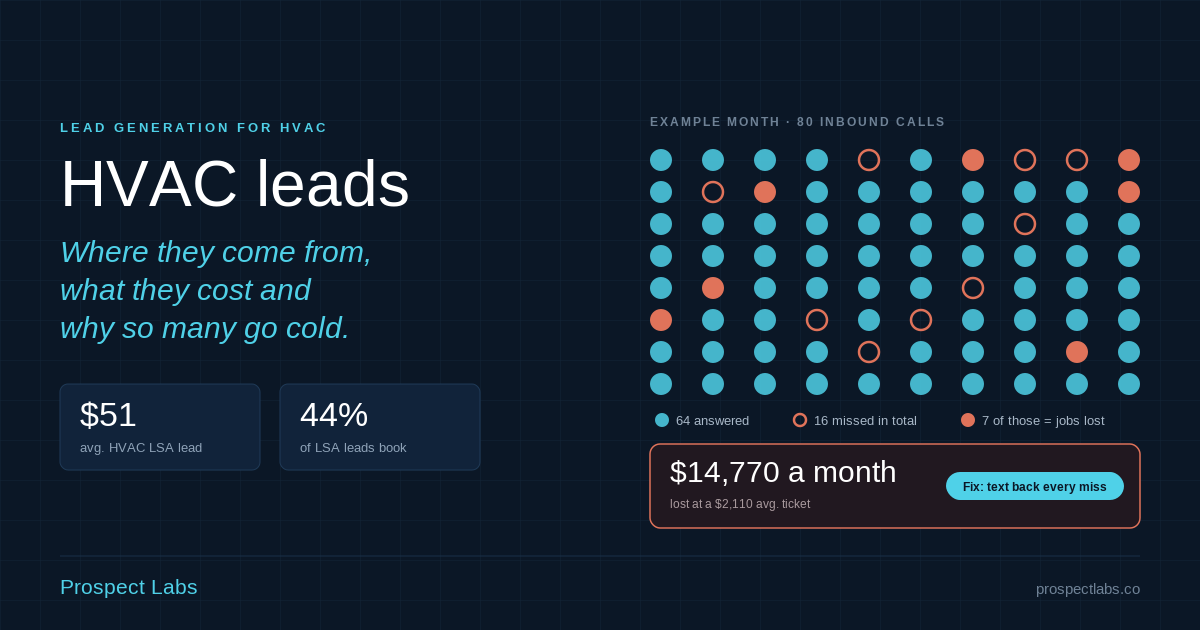
Here’s simple arithmetic on example numbers. Swap in your own.
| Example | Number |
|---|---|
| Inbound calls a month | 80 |
| Share missed while techs are on jobs | 20% |
| Missed calls a month | 16 |
| Booking rate if answered (SearchLight’s HVAC LSA figure) | 44% |
| Jobs lost a month | About 7 |
| Revenue at a $2,110 average ticket | About $14,770 a month |
That’s revenue already in reach, from leads you already paid for, before a single extra ad dollar. Your exact numbers will differ, but the pattern holds for almost every HVAC company we talk to.
It also costs you directly. According to Isoline Growth’s guide, since October 1, 2026, Google bills Local Services Ads missed calls during business hours once the caller stays on longer than 20 seconds. A missed call can now cost you the lead fee and the job.
The fix is speed, built into a system:
- Missed call text back. Every missed call gets a text in your business name within seconds, so the homeowner hears from you before they dial the next company.
- One tap texting on your website. Many homeowners would rather text a photo of the outdoor unit than wait on hold.
- Automatic follow up. Replacement leads compare quotes for weeks. A sequence of follow ups keeps you in the conversation without you chasing.
- One inbox. Calls, texts, website messages and social DMs land in one place on your phone.
How Do You Turn Past Customers Into Your Cheapest HVAC Leads?
Your cheapest HVAC leads are past customers and maintenance plan members. They already trust you, they don’t need to be outbid for on Google, and they return for repairs and replacements. A maintenance plan, review requests and seasonal reminders turn one job into years of work.
Maintenance agreements. Two visits a year keep you in the home. When the 15 year old furnace finally fails, the plan member calls you first, not Google.
Reviews after every job. Fresh reviews raise your map pack ranking and your Local Services Ads ranking, which lowers what every future lead costs you. A one click review request with a reminder does the asking for you.
Referral and return customer campaigns. A short text to past customers before each season, or a referral thank you, turns your customer list into a lead source you don’t pay per lead for.
What Are the Most Common HVAC Lead Generation Mistakes?
The most common HVAC lead generation mistakes are judging sources by cost per lead instead of cost per booked job, relying on shared leads, missing calls during peak season, ignoring past customers, and sending ad traffic to a slow website with no text option.
| Mistake | What it costs you | The fix |
|---|---|---|
| Tracking cost per lead only | You keep paying for leads that never book | Track cost per booked job by source |
| Living on shared leads | Price wars and low close rates | Build exclusive sources: LSA, SEO, referrals |
| Missed calls in peak season | Paid leads go to competitors | Missed call text back and a shared inbox |
| No follow up on replacement quotes | Big tickets go to whoever followed up | Automatic follow up sequences |
| Ignoring past customers | Your cheapest leads go unused | Maintenance plans and seasonal campaigns |
| Slow, form only website | Ad clicks bounce before calling | Fast mobile site with tap to call and text |
| Old reviews | Lower LSA and map rankings | A review request after every job |
How Do You Get More HVAC Leads Without Raising Your Ad Budget?
To get more HVAC leads without spending more, stop losing the ones you already get. Answer or text back every missed call, follow up on every quote, ask every customer for a review, and market to your past customers before buying new ones.
At Prospect Labs, we build the marketing system for contractors that does exactly that: a fast HVAC website, missed call text back, automated follow up, a 5 star review funnel, one click referral campaigns and local SEO, all on one phone. It’s the same problem other trades face, as we cover in our guides on plumbing leads and electrician leads.
If you’re comparing providers, our guide to choosing a contractor marketing agency lists the questions to ask before you sign anything. And if your scheduling software is part of the problem, see our roundup of Jobber alternatives.
Ready to Stop Losing HVAC Leads You Already Paid For?
Your next AC replacement is already calling. The question is whether someone answers.
We build website design and marketing systems for contractors at a flat monthly price, month to month, with no long term contract. You can see examples on our work page.
Book a strategy call and we’ll look at your site, your reviews and how missed calls are handled today. If it isn’t a fit, we’ll tell you straight.
FAQs
How much do HVAC leads cost?
In early 2026, HVAC Local Services Ads averaged about $51 per lead and non branded Google search leads for HVAC and plumbing averaged about $149. Costs rise in big metros and peak season. Judge every source by cost per booked job, not cost per lead.
What is the best source of HVAC leads?
For most residential HVAC companies, Google Local Services Ads bring the fastest exclusive leads, while local SEO, reviews and maintenance plan customers bring the cheapest leads over time. The best mix uses paid leads while building owned sources.
Are bought HVAC leads worth it?
Bought leads can fill gaps in slow weeks, but shared leads often go to several companies at once, which lowers close rates and pushes prices down. Exclusive leads usually cost more per lead and less per booked job.
What is a good booking rate for HVAC leads?
SearchLight’s February 2026 benchmark found 44% of HVAC Local Services Ads leads booked. Your rate depends heavily on how fast you answer and follow up, so missed calls pull it down quickly.
How do I get HVAC leads in the slow season?
Market to people who already know you. Send tune up reminders, promote maintenance plans and replacement financing, and ask for referrals. Past customers respond far better than cold audiences and cost almost nothing to reach.
How fast should I respond to an HVAC lead?
As fast as possible, ideally within minutes. Homeowners with no heat or no AC usually call the next company if nobody answers. A missed call text back buys you time while you finish the job you’re on.
Do I need a website if I run Local Services Ads?
Yes. Many homeowners click through to check your website and reviews before calling. A fast site with clear services and a text option turns more of those ad views into booked calls.