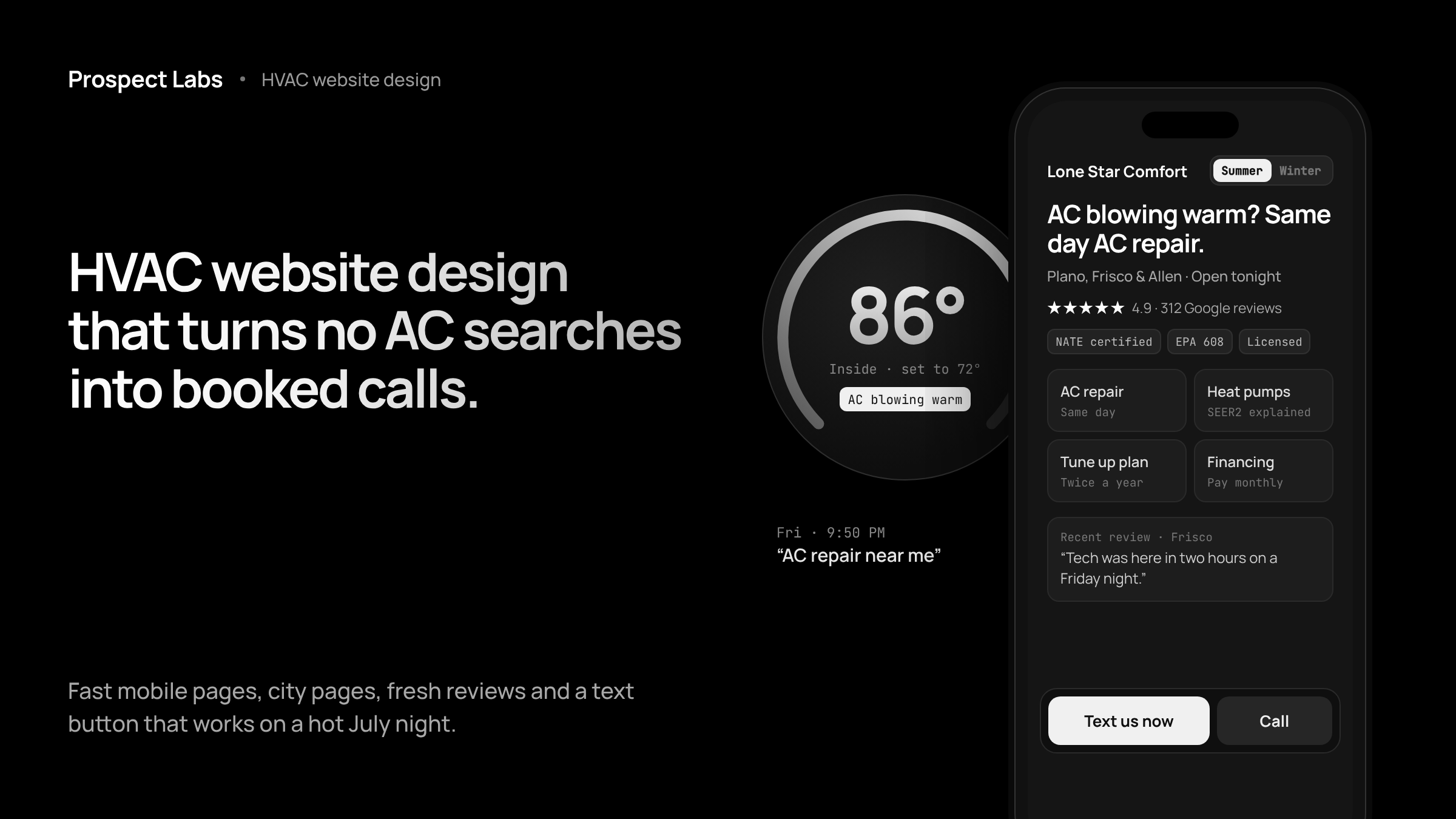

It’s 9:50 on a Friday night in July. The thermostat in the hallway reads 86 degrees, the AC is blowing warm air, and there’s a toddler who won’t sleep. The homeowner grabs a phone and types “AC repair near me.”
Three HVAC companies come up. The first site takes forever to load. The second one has a contact form that promises a reply “within one business day.” The third site loads in a blink, shows “Same day AC repair in your town” at the top, has 312 Google reviews, and a button that says “Text us now.”
You already know who gets that job. The only question is whether it’s you.
That is what HVAC website design really comes down to. Not colors. Not a fancy logo animation. Whether your site turns a sweaty, worried homeowner into a booked call before they hit the back button.
Quick answer: HVAC website design is the planning and build of a heating and cooling company’s website so it loads fast on a phone, shows exactly which services and towns you cover, proves you can be trusted, and turns an urgent search into a call or text in seconds, even after hours.
Below, we walk through what a high converting HVAC website needs, page by page, season by season, with real numbers behind each decision. If you serve more than one trade, our guide to contractor website design covers the shared basics.
What Is HVAC Website Design?
HVAC website design is building a heating, ventilation and air conditioning company’s site around one job: getting homeowners and property managers to call, text or book. It combines mobile layout, service and city pages, trust proof, local SEO and the systems that respond when you can’t.
A general web designer builds a site that looks good. An HVAC website has to do more. It has to handle a panicked “no heat” search at 2 AM in January, a planned heat pump replacement in April, and a $89 tune up offer in September. Those are three different buyers with three different moods, and the site has to serve all of them.
Why Does Your HVAC Website Matter More Than It Did Five Years Ago?
Your website matters more because homeowners now check you out online before they ever pick up the phone, and they decide fast. Reviews, speed and a clear next step settle most of the decision before you know the lead exists.
Here are the numbers HVAC owners should know right now:
| What’s changed | The figure | Source |
|---|---|---|
| Consumers who read reviews for local businesses | 97% | BrightLocal, 2026 |
| Consumers who won’t use a business with fewer than 20 reviews | 47% | BrightLocal, 2026 |
| Consumers who only care about reviews from the last 3 months | 74% | BrightLocal, 2026 |
| Consumers who now require 4.5 stars or higher | 31% (up from 17% a year earlier) | BrightLocal, 2026 |
| Share of local business discovery happening through AI tools | 45% (up from 6% a year earlier) | BrightLocal via Digital Applied |
| Mobile visits abandoned when a page takes over 3 seconds | 53% | Google via Marketing Dive |
| Heat pumps shipped in the US in 2025 vs gas furnaces | 3.64 million vs 3.25 million | AHRI via ACHR News |
| HVAC technician jobs in the US (2024) | About 425,200 | US Bureau of Labor Statistics |
Read that table as an HVAC owner and three things jump out. Homeowners judge you on recent reviews, not old ones. Slow sites lose half their mobile visitors before the page even shows up. And more people are now asking ChatGPT or Google’s AI answers which HVAC company to call, which means your site has to be clear enough for a machine to recommend you too.
What Should an HVAC Website Include?
A high converting HVAC website includes a fast mobile layout, a tap to call and text button on every screen, separate service pages, separate service area pages, visible licenses and certifications, fresh reviews, financing and maintenance plan details, and an after hours path for emergencies.
Here’s what each piece does for you.
A top of page that answers three questions in three seconds. What do you fix, where do you work, and how fast can someone reach you? “Heating and AC repair in Plano and Frisco. Same day service. Text or call now.” That’s it. Leave the mission statement for the About page.
Tap to call and tap to text, always visible. On a phone, the button should stick to the bottom of the screen while the visitor scrolls. Plenty of homeowners would rather text than talk, especially at night or at work. Give them both options.
Trust proof placed near the buttons, not buried in the footer. HVAC buyers are letting a stranger into their home and spending real money. Show your state license number, NATE certified technicians, EPA Section 608 certification, and your manufacturer dealer status if you hold one, such as a Carrier Factory Authorized Dealer, Trane Comfort Specialist or Lennox Premier Dealer. Add your Google rating and review count right beside the main button.
Real photos of your trucks, your team and your work. Stock photos of a smiling model holding a wrench make you look like everyone else. A photo of your tech in a branded shirt next to a new condenser does more selling than any headline.
Financing and maintenance plans in plain view. A new system can run into five figures, so financing removes the biggest objection. A maintenance plan or membership page turns one time customers into recurring revenue and keeps your calendar full in the slow months.
An emergency path. If you offer 24/7 service, say it at the top and give it its own page. If you don’t, tell people what happens after hours, for example “Text us tonight and we’ll call first thing at 7 AM.” Silence is what sends them to a competitor.
Which Pages Does an HVAC Website Need?
An HVAC website needs one page per core service and one page per city or area you serve, plus a homepage, emergency page, reviews page, financing page, maintenance plan page, about page and contact page. Separate pages let Google match each search to the exact service and town.
| Page | What it answers for the homeowner | Searches it can rank for |
|---|---|---|
| Homepage | Who are you, where do you work, how do I reach you? | HVAC company + city |
| AC repair | Can you fix my AC today? | AC repair near me, AC not cooling |
| Furnace repair | Can you get my heat back on? | furnace repair, no heat repair |
| Heat pump installation | Should I switch, and what will I save? | heat pump installation, heat pump vs furnace |
| AC and furnace replacement | Is it time to replace, and what are my options? | AC replacement, new furnace cost |
| Ductless mini split | Can you cool the bonus room or garage? | mini split installation |
| Indoor air quality | Can you help with allergies, dust or humidity? | air purifier installation, duct cleaning |
| Maintenance plan | What do I get for joining? | HVAC maintenance plan, AC tune up |
| Emergency service | Will someone come tonight? | emergency HVAC repair, 24 hour AC repair |
| Service area pages (one per town) | Do you actually work in my town? | AC repair + town name |
| Financing | Can I pay monthly? | HVAC financing |
| Reviews | Do people like working with you? | HVAC company reviews + city |
Service area pages are where most HVAC sites cut corners. Copying one page and swapping the town name doesn’t fool Google or homeowners. Write about local details: the neighborhoods you cover, the typical age of homes there, common problems like older ductwork or heat pumps that struggle in cold snaps, and a review from a customer in that town.
We use the same page by page structure in our roofing website design guide, and the logic carries over to every trade.
How Should HVAC Website Design Change With the Seasons?
HVAC website design should shift with the weather: cooling repair and AC tune ups up front in late spring and summer, heating repair and furnace safety checks in fall and winter, and replacements, heat pumps and maintenance plans in the shoulder months when homeowners plan ahead.
HVAC demand swings harder with the calendar than almost any other trade. A site that shows a snowflake banner in August looks abandoned. Plan your homepage hero, offers and blog topics around the season.
| Season | What homeowners search | What your homepage should lead with |
|---|---|---|
| Spring (Mar to May) | AC tune up, heat pump installation, new AC cost | Cooling tune up offer, heat pump and replacement options, financing |
| Summer (Jun to Aug) | AC not cooling, AC repair near me, emergency AC repair | Same day AC repair, after hours text option, live review count |
| Fall (Sep to Nov) | furnace tune up, heat not working, carbon monoxide check | Heating safety check, maintenance plan signup |
| Winter (Dec to Feb) | no heat, furnace repair, frozen heat pump | Emergency heating repair, “Text us now” button, response promise |
This is also where the slow months get filled. A maintenance plan banner in the shoulder seasons, plus a reminder to past customers, can keep your techs busy when the phone would normally go quiet.
How Do You Design an HVAC Website for Heat Pump and Energy Efficiency Searches?
To win heat pump and efficiency searches, give heat pumps their own pages, explain SEER2 ratings in plain English, compare heat pumps with furnaces and dual fuel setups, and point homeowners to current rebates and utility incentives in their area.
The market has moved. According to AHRI data reported by ACHR News, US factories shipped 3.64 million heat pumps in 2025 against 3.25 million gas furnaces. By mid 2026, ACHR News reported heat pumps were nearing half of all combined AC and heat pump shipments.
Homeowners researching this switch are not in a hurry. They read, compare and come back. That makes them perfect for content that builds trust before the sales visit. A strong HVAC website covers:
- Heat pump vs furnace vs dual fuel, with honest pros and cons for your climate
- SEER2, HSPF2 and AFUE explained in one sentence each, so buyers understand the labels on the equipment
- ENERGY STAR equipment and what it means for monthly bills
- Local rebates and utility programs, linked to the official source so the numbers stay accurate
- The refrigerant transition that affects newer equipment, explained without scaring anyone
Keep incentive details on one page you update regularly. Programs change, and a stale rebate figure costs you credibility.
How Does an HVAC Website Rank on Google and AI Search?
An HVAC website ranks by matching each service and town with its own page, loading fast on mobile, using LocalBusiness or HVACBusiness schema, staying consistent with your Google Business Profile, and earning a steady flow of fresh reviews. AI tools pull from the same signals.
Local SEO for HVAC companies comes down to a few things done well and done consistently:
- Your Google Business Profile matches your website. Same business name, phone number, address or service area, hours and categories. Mismatches confuse Google.
- One page per service, one page per town. Covered above. This is the single biggest ranking lever most HVAC sites ignore.
- Speed. Google’s “good” threshold for Largest Contentful Paint is 2.5 seconds. Compress your photos, skip the autoplay video header, and test on a real phone.
- Structured data. LocalBusiness or HVACBusiness schema tells search engines exactly what you do and where. Add FAQ schema to service pages that answer common questions.
- Reviews that keep coming. Since 74% of consumers only care about reviews from the last three months, ten reviews this quarter beat a hundred from 2022.
- Clear, quotable answers. AI tools like ChatGPT and Google’s AI answers recommend businesses whose sites explain clearly what they do, where, and for whom. Short, direct answers at the top of each page help both people and machines.
If you also run Local Services Ads, your website still matters. Homeowners often click through to check you out before they call, so the ad gets the attention and the site closes the deal.
What Happens After Someone Lands on Your HVAC Website?
After a homeowner lands on your site, the best HVAC websites capture the lead with a one tap text, reply instantly when a call is missed, follow up automatically until the job is booked, and ask for a review once the work is done.
This is the part almost every HVAC website design article skips. A beautiful site that sends leads into a voicemail box nobody checks until Monday is still losing jobs.
Here’s how the full journey should work:
- Found. The homeowner finds you on Google, in the map pack or through an AI answer.
- Visit. Your site loads fast and answers their question in seconds.
- Capture. They tap to text or call. The message lands on your phone.
- Respond. If you’re on a roof or under a house, a missed call text back goes out in your business name right away.
- Follow up. If the lead goes quiet, automatic follow up messages keep the conversation alive.
- Book. The job gets scheduled.
- Grow. After the job, a review request goes out, and a maintenance reminder brings them back next season.
That’s the marketing system for contractors we build at Prospect Labs, with the website as stage two of seven. Plumbers face the exact same problem with after hours emergencies, which we break down in our guide on how to get more plumbing leads.
What Are the Most Common HVAC Website Mistakes?
The most common HVAC website mistakes are slow mobile pages, a phone number hidden at the bottom, one generic services page, copied city pages, stock photos, old reviews, no texting option, and no response when calls are missed.
| Mistake | What it costs you | The fix |
|---|---|---|
| Slow mobile pages | Visitors leave before the page appears | Compress images, drop heavy sliders, test on a phone |
| Phone number only in the footer | People can’t find a fast way to reach you | Sticky tap to call and text bar on every screen |
| One page listing every service | Google can’t match you to specific searches | A dedicated page for each core service |
| Town name swapped into identical pages | Weak rankings and zero local trust | Real local details and local reviews on every area page |
| Stock photos | You look like every other company | Your own team, trucks and installs |
| Reviews from years ago | Buyers assume quality has slipped | A review request after every job |
| Contact form that replies “within one business day” | The homeowner hires whoever answers first | Instant text reply and automatic follow up |
| No after hours message | Night and weekend emergencies go elsewhere | A clear after hours promise and text option |
How Do You Choose an HVAC Website Designer?
Choose an HVAC website designer who understands home service buyers, builds mobile first, sets up local SEO from day one, can show live contractor sites, and handles what happens after the click: missed calls, follow ups and reviews. Ask who maintains the site after launch.
Most HVAC owners end up choosing between four options:
| Option | What you get | What’s usually missing |
|---|---|---|
| DIY website builder | Low effort to start, full control | Local SEO structure, speed tuning, your time |
| Freelance web designer | A good looking site, handed over | Ongoing updates, lead capture, follow up |
| Large marketing agency | Ads, SEO and content under one roof | Simple setup, contracts you can walk away from |
| A contractor marketing system | Website plus missed call text back, follow up, reviews and local SEO, maintained for you | Fit depends on your market and how you run your business |
Before you sign with anyone, ask these questions:
- Can I see live HVAC or home service sites you’ve built?
- Will I own my domain and content if I leave?
- Who updates the site after launch, and how fast?
- What happens when someone visits at 10 PM and I don’t answer?
- How will I see which calls and texts came from the website?
You can see examples of sites we’ve built for trades on our work page, and the full list of trades we serve, from HVAC and plumbing to roofing and remodeling. Remodelers deal with a much longer buying cycle, which we cover in remodeling marketing.
Ready to See What Your HVAC Website Is Missing?
Your next AC repair or furnace replacement is already searching for you. The question is whether your website starts the conversation or sends that homeowner to the next name on Google.
At Prospect Labs, we build website design and marketing systems for contractors that keep selling while you’re on the job. On a short call, we’ll look at your current site, your reviews and how missed calls are handled today, and show you a free design preview. If it isn’t a fit, we’ll tell you straight.
Book a strategy call or see how it works first.
HVAC Website Design FAQs
What makes a good HVAC website?
A good HVAC website loads fast on a phone, shows your services and service area right away, puts tap to call and text buttons on every screen, displays recent reviews and certifications, and responds to leads automatically when you can’t pick up.
How many pages should an HVAC website have?
Most HVAC websites need at least one page for each core service, such as AC repair, furnace repair and heat pump installation, plus one page for each main town you serve. Add a homepage, emergency page, financing page, maintenance plan page, reviews page and contact page.
Do HVAC companies really need service area pages?
Yes, if you want to show up in more than one town. A single homepage can’t rank for every city. Each service area page should include local details and local reviews, not just a swapped town name.
Should my HVAC website let customers text me?
Yes. Many homeowners prefer texting, especially at night or during work hours. A one tap text button that lands on your phone captures leads who would never fill out a form or leave a voicemail.
How do reviews affect my HVAC website?
Reviews shape both rankings and decisions. BrightLocal’s 2026 survey found 97% of consumers read reviews for local businesses, and 74% only care about reviews from the last three months, so a steady flow of new reviews matters more than a big old total.
Can I build an HVAC website on Wix or Squarespace?
You can, and it’s a reasonable start for a brand new company. The trade off is your time, plus the local SEO structure, speed tuning and lead follow up you’ll need to set up yourself to compete with established HVAC companies in your area.
How long does it take for an HVAC website to rank on Google?
It depends on your local competition, how long your domain has been live, your Google Business Profile and your review count. SEO builds over months, not days, which is why a site that converts the traffic you already get matters from the first week.