
It’s 4:40 on a Thursday afternoon. A hailstorm rolled through an hour ago, and a homeowner is standing in the driveway looking at dented gutters and shingle granules scattered across the concrete. They pull out their phone and search “roof inspection after hail.” Six roofing companies show up. They open three.
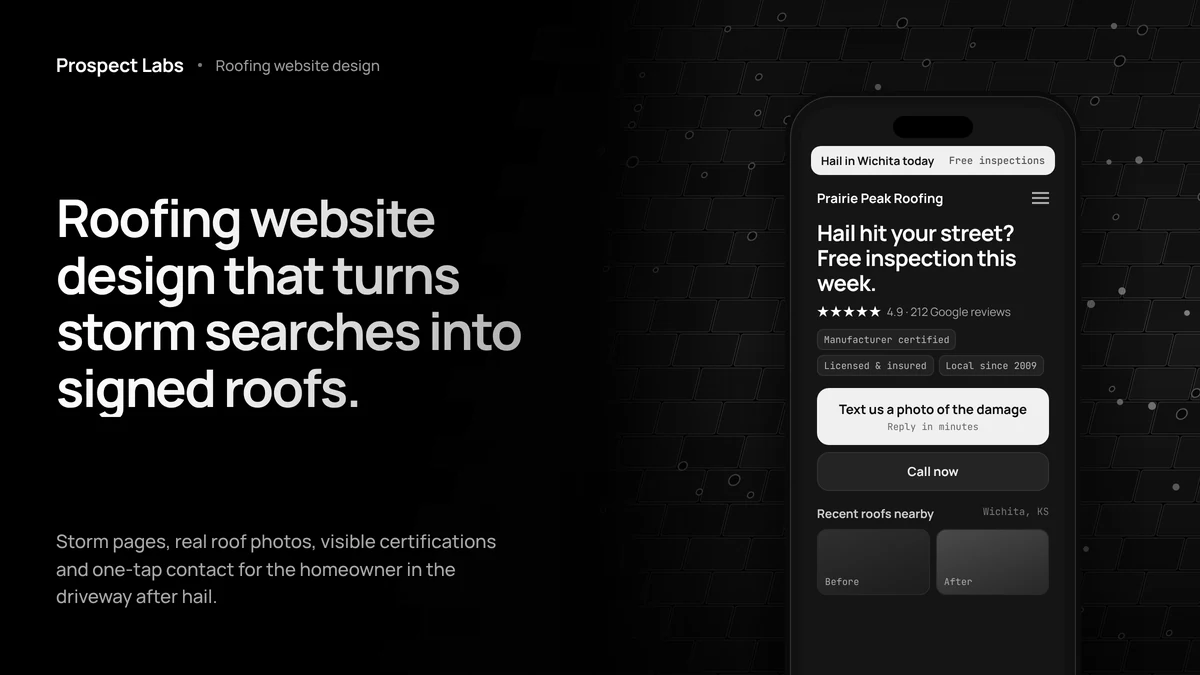
The first site is a single page with a logo, a stock photo of a shingle bundle and a contact form with eleven fields. The second takes so long to load that they give up. The third opens with “Hail hit your street? Free inspection this week,” shows real roofs from nearby neighborhoods, displays a GAF certification badge and has a button that says “Text us a photo of the damage.” They tap it.
That roofer didn’t win the job because they’re the best installer in Kansas. They won it because their website answered three questions before anyone else’s did: can you help, can I trust you, and how fast can I reach you.
Quick answer: Roofing website design is building a site that gets a roofing company found on Google, proves it can be trusted with a five figure job, and turns a worried homeowner into a booked inspection, using dedicated service pages, real roof photos, certifications and one tap contact.
This guide covers what a roofing website needs that a general trade site doesn’t: storm and insurance content, the trust signals homeowners check before letting a crew onto their roof, the numbers behind all of it, and a quick way to tell whether your current site is pulling its weight. For the foundations that apply to every trade, start with our guide to contractor website design.
What Is Roofing Website Design?
Roofing website design is web design shaped around how people actually buy a roof. A roof is a rare, expensive purchase that is often triggered by a storm and tied to an insurance claim. So the site has two jobs at once: respond fast while the damage is fresh, and build enough confidence for a decision that can cost more than a new car.
Here’s how a roofing website differs from a typical contractor site:
| Typical contractor site | Roofing website | |
|---|---|---|
| Buying moment | An ongoing need or a small emergency | A storm, an aging roof, a leak or a home sale |
| Average ticket | Hundreds to a few thousand dollars | $17,631 average replacement in 2025 (Verisk) |
| The big question | Can you come soon? | Can I trust you on my roof and with my insurance claim? |
| Proof that matters | Reviews and job photos | Reviews, manufacturer certifications, warranties, before and after roof photos |
| Demand pattern | Fairly steady | Sharp spikes after hail and wind events |
| Must have pages | Services and service areas | Repair, replacement, storm damage, insurance, inspections, materials, areas |
Why Does Website Design Matter So Much for Roofing Companies?
Because a roof is expensive, infrequent and urgent all at once, so homeowners vet roofers harder than almost any other trade. Word of mouth still leads the way, but even a referred homeowner checks your website and reviews before picking up the phone. These numbers show how much is riding on that first impression:
| What the data shows | The number | Source |
|---|---|---|
| Average US residential roof replacement cost in 2025 | $17,631 | Verisk 2026 U.S. Roof Report |
| Average roof repair cost in 2025 | $4,699 | Verisk 2026 U.S. Roof Report |
| Rise in replacement cost versus the prior four year average | 33% | Verisk, via Carrier Management |
| Homeowner hail damage claims filed in 2025 | 835,058 | Verisk, via Leader’s Edge |
| US homes with roofs in moderate to poor condition | 38% | Verisk, via Roofing Contractor |
| Homeowners who find a roofer through a personal recommendation | 74% | Roofing Contractor Homeowner Survey, 2026 |
| Homeowners who use search engines to find a roofer | 50% | Roofing Contractor Homeowner Survey, 2026 |
| Homeowners who rate online reviews very or extremely important | 62% | Roofing Contractor Homeowner Survey, 2026 |
| Mobile visitors who leave a site that takes over 3 seconds to load | 53% |
Read that table from the homeowner’s side. They’re about to spend more than $17,000 with someone they’ve probably never met, often right after a storm, when trucks with ladder racks are knocking on every door in the neighborhood. Your website is where they decide whether you’re a local pro or a storm chaser who will be gone by next spring.
Roofr’s marketing team puts it bluntly: 80% of millennials decide whether to hire a roofer from the website alone, before they ever reach out. A referral gets you the visit. The website decides whether that visit turns into a call.
What Pages Does a Roofing Website Need?
A roofing website needs a homepage, separate pages for roof repair, roof replacement, storm and hail damage, insurance claims and inspections, a page for each roofing material you install, plus service area pages, a project gallery with reviews, an about page and a contact page.
| Page | The homeowner’s question | What it must include |
|---|---|---|
| Homepage | “Are you local and legit?” | Service area, star rating, certifications and an inspection offer above the fold |
| Roof repair | “Can you just fix the leak?” | Common repairs, response time, photos of real fixes, emergency tarping |
| Roof replacement | “What does a new roof involve?” | Process, timeline, materials, typical price ranges, financing, warranties |
| Storm and hail damage | “Is my roof actually damaged?” | Signs of hail and wind damage, what to do first, free inspection offer |
| Insurance claims | “Will you help with my claim?” | How claims work, meeting the adjuster, photo documentation, timelines |
| Roofing materials | “Which roof is right for my home?” | Asphalt shingle, metal, tile and flat roofing, with pros, cons and lifespans |
| Commercial roofing | “Can you handle my building?” | TPO, EPDM and coating systems, maintenance plans, project examples |
| Service area pages | “Do you work in my town?” | Local jobs, local weather risks, neighborhood photos, local reviews |
| Reviews and gallery | “Is your work any good?” | Before and after photos, drone shots, Google reviews, short project stories |
| About | “Who will be on my roof?” | Owner photo, years in business, license, insurance, crew photos |
| Contact | “How fast can I reach you?” | Tap to call, tap to text, a short form, hours and a response time promise |
The page most roofers skip is insurance, and it’s one of the most valuable. Homeowners type full questions into Google and AI assistants, like “will insurance cover my roof after hail” or “should I call a roofer before the adjuster comes.” A clear page that answers those questions builds trust with the homeowner and gives search engines something specific to show.
Material pages work the same way. Someone comparing a metal roof to architectural shingles is close to buying. Give them straight answers on lifespan and tradeoffs, and you become the expert they call:
| Roofing material | Typical lifespan | What your material page should cover |
|---|---|---|
| Asphalt shingles | 20 to 30 years | 3 tab versus architectural, color options, impact rated shingles for hail zones |
| Metal roofing | 40 to 70 years | Standing seam versus exposed fastener, noise myths, energy savings |
| Clay or concrete tile | 50 years or more | Weight and structure checks, climate fit, repair versus replacement |
| Flat and low slope (TPO, EPDM) | 20 to 30 years | Ponding water, coatings, maintenance plans for commercial owners |
Separate service and area pages are also the backbone of local SEO for contractors. They’re the reason one roofer shows up for “hail damage roof repair” in six suburbs while another shows up nowhere.
How Should a Roofing Website Handle Storm Season?
A roofing website should be storm ready before the storm arrives. That means a storm damage page already live, an inspection offer you can switch on within an hour, and contact options that catch every lead when calls jump. After hail, the roofer who answers first usually gets the inspection.
Storms aren’t rare events anymore. The US saw 142 days of damaging hail in 2025, well above the 20 year average of 122, and sixteen states had severe hail hit more than 20% of their roofs, led by Arkansas, Kansas, Nebraska, Oklahoma and South Dakota. In Texas alone, more than 235,000 homes took damaging hail last year.
Here’s what a storm ready roofing website includes:
- A storm banner you control. A simple strip at the top of every page: “Storm damage in Johnson County? Free inspections this week.” Turn it on the morning after, turn it off when the rush ends.
- A “text us a photo” option. Homeowners can send pictures of dented gutters or missing shingles in seconds, and you can triage before you roll a truck.
- A plain English guide to what happens next. Walk them through inspection, documentation, the adjuster visit and the build. People who understand the process trust the person who explained it.
- Proof you’re local. Your office address, years in your city and photos of roofs on streets they recognize. This is the single biggest difference between you and an out of state storm chaser.
- A plan for missed calls. Call volume can multiply overnight. If your phone rings out while you’re on a roof, an automatic text back keeps that homeowner from calling the next name on Google.
One more thing: only build storm pages for places you actually work. Chasing storms in states you don’t serve with thin pages can hurt your rankings and your reputation.
What Trust Signals Do Homeowners Look for on a Roofing Website?
Homeowners look for proof that you’re licensed, insured, certified by the shingle manufacturer, local and well reviewed by recent customers. On a roofing site, those signals need to sit where people make decisions, not hidden in the footer.
| Trust signal | Why it matters to a homeowner | Where to show it |
|---|---|---|
| License number | Shows you’re registered where your state or city requires it | Footer, about page, replacement page |
| Liability and workers’ comp insurance | Protects the homeowner if someone gets hurt on their roof | About page and contact page |
| Manufacturer certifications | GAF Master Elite, Owens Corning Platinum Preferred or CertainTeed SELECT ShingleMaster status unlocks stronger warranties | Homepage, replacement and material pages |
| Warranty details | Explains both workmanship and manufacturer coverage in plain terms | Replacement page and quotes |
| Recent Google reviews | 62% of homeowners call reviews very or extremely important | Homepage and every service page |
| Before and after photos | Proves the work is real and recent | Gallery, service pages, area pages |
| Financing options | Turns a $17,000 decision into a manageable monthly payment | Replacement page and homepage |
Reviews deserve extra attention because roofing jobs are infrequent. A roofer who finishes 15 replacements a month and never asks for feedback will look smaller online than a competitor doing half the volume who asks every single customer. Our guide on how to get more Google reviews covers how to keep them flowing without awkward conversations in the driveway.
How Do Roofing Websites Turn Visitors Into Inspections?
By making the next step small and obvious. Most homeowners won’t sign for a new roof on their first visit, but they will book a free inspection or text a photo. Lead with that low commitment offer on every page, and make it possible in one tap.
Lead with the inspection, not the logo. “Free roof inspection, usually within 48 hours. Serving Tulsa and Broken Arrow.” That one line tells them what you do, where you work and what happens next.
Talk about price before they ask. Roofing Contractor’s 2026 homeowner research found that transparent pricing makes homeowners noticeably more likely to reach out. You don’t need exact quotes. Share typical ranges, explain what moves the price (roof size, pitch, material, layers to tear off) and point to financing.
Show the monthly number. A $17,600 roof spread over ten years is roughly $147 a month before interest. Framing it that way on your replacement page helps a homeowner picture yes instead of sticker shock.
Give them three ways in. Tap to call, tap to text and a short form asking for name, phone, address and the problem. Many homeowners spot damage after work hours and would rather text than leave a voicemail.
Use your own photos. Drone shots of finished roofs, close ups of flashing and ridge vents, your crew in branded shirts. Phone photos of real jobs beat polished stock images every time.
Want to see how these pieces come together on finished builds? Browse our roofing website examples.
How Fast Should a Roofing Website Load?
A roofing website should load in under three seconds on a phone, because 53% of mobile visitors leave once it takes longer. Roofing sites are especially at risk because they’re full of large project galleries, drone footage and before and after sliders.
The fixes are simple: compress every photo and serve modern formats like WebP, load galleries only when someone scrolls to them, skip autoplay video on mobile and build for the phone screen first. Remember that a homeowner checking storm damage is often standing outside on cellular data. We break down the exact speed targets in our contractor website design guide.
Does Roofing Website Design Affect Local SEO?
Yes. Your site structure tells Google what you do and where you do it. Dedicated pages for each roofing service and town, consistent business details, fast pages and real reviews all strengthen the signals that decide who shows up when someone nearby searches for a roofer.
Your website and your Google Business Profile work as a pair. The profile gets you into the map results, and the website backs it up with depth. That link is missing more often than you’d think: one analysis of 89,519 roofing profiles found 31.4% had no website linked at all. Every one of those is a free win for a competitor who has one.
A few roofing specific SEO details worth getting right:
- RoofingContractor schema. Schema.org has a dedicated RoofingContractor business type. Adding it with your name, address, phone, service area and hours helps search engines read your site correctly.
- Question based headings. Homeowners now ask long, specific questions like “why is my roof leaking around the chimney.” Pages and FAQs that answer those questions directly are more likely to appear in Google’s AI results and assistants like ChatGPT.
- Matching details everywhere. Your business name, phone number and service areas should match on your site, your Google profile and directories like the BBB and your manufacturer’s contractor locator.
Design alone won’t carry your rankings. Competition, review volume and how long your site has been live all matter. We cover the full picture in our guide to local SEO for roofers and other contractors.
What Happens After a Homeowner Lands on Your Roofing Website?
This is where most roofing websites quietly fail. The design can be perfect, but if the homeowner calls while your crew is tearing off a roof across town and nobody answers, that inspection goes to whoever picks up next.
Speed matters more than polish here. In the Harvard Business Review research on lead response, companies that followed up within an hour were nearly seven times more likely to qualify the lead than those that waited longer. Roofing adds a second challenge: replacement decisions can take weeks while homeowners wait on adjusters, compare quotes and talk it over at the kitchen table.
A roofing website that actually wins jobs needs a system behind it:
- Missed call text back, so every unanswered call gets an instant text in your business name.
- Automated follow up, so a quote sitting on the kitchen counter doesn’t go cold while the homeowner waits on their insurance company.
- Review requests after every job, so your star rating keeps growing between storm seasons.
- Neighbor and referral campaigns, because a finished roof is a billboard for the whole street. Our guide to referral marketing for contractors shows how to turn one happy homeowner into the next three jobs on the block.
That’s the difference between a website and a website and marketing system built for roofers. A website waits. A system keeps the conversation going while you’re up on the ridge. For the bigger picture on how these channels connect, read our guide to home service marketing.
What Are the Most Common Roofing Website Mistakes?
The most common roofing website mistakes all make a homeowner work harder to trust you or reach you. We see these on roofer sites every week:
- One page for every service. “We do repairs, replacements, gutters and siding” won’t rank for any of them.
- Nothing about insurance. If you help with claims, say so clearly. It’s often the deciding factor after a storm.
- Certifications hidden or missing. A manufacturer badge in the footer does far less than one next to your replacement offer.
- Stock photos of roofs you didn’t build. Homeowners can tell, and it makes you look like a lead broker.
- No storm plan. If your site looks the same the morning after a hailstorm as it did the week before, you’re leaving inspections on the table.
- Long forms. Name, phone, address and the problem is enough to book an inspection.
- Zero pricing guidance. No ranges, no financing, no explanation of what drives cost. Homeowners fill that silence with the worst number they can imagine.
- A site that hasn’t changed since last storm season. Old photos and outdated offers suggest you may not be around to honor a 25 year warranty.
How Do You Know If Your Roofing Website Is Working?
Your roofing website is working if it produces a steady flow of inspection requests, calls and texts that you can trace back to it, and if that flow climbs after storms instead of overwhelming you. Run through this quick check:
☐ It loads in under three seconds on your own phone, on cellular data.
☐ Your service area, star rating and phone number show without scrolling.
☐ A homeowner can call or text you in one tap.
☐ Repair, replacement, storm damage and insurance each have their own page.
☐ Your main towns have their own pages with real local photos.
☐ Your manufacturer certifications appear near your replacement offer.
☐ You show typical price ranges and financing options.
☐ You can launch a storm banner and inspection offer within an hour.
☐ Missed calls get an automatic text reply.
☐ Every finished roof gets a review request.
If you ticked fewer than seven, your site is probably losing inspections you never hear about.
Roofing Website Design FAQs
How much does a roofing website cost?
A roofing website can cost a few hundred dollars a year with a DIY builder, a few thousand with a freelancer, or $10,000 to $25,000 for a custom agency build. Ongoing updates, SEO and lead follow up often cost extra. Prospect Labs offers a full website and marketing system with pricing from $297 per month plus a one time setup fee.
How long does it take to build a roofing website?
A straightforward roofing website can go live in one to two weeks, while custom agency builds often take two to three months. Timing mostly depends on how many service and area pages you need and how quickly you send photos and details. Prospect Labs launches most builds in 7 to 10 days.
Should a roofing website show prices?
Yes, as ranges rather than fixed quotes. Every roof is different, but sharing typical costs, explaining what affects price and showing financing options builds trust and filters out poor fit leads before you spend time on an inspection.
Does a roofing company need separate pages for each roofing material?
If you install more than one material, yes. Homeowners comparing metal, shingle or tile roofs are close to buying, and a dedicated page for each material gives them clear answers while helping you rank for those specific searches.
Should my roofing website mention insurance claims?
If you help homeowners with storm damage claims, absolutely. Explain how the process works, what you document and how you work with adjusters. Stay accurate and avoid promising coverage, since the final decision always belongs to the insurance company.
Do roofers really need a website if most work comes from referrals?
Yes. Three out of four homeowners find roofers through recommendations, but they still look you up before calling. A clear website with recent reviews and certifications confirms the referral. Without one, that warm lead can drift to a competitor who looks more established online.
Your Roofing Website Should Work While You’re Up on the Roof
Good roofing website design isn’t about winning design awards. It’s about the homeowner standing in their driveway after a hailstorm, phone in hand, deciding who to trust with a $17,000 decision. Real roof photos, visible certifications, clear storm and insurance pages and one tap contact win that moment. A system behind the site wins every step after it.
Want to see where your current roofing website is leaking inspections? Book a free strategy call and we’ll review your site, your reviews and how your calls are handled today, then show you a free design preview. If we’re not the right fit, we’ll tell you straight.