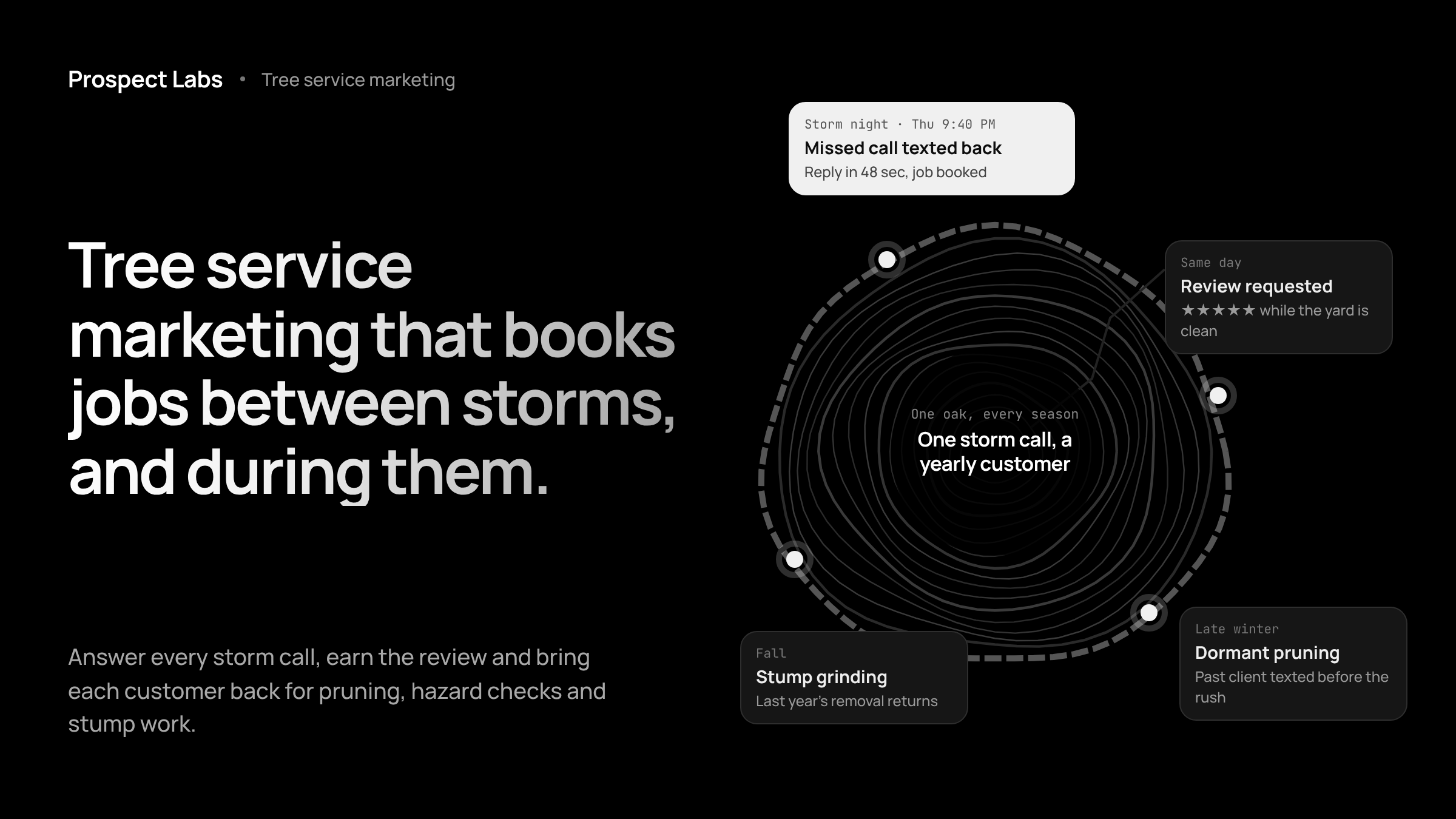

It’s 9:40 on a Thursday night. The wind finally drops, and a homeowner steps outside with a flashlight. A 40 foot oak limb is lying across the driveway, and another one is hanging over the kids’ bedroom. They grab their phone and search “emergency tree removal near me.”
They call the first company. It rings out. They call the second. Voicemail. The third company texts back in under a minute: “Sorry we missed you, this is Ridgeline Tree Care. Can you send a photo of the limb?” By Friday morning, that third company has the job, the insurance paperwork and a new customer who will need the oak pruned next spring.
That’s tree service marketing in one night. It isn’t just ads or a logo. It’s whether your business gets found, gets trusted and gets back to people faster than the crew down the road.
Quick answer: Tree service marketing is the system a tree company uses to get found on Google, earn trust through reviews and credentials, answer every call and text quickly, and turn one time removals into recurring care. The companies that win combine local SEO, a fast website, review requests and automatic follow up.
What Is Tree Service Marketing?
Tree service marketing is every step that moves a homeowner or property manager from “I have a tree problem” to a booked, paid and reviewed job. It covers Google visibility, your website, reviews, how fast you respond, and how you bring past customers back for pruning, stump grinding and plant health care.
Most tree company owners think of marketing as one thing: running ads, buying leads or posting on Facebook. In practice, those are only the first step. A lead you pay for and then miss is worse than no lead at all, because you paid for it and your competitor got the job.
If you want the bigger picture across every trade, our guide to home service marketing walks through the full customer journey. This post focuses on what makes tree work different and how to build a system around it.
Why Does Marketing a Tree Service Work Differently?
Tree work runs on two clocks at once. Storm work is urgent and goes to whoever answers first. Planned work like pruning, removals before a build and plant health care is slow and goes to whoever the homeowner trusts most. Your marketing has to win both.
Three things set tree companies apart from most trades:
- Demand spikes with the weather. One storm can bring a month of calls in two days, then the phone goes quiet. Marketing that only switches on after a storm is always late.
- The stakes feel high to the customer. A homeowner is letting a crew drop a tree next to their roof, their car and their neighbor’s fence. Proof of insurance, ISA certified arborists and real photos matter more than a clever slogan.
- The market is crowded and local. Nobody owns it. That’s good news for a well run small company, because the one that’s easiest to reach and easiest to trust usually wins.
| Tree service fact (USA) | Figure | Source |
|---|---|---|
| Tree trimming businesses in the US, 2025 | 175,035, up 6.1% from 2024 | IBISWorld |
| Market share concentration | Low; no single company dominates | IBISWorld |
| Average tree removal price, 2026 | $850 national average ($385 to $1,070 typical) | Lawn Love |
| Average tree trimming price, 2026 | $420 national average ($255 to $655 typical) | Lawn Love |
| Stump removal price range | $195 to $609 | Angi data via ThePricer |
Put those numbers together and the picture is clear. You’re one of roughly 175,000 companies, and each job is worth several hundred to a few thousand dollars. Losing even two jobs a month to a missed call or a thin review profile costs more than most marketing budgets.
How Do Homeowners Choose a Tree Service Company?
Homeowners choose a tree company by checking three things fast: recent Google reviews, proof that the crew is insured and qualified, and how quickly someone answers. Price matters, but only after the company passes that trust check.
The review numbers are hard to ignore. BrightLocal’s 2026 Local Consumer Review Survey of 1,002 US consumers found:
| What homeowners do | Share of consumers |
|---|---|
| Read reviews for local businesses | 97% |
| Expect the owner to respond to reviews | 89% |
| Only care about reviews from the last 3 months | 74% |
| Won’t use a business with fewer than 20 reviews | 47% |
| Require a rating of 4.5 stars or higher | 31% (up from 17% a year earlier) |
That “last 3 months” figure hits tree companies hard. Plenty of crews have 60 great reviews, but most of them are from two years ago. To a homeowner scrolling at 10pm, that looks like a business that slowed down.
The same survey found AI tools such as ChatGPT and Google’s AI answers jumping from 6% to 45% of local business discovery in one year. Those tools lean on the same signals: consistent reviews, clear service pages and a well kept Google Business Profile.
On your site and profile, make these trust signals impossible to miss:
- Proof of liability and workers’ comp insurance
- ISA certified arborist credentials or TCIA accreditation, if you have them
- Before and after photos of real jobs in real neighborhoods
- A plain list of services: removal, trimming, stump grinding, storm cleanup, plant health care
- Your service area, named town by town
What Does a Complete Tree Service Marketing System Include?
A complete tree service marketing system covers seven stages: getting found, the website visit, capturing the enquiry, sorting messages, following up, booking the job and growing repeat work. Most tree companies have one or two of these covered and leak jobs at the rest.
Here’s how each stage looks for a tree company, and what usually breaks:
| Stage | What it looks like for a tree company | Where jobs usually leak |
|---|---|---|
| 1. Found | Ranking in Google and the map results for “tree removal near me” in your towns | No service area pages, thin Google Business Profile |
| 2. Visit | A fast mobile site showing services, insurance, credentials and real job photos | Slow site, stock photos, phone number buried in the footer |
| 3. Capture | One tap text from the site, plus an instant text when you miss a call | Calls ring out while the crew is running a chainsaw |
| 4. Sort | Texts, web forms and Facebook messages in one inbox on your phone | Leads scattered across voicemail, email and DMs |
| 5. Follow up | Automatic reminders after you send an estimate | Quotes go quiet and nobody chases them |
| 6. Book | Clear next step, photo based estimates, fast scheduling | Homeowner books whoever confirms first |
| 7. Grow | Review requests after every job, plus spring pruning and storm prep campaigns | Happy customers never leave a review or hear from you again |
This is exactly the system Prospect Labs builds for tree companies. We design the website, connect a business phone line, switch on missed call text back, automate estimate follow up and send review requests after every job. You keep climbing. The system keeps selling.
How Do Tree Service Companies Get Found on Google?
Tree companies get found on Google through a fully built Google Business Profile, a website with a separate page for each core service, and a steady flow of fresh reviews. Together those three tell Google which jobs you do, where you do them and whether customers are happy.
Build out your Google Business Profile
Pick “Tree service” as your primary category and add related ones such as “Stump removal service” if they fit. List every service, set your service area by town, and upload new job photos at least twice a month. A profile that keeps changing looks alive, to Google and to homeowners.
Give every service its own page
A homeowner searching “stump grinding” doesn’t want to land on a page about tree removal. Build a page for each service you want to sell: emergency tree removal, tree trimming and pruning, stump grinding, land clearing and plant health care. Each page should answer the questions people ask before they call, like cost range, timing, cleanup and permits.
Make the website do the selling
Your site has one job: turn a worried visitor into a conversation. That means it loads fast on a phone, shows proof above the fold, and gives people a one tap way to text you a photo of the tree. We break this down step by step in our guide to contractor website design, and the same rules apply to small crews, as we cover in handyman websites.
Plan content around the seasons
Write for what homeowners worry about each season: storm prep and hazard checks before hurricane or ice season, pruning in late winter, and emergency cleanup guides you can share right after a storm. Seasonal content keeps you visible during the quiet weeks, so you’re already the name people recognize when the next storm hits.
How Fast Should a Tree Service Respond to a New Lead?
A tree service should reply to a new lead within minutes, and within the hour at the latest. Storm customers call several companies in a row, and the first one to answer or text back usually gets the job. A missed call with no reply is a lead handed to a competitor.
The data on calls is rough reading for any trade, and tree crews have it worse because their hands are full most of the day:
| Response fact | Figure | Source |
|---|---|---|
| Calls to home service businesses not answered | 27% | Invoca, via FieldCamp |
| Callers to home service businesses who reached a person | 52% | Invoca 2026, via FieldCamp |
| People who say they’d leave a voicemail when a business doesn’t pick up | 6% | YouGov, via Quo |
| Home service customers who expect a reply within the hour | Over 55% | Jobber, via Quo |
You’ll see bigger scary numbers online, like “85% of callers never call back.” Many of those are hard to trace to a real study, so we’ve left them out. The honest version is still bad enough: if you’re up a tree when the phone rings, most of those callers won’t wait for you.
The fix isn’t hiring a receptionist. It’s making sure every missed call gets an instant text in your company’s name, every web enquiry lands on your phone, and every estimate gets a follow up even when you forget. We walk through the same problem for plumbers in our post on how to get more plumbing leads, and tree work after a storm looks almost identical.
With the Prospect Labs system, that Thursday night caller from the opening gets a text before they dial the next company. The conversation is saved to your inbox, and you can reply from the truck in the morning with a quote.
How Do You Turn One Time Tree Removals Into Repeat Customers?
You turn one time removals into repeat customers by asking for a review the day the job is done, then contacting past clients each season with a reason to book again: spring pruning, storm prep, stump grinding or a plant health care plan. Past customers already trust you, so they’re your cheapest next job.
Most tree companies finish a removal, collect the check and never speak to that homeowner again. But a yard with one dead oak usually has five other trees that will need work over the next few years.
Here’s a simple yearly rhythm that works for most crews:
- Same day: send a one click review request while the cleanup still looks great. Add a gentle reminder a few days later.
- Late winter: text past clients about dormant season pruning before the spring rush fills your calendar.
- Before storm season: offer hazard checks on large trees near the house, with photos of limbs to watch.
- Fall: promote stump grinding for last year’s removals and deep root feeding for stressed trees.
- Anytime: run a referral campaign that rewards customers for sending a neighbor your way.
This is where the “Grow” stage pays for itself. Inside Prospect Labs, referral and return customer campaigns are already written. You pick one, press go, and your past customers hear from you without you writing a single text. Referrals still matter in this trade, and as we explain in general contractor marketing, a referred customer still checks your reviews before they call.
DIY, Lead Sites, an Agency or a Marketing System: Which Is Right for a Tree Company?
For most owner operated tree companies, a done for you marketing system beats buying leads or hiring a big agency. You own the website, the reviews and the customer list, the cost stays flat each month, and every enquiry gets answered even while your crew is working.
| Option | What you get | What’s missing | Typical cost model |
|---|---|---|---|
| Doing it yourself | Full control, low cash cost | Your evenings, and nothing happens while you’re on a job | Your time |
| Pay per lead sites | Leads without building anything | The same lead goes to several competitors, and you own nothing when you stop paying | Per lead |
| A web designer | A good looking site, handed over | No missed call texts, no review requests, the site goes stale | One time build |
| A large marketing agency | Ads, SEO and reports | Long contracts and high retainers, and they rarely fix how leads get answered | Monthly retainer plus contract |
| Prospect Labs system | Website, missed call text back, review funnel, follow up, campaigns, inbox, business phone and local SEO | Built for owners who want it done for them, not a DIY tool | Flat monthly price, month to month |
Do the math on one tree job
Prospect Labs costs $297 a month plus a one time setup fee, with no long contract. A single average tree removal at about $850 covers that nearly three times over. One extra removal a month, or one quote that doesn’t go cold, and the system has paid for itself.
That’s simple arithmetic, not a promise of results. Your market, your reviews and how you use the system all matter. But it shows why fixing the leaks usually pays off faster than buying more leads. See everything included at one monthly price, or look at builds in our work.
Tree Service Marketing FAQs
What is the best way to market a tree service business?
The best way is to combine a complete Google Business Profile, a fast website with a page for each service, steady review requests, and instant replies to every call and message. Paid ads help in busy seasons, but they waste money if leads go unanswered.
How do tree service companies get leads?
Most tree service leads come from Google searches, Google Maps, referrals and repeat customers, with storms driving big spikes. Companies that capture those leads with missed call texts and fast follow up convert far more of them than companies that rely on voicemail.
How much should a tree service spend on marketing?
There’s no fixed number, but a good test is your average job value. If one tree removal brings in around $850, a marketing system that recovers even one lost job a month usually pays for itself. Start by fixing missed calls and reviews before increasing ad spend.
Is Google Ads or SEO better for tree services?
Google Ads brings calls quickly, especially after storms, while SEO builds steady, free visibility that compounds over time. Most tree companies do best with strong local SEO and reviews as the base, then use ads to fill gaps in slower months.
How do I get more Google reviews for my tree service?
Ask every customer on the day the job is finished, while the yard looks its best. Send a one click review link by text, follow up once or twice, and reply to every review so new customers see an active, caring owner.
Your Next Tree Job Is Already Searching for You
Right now, someone in your service area is looking at a cracked limb and wondering who to call. Whether that job is yours depends on what happens in the next few minutes: whether they find you, trust you and hear back from you.
Prospect Labs builds the whole system for tree companies in about 7 to 10 days, then keeps it running for one flat monthly price. On a free 60 minute call, we’ll review your website, your reviews and how your calls are handled today, and show you a free design preview.
Book your strategy call and see exactly where your tree service is leaking jobs.