
It’s the first warm Saturday of April in Minneapolis. A couple is standing on their old pressure treated deck, the one with the soft board by the grill and the railing that wobbles when the kids lean on it. By lunch they’ve agreed: this is the year.
That evening one of them is on the couch with a phone, opening deck builder websites in tabs. The first site is a logo, a phone number and six blurry photos from 2019. The second loads slowly and the gallery won’t open. The third shows composite decks in their own suburb, explains what a 16 by 20 foot deck usually costs, and has a short form that asks about size, material and timeline.
Guess which builder gets the site visit on Tuesday.
Quick answer: Deck builder website design is building a contractor site that turns deck shoppers into booked estimates. A good one loads fast on a phone, shows real projects by material and town, explains rough pricing, offers financing, and makes requesting a quote take under a minute.
What makes a deck builder website different from other contractor websites?
A deck builder website sells a planned, visual, big ticket project, not an emergency repair. Nobody searches “deck builder near me” because water is pouring through the ceiling. They browse for weeks, compare photos, talk it over with a spouse and collect two or three quotes. Your website has to carry that whole journey.
The ticket size explains why the site matters so much. In the 2025 Cost vs. Value Report, the national average for a deck addition was:
| Deck type | Average job cost | Resale value | Cost recouped |
|---|---|---|---|
| Wood deck addition | $18,263 | $17,323 | 94.9% |
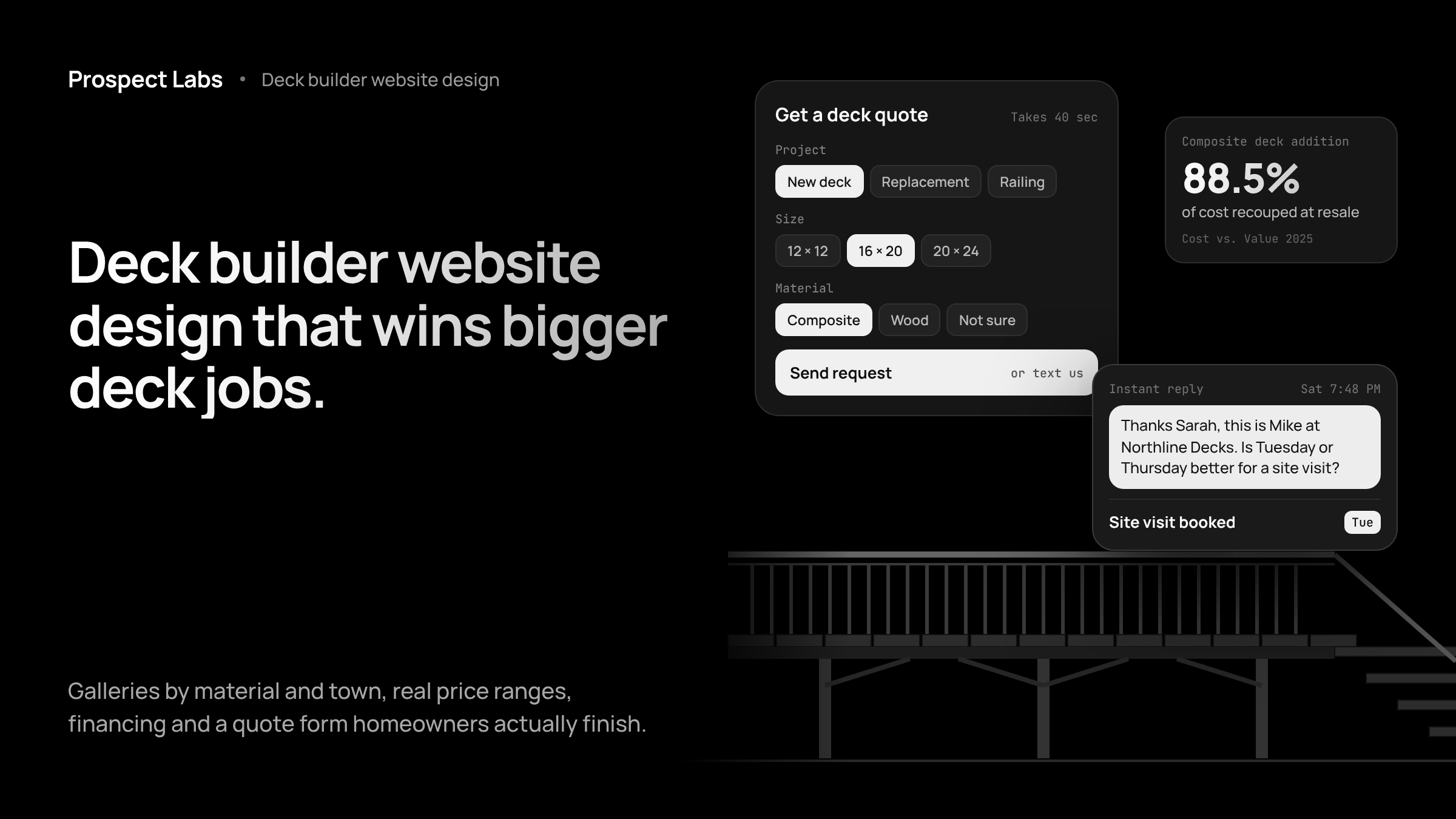
| Composite deck addition | $25,096 | $22,199 | 88.5% |
Both placed above major kitchen and bath remodels for return at resale, which is a selling point most deck sites never mention. One extra signed deck a month is worth more than most contractors spend on marketing all year.
The buyer also behaves differently from someone hiring a plumber or an HVAC tech (we cover that urgent side in our post on HVAC leads):
| Emergency trade | Deck builder | |
|---|---|---|
| Decision time | Minutes to hours | Weeks to months |
| What sells | Speed, availability | Photos, materials, trust, price range |
| Who decides | One person, now | Often two people, over several visits |
| Busy season | Weather emergencies | Late winter planning through summer |
| Key page | Phone number | Project gallery and estimate form |
The phone screen is where most of this happens. BrightLocal reports that 73% of local searches start on a mobile device and 72% of people look at three businesses or fewer before deciding. Your site is probably one of those three tabs. The question is whether it’s the one they come back to.
Which pages should a deck builder website have?
A deck builder website should have a page for every type of project you want more of, a gallery organized by material, a pricing guide and one page per main town you serve. Five generic pages (Home, About, Services, Gallery, Contact) rarely rank and rarely convince.
| Page | Why it matters | What to put on it |
|---|---|---|
| Home | First impression for map pack and brand searches | Your best project photo, towns served, review count, one estimate button |
| Composite decks | Highest ticket searches (“Trex deck builder”) | Brands you install, color samples, warranty, real jobs |
| Wood decks | Budget and cedar buyers | Pressure treated vs cedar, upkeep, finished jobs |
| Deck repair and replacement | Steady work in older neighborhoods | Signs a deck is unsafe, rebuild vs resurface, photos |
| Railings, pergolas, porches | Add on and upsell work | Cable, aluminum and glass railing options, pergola styles |
| Project gallery | The page buyers spend the most time on | Filter by material and town, captions with size and scope |
| Deck cost guide | Answers the question everyone has | Price ranges by size and material in your area |
| Financing | Moves composite buyers off the fence | Monthly payment examples, lender name, how to apply |
| City pages | Rankings beyond your home town | Local permits, HOA notes, jobs from that town |
| Estimate request | Where the lead happens | Short form plus text and call options |
If you install for a manufacturer program, such as a TrexPro or TimberTech registered contractor listing, say so on the composite page and link to your listing. It builds trust and earns a link back.
How should a deck builder show projects on the website?
Show projects the way buyers think about them: by material, size, style and town. A homeowner in a lake town wants to see a multi level composite deck with a view, not 40 random photos in one grid.
What a strong deck project entry includes:
- Three to eight photos, including one wide shot of the whole deck and one close up of the board color and railing.
- A caption with facts: “420 square foot TimberTech deck with black aluminum railing, Eden Prairie.”
- The problem it solved: rotted boards, no shade, a steep yard, a pool surround.
- A short customer quote if you have one.
- A link to the matching service page, so a browser becomes a reader of the page that sells.
Before and after sliders work well for deck replacement jobs. Drone shots work well for big builds. Skip stock photos entirely; deck buyers notice when the same image appears on three competitors’ sites.
Should a deck builder put prices on the website?
Yes, put price ranges on the website, even if every job is quoted on site. Clear pricing is one of the top three things consumers say they weigh when choosing a local business, according to BrightLocal’s 2026 research, right beside complete information and reviews.
You don’t need a calculator. A simple table on your cost guide page does the job:
| Deck size | Pressure treated wood | Composite |
|---|---|---|
| 12 x 12 ft (144 sq ft) | Your range | Your range |
| 16 x 20 ft (320 sq ft) | Your range | Your range |
| 20 x 24 ft (480 sq ft) | Your range | Your range |
Add what changes the price: height off the ground, stairs, railing type, permits, removal of an old deck and site access. Ranges filter out people who were never going to buy and warm up the ones who will. They also help you rank for “deck cost per square foot” type searches in your area.
What makes a deck estimate form actually get filled out?
A deck estimate form gets filled out when it is short, asks project questions instead of personal ones, and offers a faster option like a text. Long forms with ten required fields lose people halfway, especially on a phone.
Ask for:
- Name and mobile number
- Town or ZIP code
- Project type (new deck, replacement, repair, railing, pergola)
- Rough size and preferred material, with “not sure” as an option
- When they’d like it built
- An optional photo of the space
Then make the reply instant. A text that says “Thanks Sarah, this is Mike at Northline Decks. Got your request for a composite deck. Is Tuesday or Thursday better for a site visit?” beats a promise to call within 48 hours. The Prospect Labs system sends that kind of reply automatically, puts web messages, texts and social DMs in one inbox on your phone, and follows up leads that go quiet.
How fast and mobile friendly does a deck builder website need to be?
A deck builder website should load its first screen in about two to three seconds on a phone, with the estimate button visible without scrolling. Galleries are the usual problem: twenty full size photos straight off a camera can make a page crawl.
The fixes are simple:
- Compress photos and serve modern formats like WebP
- Load gallery images only as the visitor scrolls
- Keep a sticky “Get a quote” or “Text us” button at the bottom of the screen on mobile
- Use tap to call and tap to text links, not just a number in the footer
- Test every page on an actual phone over a cellular connection, not office wifi
The same rule shows up in every trade we work with. Our post on flooring website design makes the same case for flooring showrooms: the site has to work for the shopper sitting on the couch with a phone, because that’s where the decision starts.
How does a deck builder website help with Google rankings?
Your website and your Google Business Profile work as a pair. The profile wins the map pack for “deck builder near me.” The website wins the organic results for longer searches like “composite deck builder Eden Prairie” or “how much does a 16×20 deck cost.”
To rank, the site needs dedicated service pages, city pages with real local detail, fast load times, clean titles and headings, and schema markup for your business. Then reviews do the heavy lifting: BrightLocal found 97% of consumers read reviews for local businesses and 47% won’t use a business with fewer than 20. Ask every finished deck for one, with a photo if they’re willing.
How much does deck builder website design cost?
Deck builder website design in the US runs from a few hundred dollars for a DIY template to five figures for a custom agency build. Some agencies publish starting prices; SiteWired, for example, lists deck builder packages starting at $5,000. The bigger question is what happens after launch.
| Option | Typical cost | What you get | What’s usually missing |
|---|---|---|---|
| DIY builder (Wix, Squarespace) | Monthly subscription | Full control, low cost | Your time, SEO setup, lead follow up |
| Freelancer | One time project fee | A custom looking site | Updates, hosting support, any system after launch |
| Custom agency build | Often $5,000 and up | Strong design, sometimes SEO | Ongoing changes often billed extra |
| Prospect Labs system | From $297 a month plus setup | Website, local SEO, missed call text back, reviews, follow up, inbox | Long contracts (there aren’t any) |
Prospect Labs builds and launches in 7 to 10 days, with about 60 minutes of your time across two calls. You can see how the process works, compare pricing, and browse live client sites in Our Work.
Deck builder website checklist
Use this to grade your current site in ten minutes:
- ☐ Loads in about three seconds on a phone over cellular
- ☐ Estimate or text button visible without scrolling
- ☐ Separate pages for composite, wood, repair and railings or pergolas
- ☐ Gallery filtered by material, with captions naming size and town
- ☐ Price ranges by deck size and material
- ☐ Financing explained with a monthly payment example
- ☐ At least 20 recent Google reviews, shown on the site
- ☐ City pages for the towns you want more work in
- ☐ Instant reply to every form, call and text, even when you’re on a job
- ☐ Review request sent automatically after every finished deck
If you checked fewer than seven, your website is probably losing estimates to builders who do less careful work but answer faster.
Get a deck builder website that keeps selling while you build
Decks & patios is one of the trades we serve at Prospect Labs, alongside roofing, hardscaping, landscaping, pool construction and more. We build websites and marketing systems for contractors that get found on Google, turn visitors into text conversations, answer every missed call and ask every finished deck for a five star review.
Book a strategy call and we’ll review your current site, show you a free design preview, and tell you straight whether we’re a fit. Month to month, no long contract.
Frequently asked questions about deck builder website design
What should a deck builder website include?
A deck builder website should include separate pages for composite decks, wood decks, repairs and add ons like railings and pergolas, a gallery organized by material and town, a pricing guide, financing details, recent reviews and a short estimate form with a text option.
How much does a deck builder website cost?
Costs range from a low monthly fee for a DIY template to $5,000 or more for a custom agency build. Prospect Labs offers a full website and marketing system for contractors from $297 a month plus a one time setup fee, with no long term contract.
Do deck builders need SEO for their website?
Yes. Most homeowners search Google before contacting a deck builder. Local SEO, including a complete Google Business Profile, service pages, city pages and steady reviews, puts your site in front of people searching for deck builders in your area.
Should deck builders show prices online?
Yes, show price ranges by deck size and material. Ranges help homeowners budget, filter out poor fits and build trust before the site visit. Explain what changes the final price, such as height, stairs, railing type and permits.
How long does it take to build a deck builder website?
A custom agency build can take several weeks to a few months. Prospect Labs designs and launches a contractor website, with the marketing system behind it, in 7 to 10 days after you complete one onboarding form.