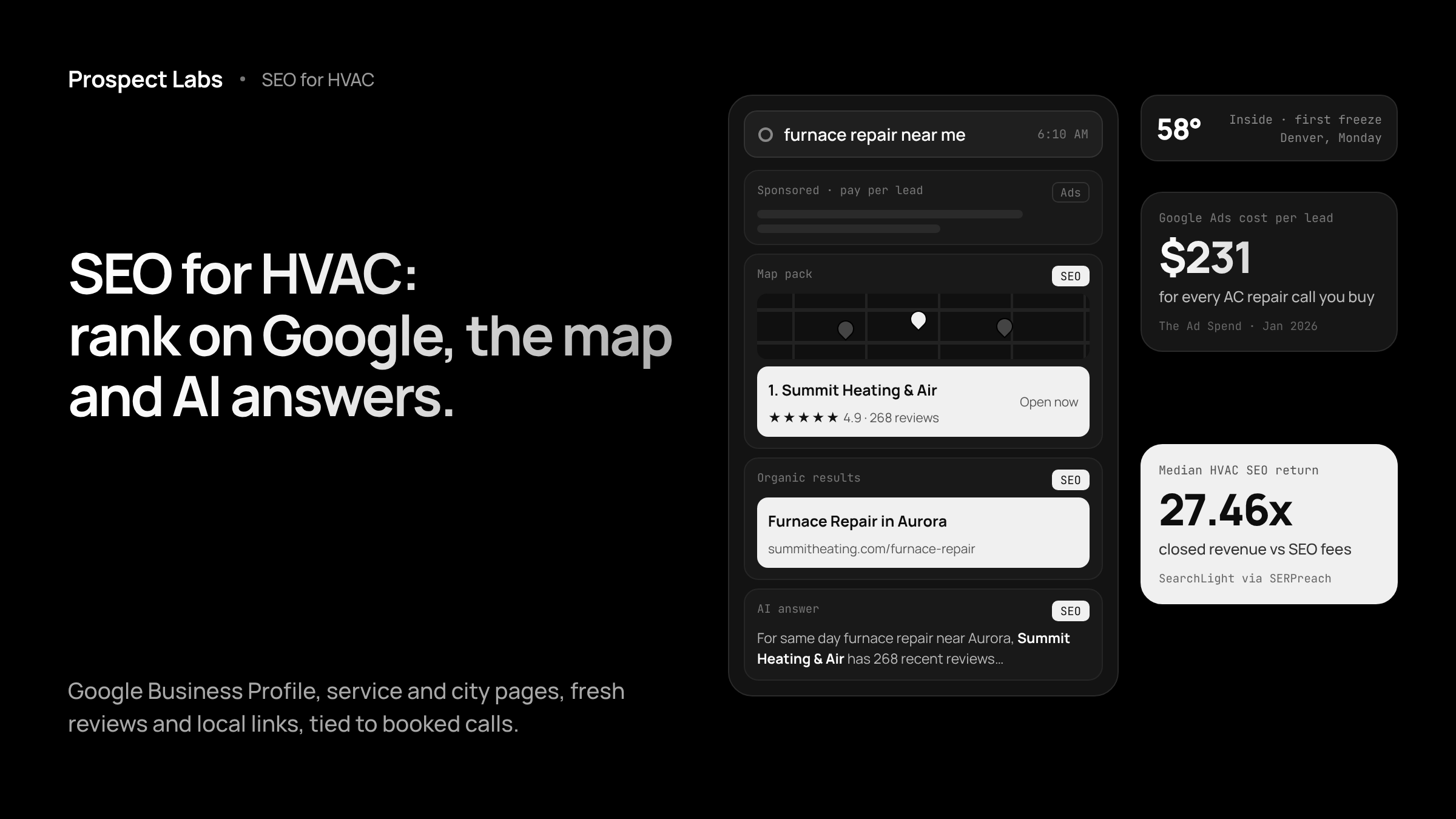

It’s 6:10 on a Monday morning in Denver, the first hard freeze of November. A homeowner wakes up to a 58 degree house and a furnace that clicks but won’t light. She grabs her phone and types “furnace repair near me.”
Three HVAC companies show up in the map. One has 41 reviews, the newest from last spring. One has no photos. The third has 268 reviews, a post from last week about furnace safety checks, and a website that loads before she finishes reading the name. She taps call.
She never scrolls down to the company that spent $3,000 on Google Ads last month. She never sees the one with the nicest trucks in town. The job went to whoever Google trusted most at 6:10 AM.
That’s what SEO for HVAC really decides. Not traffic charts. Who gets the call when the heat goes out.
Quick answer: SEO for HVAC is the work of getting a heating and cooling company found on Google Maps, Google search and AI answers when homeowners search for repair, replacement or maintenance. It rests on five things: a complete Google Business Profile, one page per service and town, fresh reviews, a fast website and local links.
Below, we break down how Google ranks HVAC companies, which keywords actually book jobs, what HVAC SEO costs in 2026 and how to turn rankings into calls you don’t miss. If you’re still deciding where your calls should come from, our guide to HVAC leads compares every source by cost.
What Is SEO for HVAC?
SEO for HVAC is search engine optimization built around how homeowners look for heating and cooling help. It covers your Google Business Profile, website pages, reviews, citations and links, so your company appears in the map pack, organic results and AI answers for the services and towns you cover.
General SEO tries to win national traffic. HVAC SEO doesn’t care about a reader in Seattle if your trucks only run around Tampa. It’s local, it’s seasonal, and it’s tied to urgent moments like no heat in January and no AC in July.
One HVAC search can now show four different places to win, and SEO covers three of them:
| Where you show up | What decides it | Do you pay per lead? | Covered by SEO? |
|---|---|---|---|
| Google Local Services Ads | Google Guaranteed badge, reviews, responsiveness, budget | Yes | No, but reviews help both |
| Google Map Pack (top 3 map results) | Google Business Profile, distance, reviews, local links | No | Yes |
| Organic results | Service and city pages, site speed, content, backlinks | No | Yes |
| AI Overviews and ChatGPT answers | Clear answers on your site, reviews, mentions across the web | No | Yes |
That’s why HVAC SEO is the cheapest source over time. Every slot in that table except the first one keeps sending calls after you stop paying for clicks.
Is SEO Worth It for HVAC Companies in 2026?
Yes. In a January 2026 benchmark of about 1,000 HVAC and home service companies, organic search returned a median 27.46 times its cost in closed revenue. Organic also produced 42% of unique leads and 44% of paying customers when measured against paid digital channels.
Here are the numbers HVAC owners should know before spending another dollar on marketing:
| What’s measured | The figure | Source |
|---|---|---|
| Median SEO return for HVAC and home service companies (Q4 2025) | 27.46x closed revenue vs SEO fees | SearchLight Digital via SERPreach |
| Top quartile vs bottom quartile SEO return | 60.54x vs 12.83x | SearchLight Digital via SERPreach |
| Share of paying customers from organic search (vs paid digital) | 44% | SearchLight Digital via SERPreach |
| Google Ads cost per lead for AC repair (Jan 2026) | $231 | The Ad Spend, SearchLight data |
| Non branded Google search cost per lead, HVAC (Jan 2026) | $149 | The Ad Spend, SearchLight data |
| HVAC Local Services Ads cost per lead (Feb 2026) | $51 | SearchLight benchmark |
| Consumers who read reviews for local businesses | 97% | BrightLocal, 2026 |
| Share of local business discovery happening through AI tools | 45% | BrightLocal via Digital Applied |
Read the table as an HVAC owner and one thing stands out. Every AC repair call you buy from Google Ads can cost more than $200, while the same call from the map pack costs nothing extra once you rank. The gap between the top and bottom quartile also tells you SEO done half way pays far less than SEO done properly.
One caution: that 27.46x figure is revenue, not profit, and it comes from companies that kept at it. SEO rewards patience.
How Does Google Rank HVAC Companies?
Google ranks HVAC companies in the map pack on three factors it names itself: relevance, distance and prominence. Relevance is how well your profile and pages match the search. Distance is how close you are to the searcher. Prominence is your reviews, links and reputation across the web.
Google explains these three in its own local ranking guidance. Here’s what each one means for a heating and cooling company:
| Ranking factor | What Google looks at | What you can control |
|---|---|---|
| Relevance | Primary category, services listed, website pages, review text | Pick “HVAC contractor” or the closest category, list every service, build a page for each |
| Distance | Your address or service area vs the searcher’s location | Service area settings, city pages, accurate address |
| Prominence | Review count and freshness, rating, backlinks, citations, mentions | A review request after every job, local links, consistent listings |
Distance is the one you can’t fake. A company 20 miles away will struggle to rank in the map for a suburb on the other side of the metro, no matter how many reviews it has. That’s why city pages and organic rankings matter so much for HVAC companies with a wide service area: they reach towns the map won’t.
Organic results work a little differently. They lean harder on your website: page content, site speed, internal links and backlinks. The two feed each other, since Google uses your website as a signal for your map ranking too.
How Do You Optimize a Google Business Profile for HVAC?
To optimize a Google Business Profile for HVAC, choose the most accurate primary category, add secondary categories for each main service, set your real service area, list every service with a short description, upload your own photos, keep hours current and post weekly. Then reply to every review.
Your profile is the single biggest lever for the map pack. It’s free, and most HVAC companies fill it in once and forget it.
- Categories. Your primary category carries the most weight. Use the one that matches your main work, such as HVAC contractor, then add secondary categories like air conditioning repair service, furnace repair service and heating contractor.
- Service area. If you work from home or a shop customers don’t visit, hide your address and list the towns you actually serve. Don’t stretch it to cities two hours away.
- Services. List each one separately: AC repair, furnace repair, heat pump installation, ductless mini split installation, indoor air quality, maintenance plans. Write one or two plain sentences for each.
- Photos. Real trucks, real techs in uniform, real installs. Before and after shots of a new condenser or a cleaned up mechanical room do more than any stock image.
- Business name. Use your real name only. Adding “Best AC Repair Denver” to it breaks Google’s guidelines and can get the profile suspended.
- Posts and offers. A weekly post about a tune up special, a heat pump rebate or a recent job keeps the profile active.
- Attributes and booking. Add your booking link and make sure your profile says plainly whether you offer 24 hour service and financing, since Google now pulls those details into its AI answers.
Keep your name, address and phone number (NAP) exactly the same here, on your website and on every directory. Small mismatches, like a suite number on one site and not another, chip away at Google’s trust.
Which Keywords Should an HVAC Company Target?
An HVAC company should target service plus location keywords first, such as “AC repair Plano,” then problem searches like “AC blowing warm air,” then replacement and cost searches like “heat pump installation cost.” These carry buying intent. Broad terms like “HVAC” bring traffic that rarely books.
Think about keywords by what the homeowner is going through, not by search volume alone:
| Keyword type | Examples | Homeowner’s mindset | Page that should rank |
|---|---|---|---|
| Emergency | no heat repair, emergency AC repair, 24 hour HVAC near me | Needs someone today | Emergency service page, map pack |
| Service plus city | furnace repair Aurora, AC repair Plano | Ready to call | Service page and city page |
| Problem | AC not cooling, furnace short cycling, heat pump frozen | Trying to diagnose it | Blog post or service page FAQ |
| Replacement and cost | new AC unit cost, heat pump vs furnace, SEER2 rating explained | Researching for weeks | Replacement page, cost guide |
| Maintenance | AC tune up, furnace tune up, HVAC maintenance plan | Planning ahead | Maintenance plan page |
| Indoor air quality | whole home dehumidifier, air purifier installation, duct cleaning | Comfort or health concern | Indoor air quality page |
| Brand and equipment | Carrier dealer near me, Trane heat pump installer, Lennox repair | Has a brand in mind | Brand or dealer page |
A few habits make keyword research pay off for HVAC:
- Use the words customers use. Homeowners search “AC,” not “split system condensing unit.” They search “furnace,” not “forced air gas heating appliance.”
- Check Google Search Console every month. It shows the real searches already bringing people to your site, including towns and problems you never thought to target.
- Follow the equipment shift. Heat pumps outsold gas furnaces in the US in 2025, 3.64 million to 3.25 million according to AHRI data reported by ACHR News. Heat pump installation, cost and rebate searches are growing with it.
- Map one main keyword to one page. Two pages chasing “AC repair Denver” split your ranking power. Pick one and link the other to it.
How Should an HVAC Website Be Structured for SEO?
An HVAC website should give every core service its own page and every main town its own page, then link them together. A homepage alone can’t rank for “furnace repair” in eight suburbs. Separate pages let Google match each search to the exact service and place.
A simple structure that works for most residential HVAC companies looks like this:
| Level | Example URL | What it does for SEO |
|---|---|---|
| Homepage | yoursite.com | Ranks for your brand and “HVAC company + main city” |
| Service hub | /services/ | Links to every service page |
| Service pages | /ac-repair/, /furnace-repair/, /heat-pump-installation/ | Rank for each service across your area |
| City pages | /service-areas/aurora/ | Rank for “HVAC + town” outside your home city |
| Service plus city (largest markets only) | /aurora/ac-repair/ | Win the highest value combinations |
| Support pages | /financing/, /maintenance-plan/, /reviews/ | Answer buying questions, build trust |
| Blog and guides | /blog/heat-pump-vs-furnace/ | Catch problem and research searches, link to service pages |
The hard part is the city pages. Copying one page and swapping the town name gives Google nothing new. A strong city page mentions the neighborhoods you cover, the age of homes there, local problems like undersized ductwork in 1970s ranches or heat pumps that struggle in cold snaps, a review from a customer in that town and any local utility rebates.
Every service page also needs the trust details homeowners look for: your state license number, NATE certified technicians, EPA Section 608 certification, ACCA membership if you have it, and manufacturer dealer status. Those details help people decide and help Google understand who you are.
We walk through the design side of each page, including layout, buttons and seasonal homepage changes, in our guide to HVAC website design. If you run more than one trade, contractor website design covers the shared basics.
What Technical SEO Does an HVAC Website Need?
An HVAC website needs fast mobile load times, passing Core Web Vitals, HTTPS, a clean XML sitemap submitted to Google Search Console, HVACBusiness or LocalBusiness schema, a unique title and meta description on every page, and no broken links or duplicate pages. Most of it is a one time setup.
Technical SEO sounds like the scary part. For a typical HVAC site with 20 to 60 pages, it’s a short checklist:
| Technical item | Target | Why it matters for HVAC |
|---|---|---|
| Largest Contentful Paint (LCP) | Under 2.5 seconds | Google’s own data found 53% of mobile visits are abandoned past 3 seconds |
| Interaction to Next Paint (INP) | Under 200 milliseconds | The call and text buttons have to respond on the first tap |
| Cumulative Layout Shift (CLS) | Under 0.1 | Stops the page jumping while someone tries to tap your number |
| HTTPS | On every page | Browsers warn visitors away from sites without it |
| XML sitemap | Submitted in Search Console | Helps Google find new service and city pages fast |
| HVACBusiness schema | On homepage and city pages | Tells search engines your name, phone, area, hours and services |
| FAQPage schema | On service pages with FAQs | Makes your answers easier to pull into results and AI answers |
| Title tags | Service + city + brand, under 60 characters | The first thing a searcher reads |
HVACBusiness is a real type in the schema.org vocabulary, a more specific version of LocalBusiness. Using it, with your areaServed, telephone and openingHours filled in, removes guesswork for Google.
The biggest technical problem we see on HVAC sites isn’t exotic. It’s a 6 MB photo of a truck at the top of the homepage. Compress your images, drop the autoplay video header and test on a real phone, not a desktop.
How Do Reviews Affect HVAC SEO?
Reviews affect HVAC SEO through prominence, one of Google’s three local ranking factors. More reviews, a higher rating, recent dates and review text that mentions your services and towns all help you rank in the map pack. They also decide whether the homeowner calls you or the next company.
Homeowners now judge freshness more than totals. BrightLocal’s 2026 survey found 74% of consumers only care about reviews from the last three months, and 47% won’t use a business with fewer than 20 reviews. A pile of five star reviews from 2022 doesn’t carry much weight in 2026.
What actually keeps reviews coming in:
- Ask every customer, every time. Right after the job, while the tech is still in the driveway, is when people say yes.
- Make it one tap. A text with a direct link to your Google review form beats a card on the fridge.
- Send a polite reminder. Most people mean to leave a review and forget. One or two nudges over a few days catches the customers who meant to and forgot.
- Reply to every review. Thank the good ones by name and the service done. Answer the bad ones calmly and offer to fix it offline.
- Never buy or gate reviews. Fake reviews and filtering out unhappy customers break Google’s rules and, under the FTC’s 2024 rule on fake reviews, can bring fines.
This is exactly what our 5 star review funnel automates inside the marketing system for contractors: a review request after every finished job, with reminders until the customer follows through.
How Do HVAC Companies Build Local Links and Citations?
HVAC companies build citations by listing the same name, address and phone on trusted directories like Bing Places, Apple Business Connect, Yelp, the BBB and Angi. They build links through manufacturer dealer pages, local sponsorships, supplier and trade association listings, and community content that local sites want to reference.
Citations confirm you exist. Links show you’re trusted. You need both, but you don’t need hundreds of either.
| Source | Type | How to get it |
|---|---|---|
| Bing Places and Apple Business Connect | Citation | Claim free listings; they feed Bing, Apple Maps, Siri and some AI tools |
| Yelp, BBB, Angi, Nextdoor | Citation | Claim and match NAP exactly to your Google profile |
| Manufacturer dealer locators (Carrier, Trane, Lennox, Rheem) | Link | Comes with dealer status; make sure your listing links to your site |
| ACCA, local PHCC or builders association | Link | Membership directory listing |
| Local utility or rebate program contractor lists | Link | Apply to be a participating contractor |
| Little League, school or charity sponsorships | Link | Ask for a link on the sponsor page |
| Local news and blogs | Link | Offer a heat wave safety tip or freeze prep checklist when the weather turns |
One good link from your county’s utility rebate page is worth more than fifty from random directories. Skip anyone selling “500 backlinks for $99.” Those links do nothing at best and get you penalized at worst.
How Does Seasonality Change HVAC SEO?
HVAC searches follow the weather. Cooling repair searches spike with the first heat wave, heating repair with the first hard freeze, and replacement and tune up searches climb in spring and fall. Good HVAC SEO prepares pages, posts and offers four to six weeks before each wave hits.
Rankings take time to move, so a page published during a heat wave is usually too late for that heat wave. Plan the year like this:
| When to publish | Searches about to rise | What to create or refresh |
|---|---|---|
| February to March | AC tune up, heat pump installation, new AC cost | Tune up offer page, heat pump cost guide, rebate page |
| April to May | AC not cooling, AC repair near me | Refresh AC repair and emergency pages, add summer FAQs |
| August to September | furnace tune up, carbon monoxide check | Furnace safety post, maintenance plan page |
| October to November | no heat, furnace repair, frozen heat pump | Refresh heating and emergency pages, cold weather heat pump guide |
The shoulder months are where SEO quietly pays off. A homeowner reading your heat pump vs furnace guide in April is the same person who signs a replacement in May. To fill those slow weeks with past customers too, see how to set up a contractor referral program.
How Do HVAC Companies Show Up in AI Search?
HVAC companies show up in AI search by being easy for AI tools to understand and trust. That means clear, direct answers on each service page, consistent business details across the web, a strong review profile and mentions on trusted local sites. Google’s AI Overviews and ChatGPT draw on the same signals as regular SEO.
This matters more every month. BrightLocal’s 2026 research, reported by Digital Applied, found 45% of local business discovery now happens through AI tools, up from 6% a year earlier.
When a homeowner asks ChatGPT “who’s the best HVAC company in Charlotte for a heat pump install,” the tool usually names a short list. To be on it:
- Answer questions in plain sentences. Start each service page with two or three lines that say what you do, where and for whom. “We install and repair heat pumps across Charlotte, Matthews and Huntersville, with same week installs” is easy for a machine to quote.
- Use FAQ sections. Real questions homeowners ask, with short, direct answers, plus FAQPage schema.
- Keep details identical everywhere. Your services, area and phone should match on your site, Google, Bing, Apple and Yelp.
- Earn mentions, not just links. Being named in a local news story, a utility contractor list or a “best HVAC companies in” roundup feeds AI answers.
- Keep reviews fresh and specific. Reviews that mention the service and the town give AI tools something concrete to repeat.
None of this is a separate strategy. AI search is mostly good local SEO, written clearly.
How Much Does HVAC SEO Cost and How Long Does It Take?
HVAC SEO from a specialist agency usually costs $1,500 to $5,000 a month in 2026, depending on your market and how many cities you target. Most HVAC companies see map pack and ranking gains in three to six months, while competitive metros often take six to twelve months.
Here’s how the common options compare:
| Option | Typical monthly cost | What you usually get | What’s often missing |
|---|---|---|---|
| Do it yourself | $0 plus your evenings | Full control, Google Business Profile basics | Time, technical setup, consistency in peak season |
| Freelance SEO | $500 to $1,500 | On page work, some content | Lead capture, reviews, reporting tied to booked jobs |
| Budget agency tier | $800 to $2,200 (PipelineOn) | Listings, a few blog posts, monthly report | Real city pages, link building |
| Specialist HVAC SEO agency | $1,500 to $5,000 (seo.com) | Full local, on page, technical and link work | Usually nothing for missed calls or follow up |
| Prospect Labs marketing system | From $297 plus a setup fee | Website, local SEO and updates, review funnel, missed call text back, follow up, one inbox | Not a heavy link building or multi city content retainer |
Timelines depend on a few things you can’t change overnight:
- Your market. Ranking for furnace repair in Boise is not the same fight as ranking in Houston.
- Your domain’s age and history. A site live for eight years usually moves faster than one launched last month.
- Your review count and pace. Prominence builds with every review you collect.
- Consistency. SEO paused every July because the crew is slammed loses ground to the company that kept going.
If you’re comparing providers, our guide to choosing a contractor marketing agency lists the questions to ask before you sign anything.
What Are the Most Common HVAC SEO Mistakes?
The most common HVAC SEO mistakes are a half finished Google Business Profile, one generic services page, copied city pages, keyword stuffed business names, old reviews, slow mobile pages, buying cheap backlinks and judging SEO by traffic instead of booked jobs.
| Mistake | What it costs you | The fix |
|---|---|---|
| Profile set up once and never touched | Competitors with weekly posts and fresh photos outrank you | Update photos, services and posts every week |
| One page listing every service | Google can’t match you to “heat pump installation” | A page for each core service |
| City pages with only the town swapped | Weak rankings, possible thin content issues | Local details and a local review on each page |
| Keywords stuffed into your business name | Profile suspension | Use your real business name only |
| Reviews from years ago | Lower map rankings and lower trust | A review request after every job |
| Slow mobile site | Visitors leave before the page loads | Compress images, test LCP on a phone |
| Cheap bulk backlinks | Wasted money or a penalty | Earn local, relevant links |
| Tracking traffic, not calls | You pay for visits that never book | Track calls, texts and booked jobs by source |
| Ranking, then missing the call | Your SEO sends the job to a competitor | Missed call text back and fast follow up |
That last row is the one almost every HVAC SEO guide leaves out, and it’s the one that costs the most.
How Do You Turn HVAC Rankings Into Booked Jobs?
You turn HVAC rankings into booked jobs by answering fast. Every call from the map pack needs a live answer or an instant text back, website visitors need a one tap way to text you, and every quote needs follow up. Rankings bring the homeowner to you; response speed decides who gets the job.
Here’s simple arithmetic on example numbers. Swap in your own.
| Example | Number |
|---|---|
| Calls a month from Google Maps and organic search | 60 |
| Share missed while techs are on jobs | 20% |
| Missed calls a month | 12 |
| Booking rate if answered (SearchLight’s HVAC figure) | 44% |
| Jobs lost a month | About 5 |
| Revenue at a $2,110 average ticket | About $10,550 a month |
That’s revenue your SEO already earned and your phone gave away. Your exact numbers will differ, but the pattern shows up in almost every HVAC company we talk to.
The fix is a system around the website, not just the website:
- Missed call text back. Every missed call gets a text in your business name within seconds.
- One tap texting on your site. Plenty of homeowners would rather text a photo of the outdoor unit than wait on hold.
- Automatic follow up. Replacement shoppers compare quotes for weeks. Follow ups keep you in the running.
- A review request after every job. Which feeds your rankings and starts the loop again.
At Prospect Labs, we build website design and marketing systems for contractors that do all of this, with local SEO built in, at a flat monthly price, month to month. The same approach works across the trades we serve, as you’ll see in our guides to handyman SEO, landscaping SEO and plumbing leads.
Ready to Turn Your Rankings Into Booked HVAC Jobs?
Your next furnace replacement is already searching. The question is whether Google shows you, and whether someone answers when it does.
See real builds on our work page, then book a strategy call. We’ll look at your Google Business Profile, your site, your reviews and how missed calls are handled today. If it isn’t a fit, we’ll tell you straight.
SEO for HVAC FAQs
What is SEO for HVAC?
SEO for HVAC is the work of getting a heating and cooling company found on Google Maps, Google search and AI answers for the services and towns it covers. It includes your Google Business Profile, service and city pages, reviews, citations, links and site speed.
How much does HVAC SEO cost?
Specialist HVAC SEO agencies usually charge $1,500 to $5,000 a month in 2026, with budget tiers starting near $800. Cost depends on your market, the number of cities you target and how much content and link building is included.
How long does SEO take for an HVAC company?
Most HVAC companies see map pack and ranking gains in three to six months. Competitive metros like Houston, Phoenix or Atlanta can take six to twelve months. Domain age, review count and how consistently the work continues all affect the timeline.
Is SEO better than Google Ads for HVAC?
They do different jobs. Google Ads and Local Services Ads bring calls within days but cost money for every lead. SEO takes months to build, then keeps bringing calls without a per lead fee. Most healthy HVAC companies use both and shift toward SEO over time.
What is the most important ranking factor for HVAC companies?
For the map pack, your Google Business Profile, distance to the searcher and your reviews matter most. For organic results, dedicated service and city pages, site speed and local links carry the most weight.
Do HVAC companies need a blog for SEO?
A blog helps when it answers real homeowner questions, like heat pump vs furnace or why an AC blows warm air, and links to your service pages. A blog of generic posts nobody searches for does little. Service and city pages come first.
Can I do HVAC SEO myself?
Yes, especially the basics: a complete Google Business Profile, consistent listings and a review request after every job. The harder parts are technical setup, city page content and staying consistent through peak season when your crew is slammed.