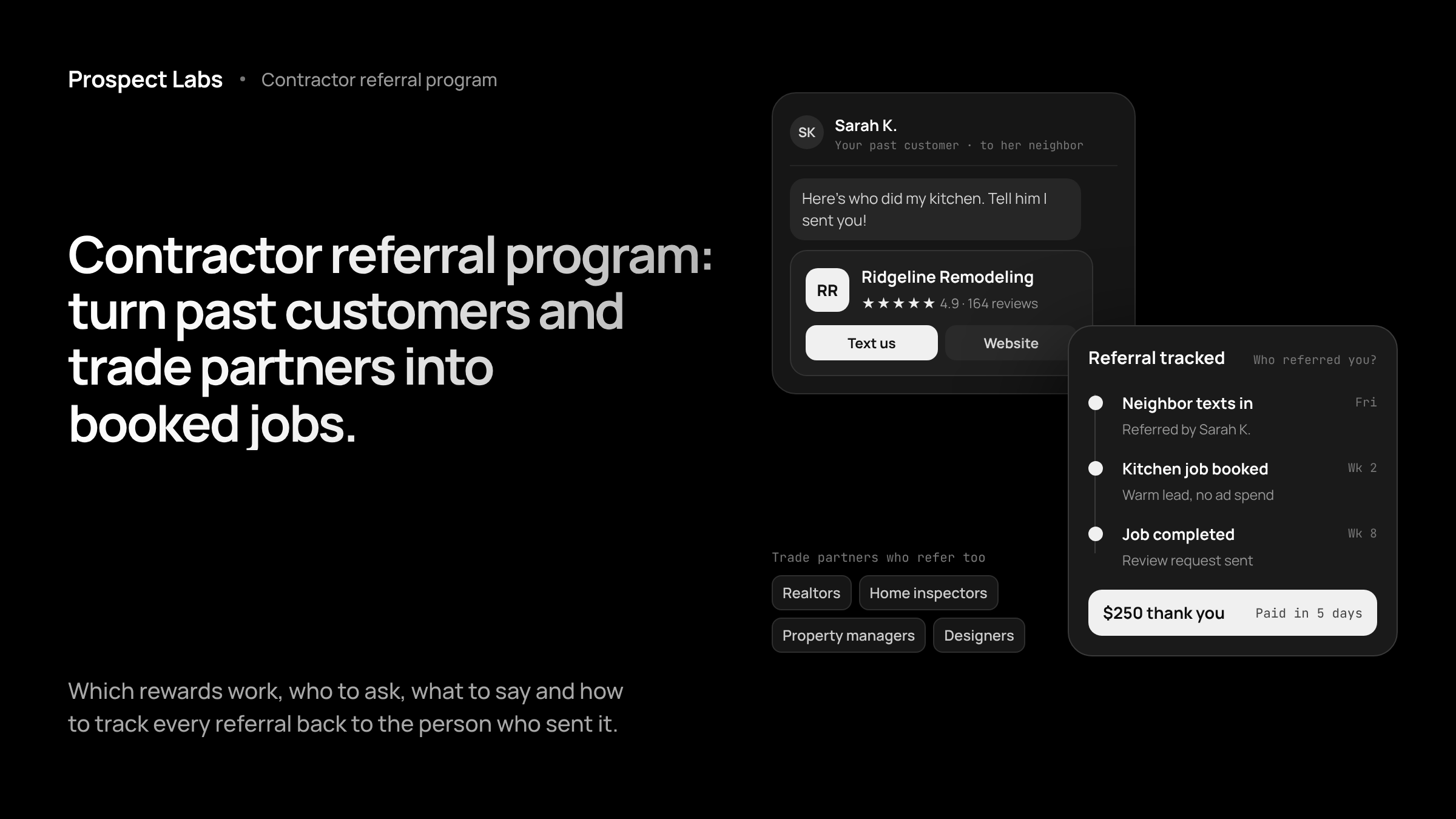

It’s a Thursday evening in Charlotte. A homeowner is standing in her neighbor’s kitchen, admiring new cabinets and a quartz island. “Who did this?” she asks. Her neighbor smiles, scrolls through her phone, and says, “Hang on, I’ll send you his number.”
That moment is worth more than any ad you will ever run. The homeowner already trusts the work, already likes the price, and already has a name. The only question is whether that moment happens by accident a few times a year, or on purpose every week.
That’s the job of a contractor referral program.
Quick answer: A contractor referral program is a simple, repeatable system that rewards past customers and trade partners for sending you new jobs. It sets a clear reward, tells people how to refer, tracks every lead back to its source, and asks at the right moment, usually right after a job goes well.
Below, you’ll see what to offer, who to ask, what to say, how to track it, and the tax and licensing details most guides skip.
What is a contractor referral program?
A contractor referral program is a planned way to get new customers through people who already trust you. Unlike word of mouth, which happens when it happens, a referral program has four parts: a reward, a way to refer, a way to track, and a habit of asking.
Here’s how those parts fit together:
- The referrer is the person sending the job. That’s usually a happy past customer, but it can also be a realtor, a property manager, or another trade.
- The referred homeowner is the new lead. They arrive warm, because someone they know already vouched for you.
- The reward is what the referrer gets, and sometimes what the new customer gets too. When both sides get something, it’s called a double sided reward.
- The trigger is the moment you ask. The best trigger is the day a job finishes and the customer is happiest.
- The tracking connects each new job to the person who sent it, so you pay the right reward and know the program is working.
If you already get referrals, you aren’t starting from zero. You’re just turning something random into something you can count on. Our own homepage answers a version of this question: if most of your work comes from referrals, why bother with marketing? You can read our straight answer in the FAQ.
Why does a referral program matter for contractors?
Referrals matter because they are still the first place most US homeowners look, and referred leads close far more often than paid ones. Surveys across roofing, HVAC and remodeling keep landing on the same pattern: friends and neighbors come first, Google comes second.
| What the research found | Figure | Source |
|---|---|---|
| Homeowners who look for a roofer through word of mouth or a recommendation | 79% (vs 62% who search online) | Roofing Contractor 2025 homeowner survey |
| Roofers who say word of mouth is their main way to promote the business | 72% | Roofing Contractor 2025 homeowner survey |
| Homeowners who find their HVAC contractor through word of mouth, including social media | 67% | ACHR News and Clear Seas Research |
| Close rate contractors report on referral leads | About 45%, vs 3% to 12% for other lead sources | Modernize contractor survey |
| Referred leads compared with paid ads | Convert 3 to 5 times higher, at roughly 60% lower cost per acquisition | Trulata, 2026 |
There’s a catch hidden in those numbers. Most contractors rely on referrals, but very few have a system that makes them happen. Happy customers mean to tell their friends. Then life gets busy and they forget your company name.
And even a referred homeowner checks you out before calling. They look at your website, read your Google reviews, and judge how fast you reply. A referral gets you on the shortlist. Your website and marketing system is what turns it into a booked job.
Customer referrals vs trade partner referrals: which should you run?
Run both. Customer referrals bring steady, small and medium jobs from people who have seen your work. Trade partner referrals bring fewer but often larger jobs from professionals who meet homeowners before you do. The two programs need different rewards and different asks.
| Customer referral program | Trade partner referral program | |
|---|---|---|
| Who refers | Past customers, neighbors, friends of customers | Realtors, property managers, home inspectors, insurance agents, other trades |
| How often they meet your next customer | A few times a year | Every week, sometimes every day |
| What motivates them | Helping a friend, a thank you gift, a credit on their next job | Making their own clients happy, getting referrals back, a reliable person to call |
| Best reward | Gift card, service credit, or a discount for both sides | Reciprocal referrals, priority scheduling, fast quotes for their clients |
| How you ask | Text after the job, review request, seasonal campaign | A short intro meeting, a leave behind card, a quick follow up after each job they send |
Good trade partner matches by trade:
- Roofers: home inspectors, insurance agents, gutter and siding companies.
- HVAC and plumbing: realtors (pre sale inspections), property managers, electricians.
- Remodelers and painters: interior designers, flooring installers, cabinet shops.
- Landscapers and hardscapers: pool builders, fence companies, homebuilders.
- Handymen: property managers, realtors, moving companies.
The pattern is simple. Look for businesses that serve the same homeowner right before or right after you do.
How do you build a contractor referral program step by step?
You build one in six steps: set a goal, pick a reward, make referring easy, choose when to ask, track every lead, and pay fast. Most contractors can set up a basic version in an afternoon and improve it over the first few months.
- Set a simple goal. Look at last year’s jobs and count how many came from referrals. Then pick a realistic target, such as two extra referred jobs a month. A number keeps the program from fading after the first busy week.
- Pick a reward that fits your average job. A $25 gift card feels generous after a gutter cleaning and cheap after a $15,000 roof. Match the reward to the job size (see the table in the next section).
- Make referring take ten seconds. Give customers one way to send a friend: a short link, a text they can forward, or a card with your number. If they have to explain who you are, most won’t bother.
- Decide when to ask. Ask when the customer is happiest. That’s usually the day the job is done, right after they say thanks, and again when they leave you a review.
- Track every lead to its source. Add a “Who referred you?” question to every form and every phone intake. Without it, you’ll miss rewards, upset referrers, and never know if the program works.
- Pay the reward fast and say thank you. Send the reward within a week of the referred job being paid. Add a short personal note. Fast thanks is what turns a one time referrer into a repeat one.
A small tip that makes a big difference: don’t let referred leads wait. A referred homeowner who calls and gets voicemail feels let down twice, once for themselves and once for the friend who recommended you. A missed call text back makes sure every caller hears from you within seconds, even when you’re on a roof.
What referral rewards work best for contractors?
The best reward is one that feels generous to the customer and still leaves you a healthy profit on the job. For most home service businesses, that means a gift card or a credit sized to the average ticket, often paired with a small discount for the new customer.
The ranges below are common starting points, not rules. Adjust them to your margins and your market.
| Job size | Example trades | Typical reward for the referrer | Optional reward for the new customer |
|---|---|---|---|
| Under $1,000 | Handyman, pressure washing, pest control, carpet cleaning | $25 to $50 gift card or service credit | 10% off the first visit |
| $1,000 to $10,000 | HVAC repair, painting, plumbing, electrical, flooring | $100 to $250 | $100 off the job |
| Over $10,000 | Roofing, remodeling, HVAC replacement, pools, hardscaping | $250 to $500, or a credit toward their next project | A free upgrade (better materials, extended warranty) |
| Recurring service | Lawn care, pool service, pest control plans | One free month or service visit | One free month |
A quick way to set your number: decide what you’d happily pay for a new customer through ads or a lead site. Then offer a referral reward well below that. If a single referred HVAC replacement brings in thousands, a $250 thank you is easy math.
A few reward ideas that often beat cash:
- Service credits. They cost you less than face value and bring the customer back.
- Local gift cards. A card from a well known local restaurant feels personal and supports your community.
- Charity donations. Some customers would rather you give $100 to a local cause in their name. This works well for higher end clients.
- Tiered rewards. One referral earns a gift card. Three in a year earns something bigger, like a free annual maintenance visit.
When and how should you ask for referrals?
Ask at the three moments a customer feels best about you: when the job is finished, when they leave a review, and a few months later when the work still looks great. Keep the ask short, specific, and easy to act on. You aren’t begging. You’re helping their friends avoid a bad contractor.
Moment 1: the walkthrough. The customer is standing in front of the finished work. Say something like:
“I’m really glad you’re happy with it. Most of our work comes from people like you telling a friend. If anyone you know needs a hand, I’ll take great care of them, and we’ll send you a $100 thank you once their job’s done.”
Moment 2: the follow up text. Send this the same day or the next morning:
“Hi Sarah, thanks again for choosing us for your new deck. If you know anyone who needs similar work, just forward them this link. When their job is complete, we’ll send you a $100 gift card as a thank you.”
Moment 3: the seasonal campaign. A few months later, reach out to everyone at once. Spring and fall work well for most trades:
“Spring is here and lots of your neighbors are planning projects. Know someone who needs a hand? Send them our way and get $100 when their job is done.”
For trade partners, the ask is a conversation, not a text. Meet for coffee, explain what kind of jobs you want, and offer something useful in return: fast quotes for their clients, priority scheduling, or referrals back.
The review request and the referral ask work best together. A customer who just left five stars is already in a generous mood. Our 5 star review funnel sends that request automatically after every job, and our one click referral campaigns let you send a seasonal ask to every past customer with a single button.
How do you track a referral program and stay on the right side of the rules?
Track four numbers every month and keep a simple record of every reward you pay. That tells you whether the program is working, and it keeps you ready for tax season and any state rules on referral payments.
| Metric | What it tells you | Healthy sign |
|---|---|---|
| Referred leads per month | Whether people are actually referring | Steady or climbing month over month |
| Referral close rate | How warm those leads really are | Clearly higher than your paid leads |
| Revenue from referred jobs | What the program is worth | Many times what you pay in rewards |
| Top referrers | Who your biggest fans are | A short list of repeat names worth thanking personally |
Tax basics (check with your accountant). Referral rewards are generally taxable income for the person who receives them. Starting with payments made in 2026, the federal reporting threshold for Forms 1099 NEC and 1099 MISC rose from $600 to $2,000 per person per year under the One Big Beautiful Bill Act (Patriot Software). Most single customer rewards fall well under that line, but a busy trade partner can cross it. Keep a log of who you paid, how much, and when.
Licensing and partner rules. Some licensed professionals, like real estate agents and insurance adjusters, work under state rules or company policies that limit accepting referral fees from contractors. Before offering cash to a partner, check your state’s rules. Reciprocal referrals and great service for their clients are usually the safer, stronger offer anyway.
Put the terms in writing. A short terms section on your referral page avoids awkward conversations. Say when the reward is paid (for example, once the referred job is completed and paid), whether there’s a limit, and that the referred person must be a new customer.
What mistakes stop contractor referral programs from working?
Most referral programs fail quietly, not loudly. Nobody complains. The referrals just stop coming. These are the five most common reasons:
- Never asking. Contractors worry about sounding pushy, so they skip the ask. Silence is the most expensive mistake on this list.
- Asking once, then forgetting. One mention at the walkthrough isn’t a program. Customers need a reminder months later, when a neighbor asks.
- Slow rewards. If a referrer waits two months for a gift card, they won’t refer again. Pay within a week.
- No tracking. Without a “Who referred you?” question, rewards get missed and goodwill disappears.
- A weak first impression. Referred homeowners still check your website and reviews. An outdated site or a handful of old reviews can lose a job your best customer sent you.
How does Prospect Labs help contractors get more referrals?
Prospect Labs builds the system that makes referrals happen on their own. Every finished job triggers a review request, past customers get referral and return customer campaigns with one tap, and every referred lead gets a fast reply, even when you’re busy on site.
Here’s what that looks like day to day:
- A job wraps up, and the customer automatically gets a review request with friendly reminders.
- A few months later, you switch on a spring referral campaign. Every past customer hears from you.
- A referred homeowner visits your site, texts you in one tap, and the message lands on your phone.
- If you miss their call, they get a text in your business name straight away.
It all runs from one phone, starting at $297 a month on a month to month plan. You can see real contractor builds in our work, or explore more guides for your trade, like how to get more HVAC leads, how to get more electrician leads, handyman SEO, landscaping SEO, and how to advertise a painting business.
Ready to turn happy customers into your best salespeople? Book a free strategy call and we’ll show you the full system running on live contractor accounts.
Frequently asked questions about contractor referral programs
How much should a contractor pay for a referral?
Most contractors pay between $25 and $500, depending on job size. A good rule is to keep the reward well below what you’d pay for a new lead through ads or lead sites, while still feeling generous to the customer.
Is it legal to pay referral fees as a contractor?
Paying customers for referrals is generally allowed in the US, but some licensed professionals, such as real estate agents and insurance adjusters, face limits on accepting fees. Check your state’s rules and talk to your accountant about tax reporting.
Do I need to send a 1099 for referral rewards?
For payments made in 2026 and later, the federal reporting threshold for Forms 1099 NEC and 1099 MISC is $2,000 per person per year. Most single customer rewards fall below it, but frequent trade partners may not. Ask your accountant.
What’s the best time to ask for a referral?
The best time is right after the job is finished and the customer says they’re happy. Ask again when they leave a review and with a seasonal reminder a few months later.
Should I offer cash or gift cards?
Gift cards and service credits usually work better than cash. They feel like a thank you rather than a payment, and service credits bring customers back for more work.
How do I track referrals?
Add a “Who referred you?” field to every web form and phone intake, give each customer a simple link or code, and log every reward you pay. Review the numbers once a month