
It’s 9:20 on a Tuesday night in Columbus. A homeowner is sitting on carpet that’s older than her kids, three LVP samples fanned out on the coffee table, comparing flooring installers on her phone.
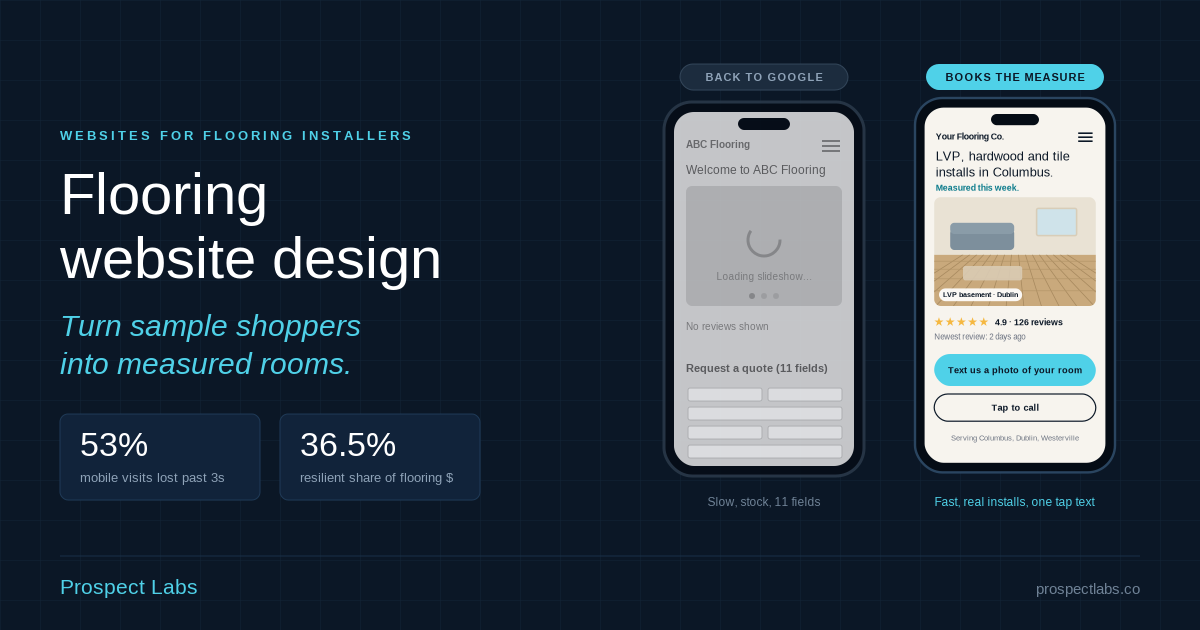
The first website opens with a slideshow of a showroom she’ll never visit. It takes so long to load that she’s already back on Google before the second slide. The second site looks fine but has one page called “Services” that lists everything from carpet to epoxy in a single paragraph. The quote form wants eleven fields, including square footage she doesn’t know.
The third site loads before she’s finished scrolling. The headline says “LVP, hardwood and tile installation in Columbus. Measured this week.” Below it: a finished basement that looks a lot like hers, 4.9 stars from 126 reviews, and a button that says “Text us a photo of your room.” She sends one. By Thursday, someone is in her living room with a laser measure.
| Quick answer: A good flooring website design loads in under three seconds on a phone, shows real installs, gives each floor type (LVP, hardwood, refinishing, tile and carpet) its own page, makes your service area obvious, shows fresh reviews and offers a one tap way to call or text. Its job is booking measures, not looking pretty. |
This guide is about the website itself: the pages, the first screen, speed, photos, lead capture, trust signals and SEO structure. For the bigger picture of channels, ads and referrals, see our guide to flooring marketing.
What should a flooring website actually do?
A flooring website has one job: turn a homeowner who’s comparing installers into a booked measure or estimate. To do that, it has to prove three things fast. You install the floor they want, you work in their town, and you do clean, careful work that other homeowners vouch for.
Flooring is a high consideration, highly visual purchase. Homeowners live with their decision for 15 years or more, and most of them can buy the planks themselves at a big box store on Saturday. What they can’t buy off a shelf is a flat subfloor, tight seams, clean transitions and a crew that puts the furniture back. Your website has to sell workmanship and trust, not product.
That’s also why so many flooring websites underperform. They look like brochures. They describe the company instead of answering the homeowner’s questions, and they make getting in touch feel like work. If that sounds familiar, our piece on why a contractor website isn’t getting jobs explains the pattern.
What pages does a flooring contractor website need?
At minimum, a flooring contractor website needs a homepage, a separate page for each floor type you install, service area pages for your main towns, a project gallery, a reviews page, an about page with your licensing and training, and a contact or booking page. Each page should target the search a homeowner actually types.
THE PAGES EVERY FLOORING WEBSITE NEEDS
| Page | What goes on it | Searches it can catch |
|---|---|---|
| Homepage | What you install, where, proof and one clear action | “flooring installer [town],” “flooring contractor near me” |
| LVP and SPC installation | Waterproof options, basements and kitchens, subfloor prep, real photos | “LVP installation near me,” “waterproof flooring installers” |
| Hardwood installation | Solid versus engineered, acclimation, nail down, glue down and floating methods | “hardwood floor installation [town]” |
| Hardwood refinishing | Sanding, stain samples, dust containment, how long the house is off limits | “hardwood floor refinishing near me” |
| Tile installation | Bathrooms, kitchens, mudrooms, heated floors, large format tile | “tile installer [town]” |
| Carpet installation | Bedrooms, stairs, padding options, old carpet removal | “carpet installation near me” |
| Subfloor and floor repair | Squeaks, water damage, leveling, moisture testing | “subfloor repair,” “floor leveling contractor” |
| Service area pages | Each main town, with real jobs completed there | “flooring company [town]” |
| Project gallery | Before and after sets organized by room and material | Image search and trust building |
| About | Crew photos, insurance, warranty, CFI or NWFA training | Brand searches and trust checks |
| Contact or book a measure | Call, text, short form and the measure process explained | Brand searches |
Lead with resilient flooring. According to Floor Covering News, resilient products like LVP, SPC and WPC made up about 36.5% of US flooring dollars in 2025, so for most installers that page will be the busiest on the site. Put it first in your menu.
What should the first screen of a flooring website show?
Within one phone screen, a homeowner should know what you install, where you work, why they should trust you, and how to reach you in one tap. Everything else can wait for the scroll. Most flooring sites fail this test because the first screen is taken up by a logo, a slideshow or a welcome paragraph.
A WEAK FIRST SCREEN VERSUS A STRONG ONE
| Element | Weak | Strong |
|---|---|---|
| Headline | “Welcome to ABC Flooring” | “LVP, hardwood and tile installation in Columbus. Measured this week.” |
| Main image | Stock photo of a staged showroom | Your crew’s finished basement, shot in natural light |
| Proof | Nothing above the fold | “4.9 stars from 126 Google reviews,” with the newest review date |
| Action | An eleven field quote form | Tap to call and “Text us a photo of your room” |
| Location | Hidden in the footer | “Serving Columbus, Dublin, Westerville and Hilliard” |
How fast does a flooring website need to load?
Fast enough to load before the homeowner gives up. Google research found 53% of mobile visits are likely to be abandoned when a page takes longer than three seconds to load, and Google’s 2017 benchmark research found the chance of a visitor bouncing rises 32% as load time grows from one to three seconds.
Flooring sites have a specific weakness here: photos. The same gorgeous wide shots that sell the job are often uploaded straight from a camera at 6 or 8 MB each. Compress every image, use modern formats like WebP, size images to the space they actually fill, load photos below the first screen only as people scroll, and skip autoplay video and sliders on the homepage.
Google measures this with Core Web Vitals. These are the targets to aim for:
CORE WEB VITALS TARGETS FOR A FLOORING WEBSITE
| Metric | What it measures | Good score | Common flooring site problem |
|---|---|---|---|
| Largest Contentful Paint (LCP) | How fast the main image or headline appears | 2.5 seconds or less | A huge uncompressed hero photo |
| Interaction to Next Paint (INP) | How quickly the page responds to taps | 200 milliseconds or less | Heavy chat widgets and room visualizer plugins |
| Cumulative Layout Shift (CLS) | How much the page jumps while loading | 0.1 or less | Images without set dimensions and popups |
Thresholds from Google’s Core Web Vitals guidance. Check your own scores free in Google PageSpeed Insights.
Which photos actually sell flooring jobs?
Real photos of your own installs, shot well, outperform any stock image. Homeowners want to picture their own room, see that your seams and transitions are clean, and trust that your crew will respect their home. A good gallery answers all three before you ever pick up the phone.
THE FLOORING PHOTOS WORTH TAKING ON EVERY JOB
| Shot | Why it works |
|---|---|
| Wide shot of the finished room in natural light | Helps homeowners picture the result in their own space |
| Before and after from the same angle | Proves the change better than any description |
| Close ups of seams, transitions and stair nosing | Shows the workmanship where cheap installs fall apart |
| Subfloor prep in progress, like leveling or moisture testing | Shows you do the work others skip |
| Crew on site with shoe covers and furniture protected | Builds trust about having strangers in the house |
| Material close up, named (“7 inch white oak”) | Matches what homeowners search and compare |
Caption each project with the room, material and town (“Engineered white oak in a Westerville living room”), and write alt text the same way. It helps homeowners, Google and AI tools understand what you do and where.
How should a flooring website capture leads?
Make getting in touch easier than closing the tab. Give homeowners three options on every page: tap to call, text a photo of the room, or book a measure with a short form. Keep forms to name, phone, town and floor type. Square footage can wait for the measure.
Text matters more in flooring than most trades. A photo of the room tells you more than a form ever will: the current floor, the transitions, the stairs, the furniture. And it’s easier for a homeowner sitting on that floor at 9 PM than a phone call.
Then make sure every enquiry gets an instant reply, because installers can’t answer the phone with adhesive on their hands. A missed call text back, instant form replies and a few automatic follow ups keep the conversation alive until you’re off your knees. We walk through what really happens when you miss a call, and it plays out the same way for flooring.
Consider a simple price guide, too. Homeowners want a ballpark before they invite someone in. Angi puts the average 500 square foot installation around $3,161. Publishing your own typical ranges per square foot for each floor type filters out bad fits and builds trust with good ones.
How do reviews and trust signals fit into flooring website design?
Reviews belong on the website, not just on Google. BrightLocal’s 2026 survey found 47% of consumers won’t use a business with fewer than 20 reviews, 74% only care about reviews from the last three months and 31% now expect 4.5 stars or higher. Show recent reviews near every call to action.
Flooring has trust signals that most installers forget to mention. Say that you’re insured and spell out your workmanship warranty. If your installers have training through the Certified Flooring Installers Association (CFI) or the National Wood Flooring Association (NWFA), show it. And explain that you install to manufacturer guidelines, because homeowners worry about voiding a product warranty with a bad install. To keep new reviews coming in, our guide to getting more five star Google reviews has wording you can use at the final walkthrough.
COMMON FLOORING WEBSITE MISTAKES AND HOW TO FIX THEM
| Mistake | Why it costs jobs | Fix |
|---|---|---|
| One “Services” page for every floor type | Can’t rank for specific searches and doesn’t answer specific questions | A dedicated page for each floor type |
| Stock photos or manufacturer images | Homeowners can’t see your actual work | Real installs, captioned with room, material and town |
| Long quote form | People quit halfway | Name, phone, town, floor type, plus a text option |
| Phone number only in the footer | Mobile visitors can’t find it | A tap to call button pinned on every screen |
| No service area info | Homeowners aren’t sure you come to them | Towns in the headline and on dedicated pages |
| Reviews only on Google | Proof is missing at the moment of decision | Recent reviews beside every call to action |
| Heavy homepage slider | Slow loads and no clear message | One strong photo, one headline, one action |
How does SEO fit into flooring website design?
SEO starts with structure. Give every page one clear H1, a title tag that names the floor type and town, and a meta description written for humans. Link related pages to each other, keep your business name, address and phone identical everywhere, and add LocalBusiness schema so search engines understand who you are.
For flooring installers, the HomeAndConstructionBusiness schema type fits well, with your service area and services listed. Link your website to your Google Business Profile and vice versa, and make sure the services on both match. Our guide to local SEO for contractors covers the profile side in detail.
This structure matters beyond Google too. BrightLocal found that the share of consumers using AI tools like ChatGPT for local recommendations jumped from 6% to 45% in a single year. Those tools lean on clear service pages, consistent business details and plenty of recent reviews. A well structured flooring site shows up in both places. It’s the same page by page approach we lay out in our HVAC website design guide, adjusted for a visual trade.
What does a flooring website cost, and is it worth it?
Flooring websites range from one time builds that cost a few thousand dollars and slowly go stale, to monthly plans that include hosting, updates and lead follow up tools. Our guide to contractor website design breaks down the general cost options in more detail. The right question isn’t the price of the site. It’s how many measures the site books compared with what it costs.
Run the math on your own average job. If an install averages around $3,161, one extra booked job a month covers most website plans many times over. Prospect Labs, for example, builds and maintains the website plus the follow up system around it for one monthly price starting at $297 a month, month to month. That’s roughly a tenth of one average install. Simple arithmetic, not a promise. If you’re comparing providers, our guide to choosing a contractor marketing agency lists the questions worth asking.
Your flooring website launch checklist
WHAT TO CHECK BEFORE AND AFTER LAUNCH
| Window | Focus | What to do |
|---|---|---|
| Before launch | Structure and proof | Build a page for each floor type and top town, upload 20+ real project photos, add recent reviews, set tap to call and text buttons |
| First 30 days | Speed and tracking | Test every page in PageSpeed Insights, fix anything over three seconds, set up call and form tracking, connect missed call text back |
| Days 31 to 90 | Grow and refine | Add a project page after every notable job, request a review at every walkthrough, check which pages bring enquiries and improve the rest |
If you’d rather have it built for you, that’s exactly what we do for flooring installers. You can see real builds before deciding anything.
Flooring website design FAQs
What makes a good flooring website?
A good flooring website loads fast on a phone, shows real installs, gives each floor type its own page, makes the service area obvious, shows recent reviews and makes it easy to call, text or book a measure. It’s built to book appointments, not just to look good.
How many pages should a flooring website have?
Most flooring installers need around 10 to 15 pages to start: a homepage, one page per floor type, pages for the main towns served, a gallery, reviews, about and contact. Add project pages over time. More useful pages give Google and homeowners more ways to find you.
Should I show prices on my flooring website?
Showing typical price ranges per square foot usually helps. Homeowners want a ballpark before inviting someone in, and ranges filter out bad fits. Explain what affects the final price, like subfloor condition, removal, stairs and transitions, so the estimate doesn’t surprise anyone.
Do I need a separate page for each flooring type?
Yes. Homeowners search for specific floors like LVP installation or hardwood refinishing, and a dedicated page ranks better and answers their questions more clearly than one general services page. Each page should include real photos, process details and a clear way to book.
How do I make my flooring website load faster?
Compress and resize every photo, use modern image formats like WebP, load images below the first screen only as visitors scroll, remove homepage sliders and autoplay video, and limit heavy plugins. Then test with Google PageSpeed Insights and aim for the main content to appear in 2.5 seconds or less.
Should a flooring website have a room visualizer?
A visualizer can help showrooms selling many products, but for most installers it adds weight and slows the site down. Real before and after photos of your own work usually persuade better. If you add one, test your speed scores afterward and keep it off the homepage.
Your next floor job is already searching for you
Somewhere in your service area tonight, a homeowner is holding a plank sample over a tired floor, phone in the other hand, comparing three installers’ websites. The one that loads fast, looks trustworthy and makes it easy to reach out gets the measure.
On a 60 minute call we’ll look at your website, your Google profile and how your enquiries are handled today, then show you the full system running on live client accounts, plus a free design preview of your new site. If it isn’t a fit, we’ll tell you straight.
| About Prospect Labs: Prospect Labs builds websites and marketing systems for contractors across the US, including flooring installers, roofers, electricians, remodelers and 20+ other trades. Every build includes local SEO, missed call text back, automated follow up and a five star review funnel, all month to month. |