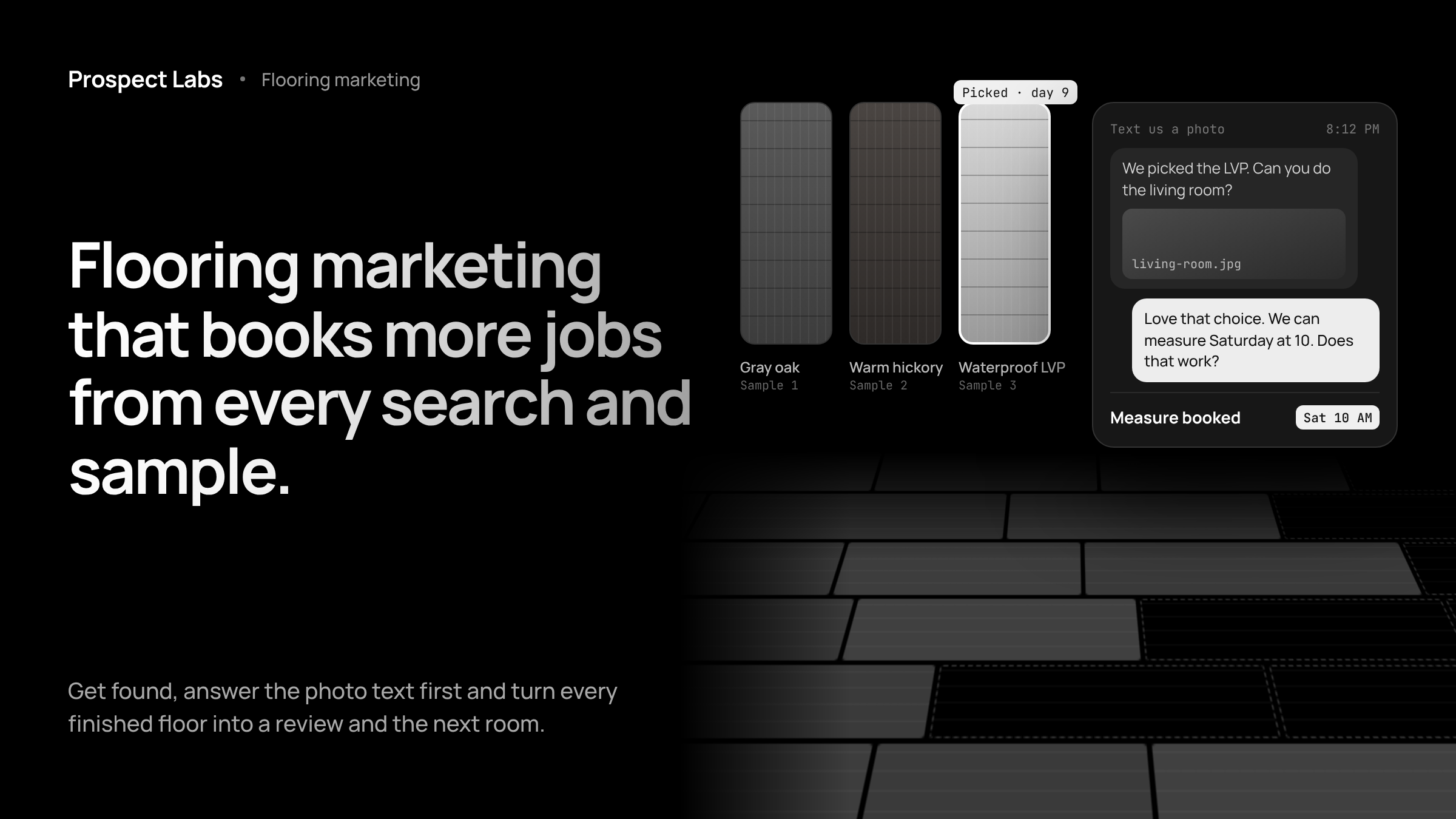

Three plank samples have been lying on a living room floor in Charlotte for nine days. One is a gray oak, one is a warm hickory, and one is a waterproof LVP the dog has already tested with muddy paws. Tonight the homeowner finally picks the LVP, snaps a photo of it next to the scratched hardwood it’s replacing, and searches “flooring installer near me.”
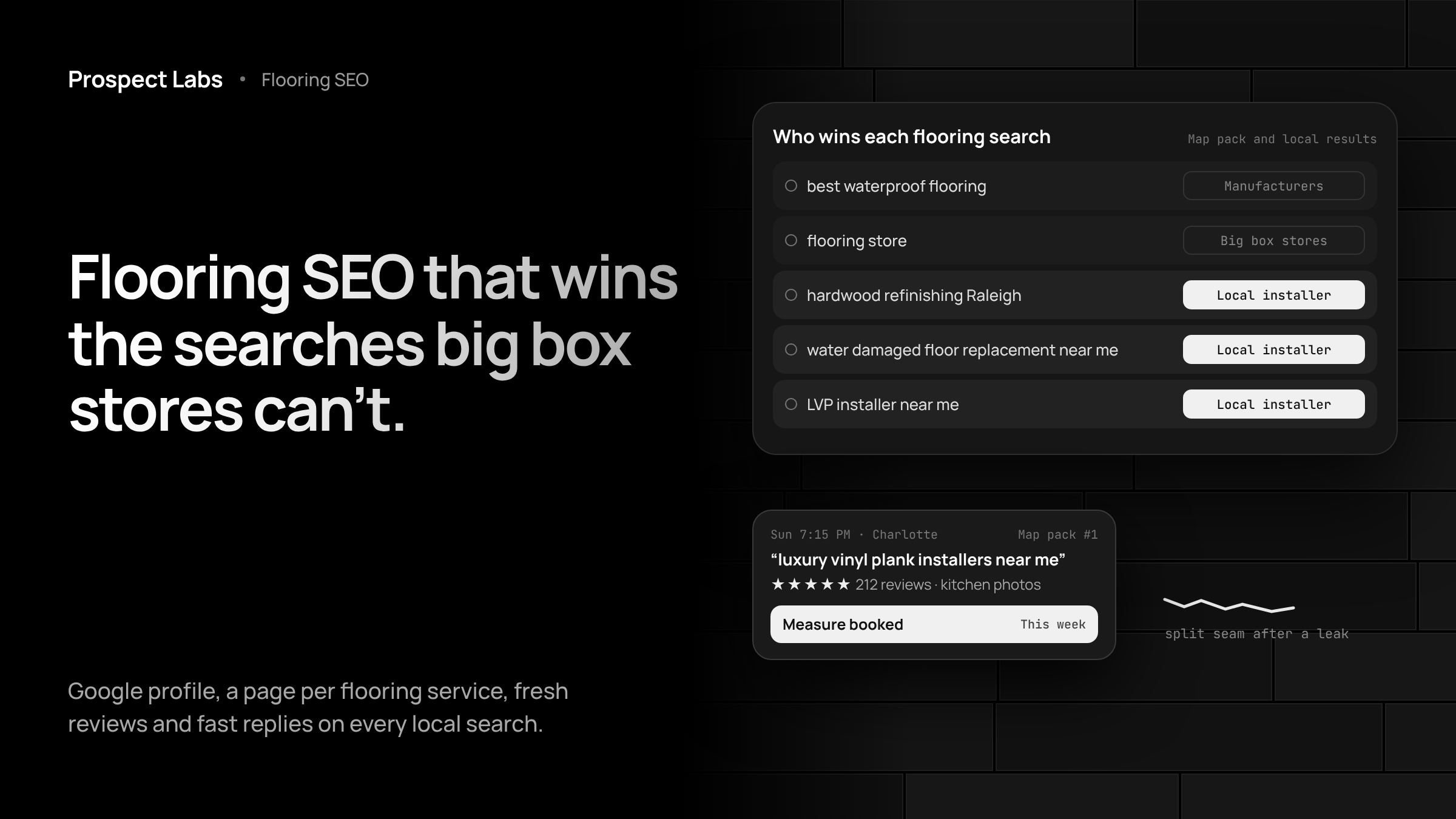
Three names come up in the map pack. The first has 11 reviews and no photos newer than 2023. The second sends them to a contact form that asks for square footage they don’t know. The third has a gallery of finished living rooms, a fresh review that mentions a golden retriever, and a button that says “Text us a photo of your room.” They send the picture they just took. A reply lands before they’ve put the samples away.
Same samples, same budget, same search. By the weekend, the third installer has measured the room, and the other two never knew the job existed.
That’s flooring marketing in a single evening. Not a logo. Not a billboard. It’s whether your business shows up, looks like the safe choice, and answers first.
| Quick answer: Flooring marketing is the system a flooring installer uses to get found by homeowners planning new floors, win their trust with reviews and real project photos, reply to every enquiry fast, and turn finished installs into reviews and referrals. |
This guide covers how homeowners actually pick a flooring installer, the 2026 numbers worth knowing, which channels book jobs, why leads go cold, and a simple 90 day plan you can start this week.
What is flooring marketing, really?
Flooring marketing covers everything that moves a homeowner from “our floors look tired” to a signed estimate and, later, a referral. For an installer, that usually comes down to five jobs: getting found on Google, proving you do clean work, answering fast, following up until a decision is made, and asking every happy customer for a review.
Installers sell something different from a showroom. A homeowner can buy SPC planks at a big box store on Saturday. What they can’t buy off a shelf is a level subfloor, tight seams, transitions that don’t catch a toe, and a crew that puts the furniture back where it was. Your marketing has to sell workmanship and trust, not product.
That’s why we treat it as one connected marketing system for contractors, not a pile of separate tactics. A great website with no follow up still loses jobs. Great reviews with a slow reply still lose jobs. Each piece only pays off when the next one catches the lead. Our home service marketing guide shows how the same idea works across every trade.
How big is the US flooring market, and why does it matter for your marketing?
According to Floor Covering News, total US flooring sales slipped 1.8% in 2025 to about $23.5 billion, while the volume sold fell 3.1% to roughly 16.7 billion square feet. Floor Covering Weekly has pointed to existing home sales as a major driver of replacement flooring, and reported that this driver has dropped by about a third since 2021.
In plain terms: fewer people are moving, so fewer floor jobs show up on their own. The homeowners who are buying are shopping harder and comparing more. In a flat market, growth comes from taking share, and share goes to the installer who’s easiest to find and easiest to trust.
TABLE 1. Where US flooring dollars went in 2025
| Category | 2025 figure | What it means for your marketing |
|---|---|---|
| Total US flooring sales | About $23.5 billion, down 1.8% | A flat market. Growth comes from winning share, not waiting for demand. |
| Total volume | About 16.7 billion sq ft, down 3.1% | Fewer square feet sold, so every single enquiry is worth more. |
| Resilient (LVP, SPC, WPC, sheet vinyl) | About $8.6 billion, 36.5% of dollars | Usually your busiest service page and ad group. Lead with LVP. |
| SPC rigid core alone | About $3.5 billion, roughly 15% of all flooring | Homeowners search “SPC” and “waterproof flooring” by name. Use those words. |
| Ceramic tile | About $2.95 billion, roughly 12.5% of dollars | Kitchens and bathrooms. Pair tile pages with remodel searches. |
Sources: Floor Covering News 2026 statistics on total industry, resilient and ceramic tile.
How do homeowners choose a flooring installer?
Fast, on a phone, from a very short list. BrightLocal’s 2026 consumer research found that 73% of local searches start on mobile, 72% of people look at three or fewer businesses before deciding, and 75% make their choice in under 30 minutes.
Reviews sit right in the middle of that decision. BrightLocal’s Local Consumer Review Survey 2026 reports that 97% of consumers read reviews for local businesses, and its search behavior research found that 65% of people who rejected a business did so for a review reason: a low rating, negative reviews, or no recent ones.
There’s a newer twist too. The same 2026 survey found 45% of consumers now use AI tools like ChatGPT for local recommendations. Those tools lean on the same signals Google does: clear service pages, consistent business details and plenty of recent reviews. Get the basics right and you show up in both places.
Here’s what a lost floor job usually looks like:
TABLE 2. Anatomy of a lost flooring job
| Time | What happens | Where the job leaks |
|---|---|---|
| 7:48 PM | Homeowner searches “hardwood floor refinishing near me” | Your Google Business Profile has nine reviews, the newest from last year |
| 7:51 PM | Taps your website | No photos of real jobs, no price guide, no quick way to ask a question |
| 7:53 PM | Calls you | You’re on your knees with a trowel. It rings out. No text goes back. |
| 7:56 PM | Calls the next installer | Someone answers on the second ring and books a measure |
| Next day | You call back | They’ve already booked someone else |
Eight minutes from search to lost. You never knew it happened.
Which flooring marketing channels actually book jobs?
Not every channel pulls its weight. Some catch homeowners at the exact moment they’re ready to hire. Others build awareness that pays off months later. Here’s how they stack up for a flooring installer.
TABLE 3. Flooring marketing channels compared
| Channel | Buyer intent | How you pay | Time to results | Watch out for |
|---|---|---|---|---|
| Google Business Profile and map pack | Very high | Free (your time) | Weeks | Thin profile, old photos, few recent reviews |
| Local SEO and service pages | High | Your time or an agency | 3 to 6 months | One generic “Services” page for every floor type |
| Google Local Services Ads | Very high | Pay per lead | Days | Availability varies by area; disputing bad leads takes effort |
| Google search ads | High | Pay per click | Days | Broad keywords that attract DIY shoppers |
| Angi, HomeAdvisor, Thumbtack | Medium | Pay per lead | Days | Shared leads, so you race several installers |
| Houzz, Facebook, Instagram | Low to medium | Free or paid | Months | Pretty posts with no way to book |
| Referral and past customer campaigns | Very high | Almost free | Weeks | Nobody remembers to send them |
Google Business Profile: your real front door
For many homeowners, your Google Business Profile is the first and last thing they see. Set your primary category to Flooring contractor, add each service you offer (LVP installation, hardwood installation, refinishing, tile, carpet, subfloor repair), list the towns you actually serve, and add photos of real jobs every week. A finished staircase in natural light beats any stock image. Our guide to local SEO for contractors walks through the full setup.
Service pages that match how people search
Homeowners don’t search “flooring services.” They search “LVP installation cost,” “engineered hardwood vs solid hardwood” or “tile installer for a small bathroom.” Give each floor type its own page with real photos, typical timelines, what’s included (removal, moisture testing, subfloor prep, trim and transitions) and one obvious way to get in touch. Our breakdown of contractor website design covers exactly what those pages need.
Paid ads and lead marketplaces
Google Local Services Ads and search ads can fill a slow month quickly, as long as your site and follow up are ready to catch the leads. Angi, HomeAdvisor and Thumbtack can work too, but you’re usually one of several installers getting the same lead. Treat them as rented traffic. Your own profile, website and reviews are the assets you keep. If you’re thinking of handing this off, read our guide to choosing a contractor marketing agency first.
Visual proof on social media
Floors are one of the most visual trades there is. Short before and after clips (old carpet up, new oak down) do well on Instagram and Facebook, and they double as website and Google profile content. Tag the town with each job so neighbors recognize it.
Why do flooring leads go cold so fast?
Because the homeowner keeps searching until somebody answers. The often cited Harvard Business Review study The Short Life of Online Sales Leads found that companies that contacted a lead within an hour were nearly seven times more likely to have a meaningful conversation than those that waited even one more hour, and over 60 times more likely than those that waited a day.
Installers have a built in problem here. You can’t answer the phone with adhesive on your hands or a nailer in the middle of a row. That’s not a work ethic issue. It’s a systems issue.
The fix is a missed call text back that replies in your business name the moment a call goes unanswered, followed by automatic follow ups if the homeowner goes quiet. We walk through what really happens when you miss a call, minute by minute, and it plays out exactly the same way in flooring.
TABLE 4. Just a website vs a flooring marketing system
| The moment | Just a website | A flooring marketing system |
|---|---|---|
| Homeowner visits | Looks at a few photos, finds no easy next step, leaves | Texts you a photo of the room in one tap |
| You miss a call | It rings out. They call the next installer. | They get a text in your business name right away |
| Estimate goes quiet | Nobody follows up | Friendly follow ups keep the conversation going |
| Furniture goes back in | You mean to ask for a review, then forget | A review request goes out the same day, with reminders |
| A year later | They forget your name | A “next room” or referral campaign brings them back |
How many reviews does a flooring company need?
More than most installers think, and they need to be fresh. According to BrightLocal’s 2026 review survey, 74% of consumers only care about reviews from the last three months, 68% will only use a business rated four stars or higher, and 47% won’t use a business with fewer than 20 reviews.
So the goal isn’t a burst of reviews once a year. It’s a steady trickle from every finished job. The best moment to ask is the final walkthrough, when the homeowner is standing on their new floor and smiling. A simple text with a direct review link, plus a polite reminder a few days later, does most of the work. We cover the wording in our guide to getting more five star Google reviews.
One small trick: ask customers to mention the floor type and their town. A review that says “Our new LVP in the basement in Plano looks amazing” helps the next homeowner decide and helps your local rankings at the same time.
What does a flooring job have to be worth for marketing to pay off?
Less than you’d think. Angi puts the average cost of a 500 square foot flooring installation at about $3,161, or around $12.50 per square foot. One average job a month can cover a serious marketing system and leave plenty of margin.
Prospect Labs, for example, runs the whole system for one monthly price starting at $297 a month, month to month. That’s roughly a tenth of one average install. Simple arithmetic, not a promise, but it shows why a single recovered missed call can pay for months of marketing.
Whatever you invest in, track these five numbers every month:
TABLE 5. The five flooring marketing numbers worth tracking
| Metric | What it tells you | How to improve it |
|---|---|---|
| Leads per month (by source) | Which channels actually bring enquiries | Double down on your top two sources |
| Response time | How many leads you lose before a conversation starts | Missed call text back and instant replies |
| Lead to measure rate | Whether your replies and follow up work | Follow up three or four times before giving up |
| Measure to signed job rate | How well your estimate and proof convince | Show photos of similar jobs and recent reviews at the estimate |
| New reviews per month | Whether trust is growing or going stale | Ask at every walkthrough, every time |
How do flooring installers get more repeat and referral work?
Floors last for years, but homes have a lot of rooms. The customer who got new LVP in the basement may want hardwood upstairs next spring, new stair treads, or a refinish in a few years. A short “next room” message to past customers every few months costs almost nothing and reaches people who already trust you. Our guide to referral marketing for contractors shows how to set it up without feeling pushy.
Trade partners matter too. Remodelers, kitchen and bath designers, realtors and property managers all need a reliable flooring sub. Our guide to remodeling marketing shows how remodelers win their projects, which tells you exactly what they want from a flooring partner: fast replies, clean job sites and no surprises. And the storm driven demand we cover in roofing marketing often spills into water damaged floors, so a good relationship with a couple of local roofers is worth a coffee.
A simple 90 day flooring marketing plan
TABLE 6. Your first 90 days
| Window | Focus | What to do |
|---|---|---|
| Days 1 to 30 | Get found and get answered | Complete your Google Business Profile, add 20+ real job photos, set up missed call text back, add a one tap text button to your website |
| Days 31 to 60 | Build trust | Send a review request after every job, build separate pages for LVP, hardwood, tile, carpet and refinishing, add pages for your top towns |
| Days 61 to 90 | Grow and repeat | Send a “next room” campaign to past customers, reach out to three remodelers or realtors, review your five numbers and cut what isn’t working |
If you’d rather not build all of that yourself, that’s exactly what our seven stage system does for installers, from getting found to bringing past customers back. You can see real builds before deciding anything.
Flooring marketing FAQs
What is the best marketing for a flooring company?
For most flooring installers, the best marketing is a complete Google Business Profile, a fast website with a page for each floor type, quick replies to every call and text, and a steady flow of fresh reviews. Paid ads help, but only once those basics catch leads properly.
How much should a flooring installer spend on marketing?
Work backward from your average job. If an install averages around $3,000, you can afford to spend a meaningful share of one job to win several. Track cost per signed job rather than cost per lead, because cheap leads you never reach are not cheap.
Are Angi and HomeAdvisor worth it for flooring installers?
They can fill gaps, especially when you’re starting out. The catch is that leads are often shared, so you’re racing other installers to reply. Use them alongside your own Google profile, website and reviews, which keep working without a fee per lead.
How long does SEO take for a flooring business?
Google Business Profile improvements can show results within weeks. Ranking service pages for terms like LVP installation or hardwood refinishing in your area usually takes three to six months, depending on local competition, your reviews and how long your site has been live.
Do flooring installers need a website if they have a Google Business Profile?
Yes. Your profile gets you noticed, but most homeowners click through to check real photos, services and prices before they reach out. A website built for phones, with a one tap way to text you, turns that visit into a real conversation.
How can I get more flooring leads without paying per lead?
Improve your Google Business Profile, ask every customer for a review, build a page for each floor type and town you serve, post before and after photos, and run referral campaigns to past customers. These channels build on each other over time instead of resetting every month.
Your next floor job is already searching for you
Somewhere in your service area tonight, a homeowner is standing on a tired floor, phone in hand, comparing three installers. The one who shows up, looks trustworthy and answers first gets the measure.
On a 60 minute call we’ll look at your Google profile, your website and how your calls are handled today, then show you the full system running on live client accounts. If it isn’t a fit, we’ll tell you straight.
[Book a strategy call](https://go.prospectlabs.co/booking-website)
About Prospect Labs: Prospect Labs builds websites and marketing systems for contractors across the US, including flooring installers, roofers, remodelers, plumbers and 20+ other trades. Every build includes local SEO, missed call text back, automated follow up and a five star review funnel, all month to month.