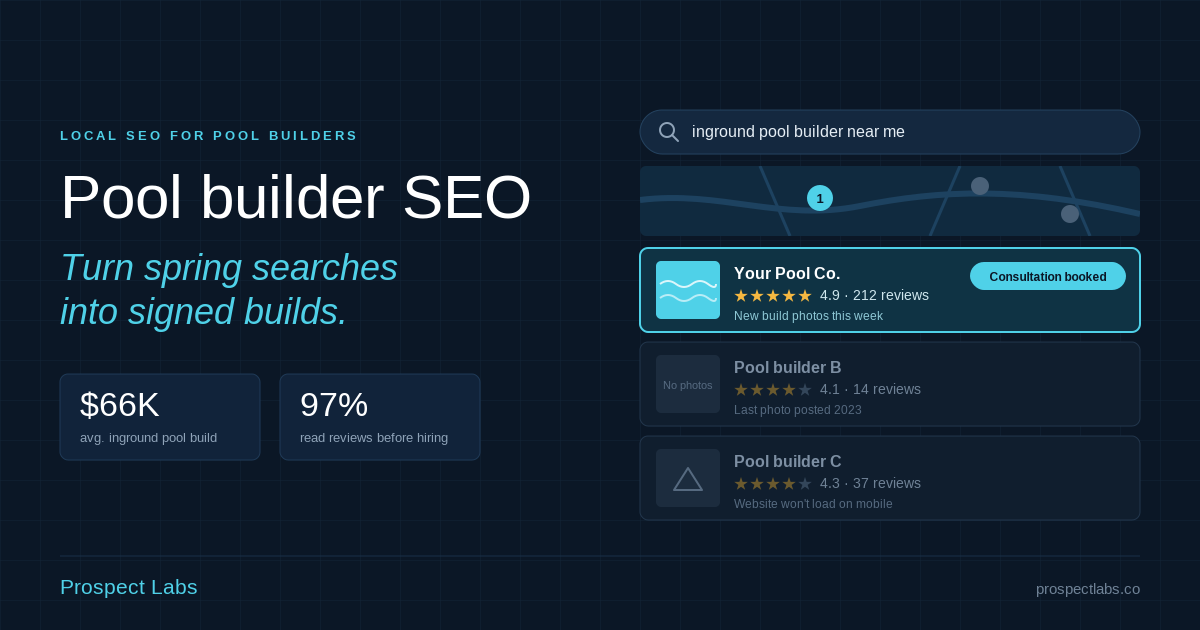

It’s 8:40 on a Sunday night in early March. A couple in Plano has three browser tabs open on the couch. One shows a fiberglass pool they saw on Instagram. One shows a financing calculator. The third is a Google search for “inground pool builder near me.”
They scroll past the ads and look at the map. Three pool companies show up. One has 212 reviews and photos of finished backyards from last month. One has 14 reviews and no photos since 2023. The third has a website that won’t load on the phone.
By Tuesday, the first company has a design consultation on the calendar. A $66,000 project just picked a builder before a single phone call was made. That’s what pool builder SEO decides, and most pool companies never see the moment it happens.
Quick answer: Pool builder SEO is the process of getting a pool construction company to rank in Google’s map pack and organic results for searches like “pool builder near me” and “fiberglass pool installation [city].” It combines a fully optimized Google Business Profile, steady recent reviews, dedicated service and city pages, project photos and fast technical setup.
This guide walks through each piece in the order it matters, with real numbers from the pool industry and from US homeowner surveys. Where it fits, we’ll show how Prospect Labs connects SEO to the rest of the job: answering the call, following up the lead and asking the finished backyard for a review.
What Is Pool Builder SEO?
Pool builder SEO is search engine optimization built around how homeowners shop for a new pool. It covers three surfaces: the Google map pack (the three listings under the map), the organic results below it, and the AI answers that now sit above both.
General contractor SEO tips don’t fully transfer, because a pool is not an emergency repair. Nobody searches “pool builder” at midnight with water on the floor. They research for weeks, compare finishes, check financing and read reviews from neighbors before they ever fill out a form. That longer path changes what your website needs to do.
The core entities in pool builder SEO are:
- Your Google Business Profile, with the primary category set to Swimming pool contractor.
- Service pages for each build type you sell: fiberglass, gunite or shotcrete concrete, and vinyl liner.
- City pages for the towns and suburbs where you actually dig.
- A project gallery that proves real backyards, real yards and real timelines.
- Reviews, in volume and recency.
- Technical signals like page speed, mobile layout and structured data.
Why Does SEO Matter More for Pool Builders Than for Most Trades?
Because there are fewer buyers and each one is worth far more. New pool construction has roughly halved since the pandemic boom, so every homeowner who is still shopping is fought over harder. A roofer can lose a repair lead and get three more next week. A pool builder who loses one March consultation can lose a whole crew week in June.
| Pool market fact | Figure | What it means for your SEO |
|---|---|---|
| New inground pools built in the US, 2021 peak | About 120,000 | The boom years hid weak marketing |
| New inground pools built in the US, 2025 | Just under 60,000 | Half the buyers, so rankings decide who gets them |
| Share of new pool starts in Florida, California, Texas and Arizona | About two thirds | Sunbelt markets are the most crowded map packs |
| Average inground pool cost, 2026 | $66,000 (typical range $44,300 to $86,500) | One extra signed build can cover years of marketing |
| Concrete inground pool range | $65,000 to $120,000 | Gunite pages deserve their own depth |
| Fiberglass inground pool range | $25,000 to $60,000 | A high volume search category in most markets |
| Vinyl liner inground pool range | $20,000 to $40,000 | Budget buyers search for this by name |
Sources: construction volumes and regional share from PoolDial’s 2026 pool industry statistics, which compiles Pool Corporation and Latham Group filings; cost ranges from Angi’s 2026 pool cost guide.
The reviews side is just as sharp. In BrightLocal’s Local Consumer Review Survey 2026, 97% of US consumers said they read reviews for local businesses, and 27% said they had spent more than $1,000 after reading them. A pool is the definition of a big ticket purchase made after reading reviews.
If you want the wider picture of choosing a partner for this work, our guide to picking a contractor marketing agency covers the questions to ask before you sign anything.
How Do Pool Builders Rank in the Google Map Pack?
Pool builders rank in the map pack by matching three things Google weighs for every local search: relevance to the query, distance from the searcher and prominence across the web. You can’t move your shop closer to every homeowner, so the work goes into relevance and prominence, and most of both lives in your Google Business Profile.
Set the right categories
Your primary category is the single strongest relevance signal on the profile. For a builder, that’s Swimming pool contractor. Add secondary categories only for work you actually sell, such as Swimming pool repair service, Pool cleaning service or Hot tub store. A category you don’t deliver brings calls you can’t take and reviews that don’t match.
Fill in services, not just the description
The services section lets you list each offering with its own short description. Most pool companies leave it half empty. List every build and remodel type by name: fiberglass pool installation, gunite pool construction, vinyl liner pools, pool resurfacing, pool remodeling, spa installation, outdoor kitchens and pool decks. Each one is a phrase Google can match to a search.
Define a real service area
If you don’t run a showroom, hide your street address and set a service area made of the counties and cities your crews reach. Keep it honest. A builder in Scottsdale who lists Tucson won’t rank there anyway, and it dilutes the areas you do serve.
Post finished backyards every week
Pool buying is visual. A weekly post with a photo of a finished build, the city it’s in and the pool type (“Fiberglass spool with sun shelf, Frisco”) keeps the profile active and gives searchers proof. Excavation day, gunite spray and the first fill are all strong posts too, because they show you actually build.
Keep your name, address and phone identical everywhere
Your business name, address and phone number should match exactly on your website footer, Google, Apple Maps, Yelp, the Better Business Bureau, Houzz and any pool industry directories. Mismatched listings make Google less sure the businesses are the same, which weakens prominence.
Answer the questions before customers ask them
Use the business description and your website FAQ to answer what buyers want to know: whether you offer financing, how long a fiberglass install takes in your area, whether you handle permits and fencing, and when your spring schedule fills. Google and AI tools pull from both. Every answer is one less reason to scroll to the next builder.
Getting found is stage one of the seven stage marketing system we build for contractors. Ranking only pays when the stages after it are working too.
What Pages Should a Pool Builder Website Have?
A pool builder website should have one dedicated page for every pool type you build, every major service you sell and every core city you serve, plus a project gallery and a cost page. One “Services” page that lists everything in a paragraph can’t rank for any of it.
Think of each page as an answer to one search. Someone typing “gunite pool builder Austin” wants a page about gunite pools in Austin, not a homepage that mentions both somewhere near the bottom.
| Page | Example search it answers | What it must include |
|---|---|---|
| Homepage | pool builder [city] | Who you are, where you build, review count, one clear way to start a conversation |
| Fiberglass pools | fiberglass pool installation [city] | Shell brands you install, typical install timeline, price range, finished project photos |
| Concrete (gunite or shotcrete) pools | custom gunite pool builder | Design process, finishes (plaster, pebble, tile), engineering and permit handling |
| Vinyl liner pools | vinyl liner pool cost | Liner life expectancy, wall options, honest comparison with fiberglass |
| Pool remodeling and resurfacing | pool resurfacing near me | Before and after photos, signs a pool needs work, typical project length |
| Spas and outdoor living | pool and spa builder, outdoor kitchen with pool | Add ons, package examples, how it ties into the build |
| City or service area pages | pool builder [suburb] | Local soil and permit notes, HOA tips, projects from that town |
| Pool cost page | how much does an inground pool cost in [state] | Your real price bands, what moves the number, financing options |
| Project gallery | [pool type] pool ideas | Captioned photos by pool type and city, with a short story per build |
| Financing | pool financing | Lender partners, sample monthly payments, how to apply |
Write city pages that are actually about the city
Thin city pages with the town name swapped in are easy to spot, for Google and for homeowners. A useful city page mentions what makes building there different: caliche soil in parts of Arizona, a high water table near the coast, HOA approval in master planned communities, or a city’s fence and barrier rules. Add two or three projects you built in that town and a review from a customer who lives there.
Build the pool cost page you’ve been avoiding
Many builders hide pricing because every yard is different. Homeowners search for cost anyway, and someone will rank for it. A page that explains your real price bands, what pushes a project up (access, excavation, rock, decking, water features) and how financing works pulls in early researchers and filters out mismatched budgets before the consultation.
Make every page start a conversation
A page that ranks but doesn’t capture is a cost, not an asset. Every service and city page needs a visible way to reach you on a phone: a tap to text button, a short design consultation form and your business number. The same principle drives how we approach HVAC website design and websites for electricians: the page exists to start the conversation, not to look pretty.
Which Keywords Should a Pool Builder Target?
Pool builders should target three layers of keywords: buying searches with a city attached, comparison searches that show a homeowner is choosing a pool type, and early research searches about cost and timelines. The first layer books consultations this month. The other two fill next season.
- Buying searches: pool builder near me, inground pool builder [city], fiberglass pool installer [city], custom pool builder [city], pool remodeling [city].
- Comparison searches: fiberglass vs gunite pool, vinyl liner vs fiberglass, saltwater vs chlorine pool, best pool shape for a small yard.
- Research searches: how much does an inground pool cost in [state], how long does it take to build a pool, do pools add home value, pool financing options.
Map each keyword to exactly one page. If your homepage, your fiberglass page and a blog post all chase “fiberglass pool builder [city],” they compete with each other and none of them wins.
When Should Pool Builders Start SEO for the Season?
Pool builders should start SEO work in the fall, months before the spring rush. Angi notes that most homeowners start pool projects in spring, ahead of summer, while equipment and contractor deals tend to show up in the off season. Rankings take time to build, so the pages and reviews you add in October are the ones that show up in March.
| Window | What homeowners are doing | What your SEO should be doing |
|---|---|---|
| September to November | Dreaming, saving, browsing photos | Publish cost and comparison pages, refresh gallery with summer builds, push for reviews from this season’s customers |
| December to February | Collecting quotes, comparing builders | Tighten city pages, answer financing questions, post weekly on your Business Profile |
| March to May | Booking consultations, signing contracts | Respond fast, keep posts and reviews fresh, track which pages bring calls |
| June to August | Swimming, sending neighbors your way | Ask every finished build for a review and photos, start referral campaigns |
In Florida, Arizona and South Texas the curve flattens, because pools sell almost year round. In the Northeast and Midwest it’s steep, and missing the window means waiting a year.
How Do Reviews Affect Pool Builder Rankings and Sales?
Reviews affect both, and for pool builders the sales effect is bigger. A homeowner spending $66,000 reads more reviews, more carefully, than someone hiring a handyman. BrightLocal’s 2026 survey shows how high the bar now sits:
| Review behavior (US consumers, 2026) | Share |
|---|---|
| Read reviews for local businesses | 97% |
| Only care about reviews from the last three months | 74% |
| Won’t use a business with fewer than 20 reviews | 47% |
| Only use businesses rated 4.5 stars or higher | 31% |
| Expect the business owner to respond to reviews | 89% |
| Left a review after being asked in the last year | 83% |
Source: BrightLocal Local Consumer Review Survey 2026, 1,002 US adults.
The last row is the one that matters most. Most people will review you if you ask, and most builders forget to ask. Pool builders have a natural moment for it: the first swim. Send a review request the week the pool is filled and the family is in it, with a direct link, and send a polite reminder if they don’t get to it. Reply to every review by name and mention the pool type and city, which adds relevance for the next search.
Do Project Photos Help Pool Builder SEO?
Yes. Photos are where pool buyers spend most of their time, and well labeled photos help both Google and AI tools understand what you build. Give each image a file name and alt text that describe it (“fiberglass pool with tanning ledge in McKinney TX”), compress it so the page stays fast, and group gallery photos by pool type and city. A short caption with the yard challenge and the build timeline turns a pretty picture into proof.
What Technical SEO Does a Pool Builder Website Need?
A pool builder website needs to load fast on a phone, be easy for Google to crawl and describe the business in structured data. Pool sites are photo heavy, which makes them slow by default, and a slow gallery on a weak signal in a backyard is a lost lead.
- Speed: serve images in a modern format like WebP, size them to the screen and lazy load anything below the fold. Aim for the main content to appear in under about two and a half seconds on mobile.
- Mobile layout: most pool research happens on a phone in the evening. Buttons should be big enough for a thumb, and the text or call option should stay visible as the visitor scrolls.
- Secure site: run everything over HTTPS so browsers don’t warn visitors away from your form.
- Clean structure: one H1 per page, headings that read like questions buyers ask, and internal links between related pages (fiberglass page to fiberglass gallery to fiberglass cost section).
- Index hygiene: submit an XML sitemap in Google Search Console, and make sure old landing pages and duplicate city pages aren’t competing with your real ones.
Which schema markup helps pool builders?
Schema is code that tells search engines exactly what a page is about. For pool builders, the useful types are:
| Schema type | Where it goes | What it tells Google |
|---|---|---|
| LocalBusiness (or HomeAndConstructionBusiness) | Homepage and contact page | Business name, phone, service area, hours, review rating |
| Service | Each pool type and service page | The specific service, who provides it and where |
| FAQPage | Pages with a real FAQ section | Questions and answers that can feed rich results and AI answers |
| BreadcrumbList | Every page | Where the page sits in your site |
| ImageObject | Gallery pages | What each project photo shows and where it was built |
How Do Pool Builders Show Up in AI Search?
Pool builders show up in AI search the same way they earn trust in regular search: consistent business facts, plenty of recent reviews and pages that answer questions clearly. AI is no longer a side channel. In BrightLocal’s 2026 survey, the share of consumers using ChatGPT and other AI tools for local recommendations jumped from 6% to 45% in a year, making AI the third most used source behind Google and Facebook.
AI tools build their answers from what they can find and verify. That means:
- Open each key page with a short, direct answer to the main question, the way this article does under each heading.
- Keep your name, address, phone and services identical across Google, Apple Maps, Yelp, Houzz and the BBB, since BrightLocal found Apple Maps use nearly doubled to 27% this year.
- Publish specifics AI can quote: price bands, timelines, warranty terms, service areas and the pool brands you install.
- Keep review flow steady, because AI review summaries are now read by 82% of consumers in the same survey.
None of this is a separate project. It’s the same pool builder SEO done with more precision.
Why Do Rankings Alone Not Book Pool Projects?
Rankings bring the homeowner to your door. They don’t open it. Go back to the couple in Plano. If they tap your listing on Sunday night, fill in a form and hear nothing until Wednesday, the builder who texted back on Monday morning gets the consultation. Your SEO did its job and still lost the build.
Pool leads leak in the same four places as every trade, only with bigger numbers attached:
- Missed calls. Your design consultant is on a site walk and the phone rings out. Homeowners rarely leave a voicemail. They call the next name on the map.
- Slow replies to forms. A pool shopper is often collecting three quotes in one evening. The first useful reply sets the tone.
- Quotes that go quiet. Pool decisions take weeks. Without follow up, a warm quote turns cold while the homeowner talks to a cheaper builder.
- Finished builds that never become reviews. Every completed pool is your best marketing asset, and most builders never ask for the review or the referral.
That’s why Prospect Labs builds the website as the front end of a complete system instead of a standalone site. The local SEO gets you found. A missed call text back replies in your business name within seconds. Automated follow ups keep a quoted homeowner warm through a long decision. A one click review request goes out after the first swim. Referral campaigns bring neighbors in the next summer. It’s the same approach we use for remodeling marketing and flooring marketing, adapted for a longer, higher value sale.
How Much Does Pool Builder SEO Cost?
Pool builder SEO usually costs a monthly fee rather than a one time project, because rankings need fresh content, reviews and updates to hold. What matters more than the fee is how many builds it takes to pay for itself.
| Marketing approach | How you pay | What one signed $66,000 build covers |
|---|---|---|
| Pay per lead platforms | Per lead, shared with other builders | A limited number of leads that competitors also receive |
| Paid search ads | Per click, every click | Clicks that stop the day the budget stops |
| Specialist SEO retainer | Monthly, often with a contract | Varies widely by agency and term length |
| Prospect Labs system (website, local SEO, missed call text back, review funnel, follow ups) | From $297 a month plus one time setup, month to month | About 18 years of the monthly fee |
The last row is simple arithmetic, not a promise: $297 a month is $3,564 a year, and the average inground pool is about $66,000. You can see the full breakdown on our pricing section. Results still depend on your market, your competition, your reviews and how quickly you respond.
How Do You Measure Pool Builder SEO Results?
Measure SEO by booked consultations and signed builds, not traffic. A pool builder who ranks first for a city nobody searches in has a nice screenshot and an empty calendar.
- Calls and texts from your Business Profile, tracked monthly and compared year over year, since pool demand is seasonal.
- Form and text enquiries by page, so you know whether the fiberglass page or the Frisco city page is producing.
- Map pack visibility across your service area, checked from several points in each town, not just from your office.
- Review count, average rating and review recency, against the 20 review and three month thresholds above.
- Consultation to contract rate, which tells you whether the leads SEO brings are the right budget and the right fit.
Pool Builder SEO FAQs
How long does pool builder SEO take to work?
Most pool builders see early movement in the map pack within a few months of fixing their Business Profile and reviews, while organic pages for competitive cities often take six to twelve months. Starting in the fall gives the work time to land before spring demand.
Is SEO better than pay per lead sites for pool builders?
SEO builds an asset you own, and the enquiries come only to you. Pay per lead sites deliver faster but share each homeowner with other builders. Many builders run both while SEO matures, then lean on SEO as rankings and reviews grow.
Do I need separate pages for fiberglass, gunite and vinyl pools?
Yes. Each pool type has its own searches, prices and questions. A dedicated page for each one can rank for its own terms, while a combined page usually ranks for none of them.
Can a pool builder rank in cities without an office there?
In the organic results, yes, with genuine city pages and local projects. In the map pack, distance from the searcher matters, so ranking far from your verified location is harder. Focus city pages on towns your crews actually serve.
What’s the most common pool builder SEO mistake?
Treating SEO as separate from the phone. Builders invest in rankings, then miss the call, reply to the form two days later and never ask the finished customer for a review.
Ready to Turn Pool Searches Into Signed Builds?
The homeowners who will sign next spring’s contracts are browsing right now. Whether they find you, hear back from you and see fresh reviews when they do is something you can set up this season.
On a 60 minute call we’ll look at your current website, your Business Profile and how calls are handled today, then show you the full system running on live client accounts. You can see how it works and browse our work first, or skip straight to it. If we’re not the right fit for your pool company, we’ll tell you.