
It’s 6:10 on a Wednesday morning in late April. A line of hail rolled across the north side of town overnight, and by breakfast the neighborhood Facebook group is full of photos: dented gutters, a cracked skylight, granules piled at the bottom of every downspout. Dozens of homeowners will search “roof inspection near me” before lunch. A couple of out of state crews are already parking their trucks at the end of the street.
By Friday, most of those homeowners will have booked an inspection with somebody. The roofers who get those inspections aren’t always the best roofers in town. They’re the ones who showed up in the search, looked trustworthy at a glance, and answered first.
That’s the whole game. You don’t need more noise. You need more chances to be found, and fewer leads leaking out after you’re found.
| Quick answer: To get more roofing leads, show up where homeowners search (your Google Business Profile, Local Services Ads and service pages), earn fresh reviews after every job, build referral partners like home inspectors and insurance agents, and reply to every call and form within minutes. Fixing response time often adds more signed roofs than buying more leads. |
This guide covers the 2026 numbers worth knowing, the channels that bring roofing leads, what each lead really costs once you count your close rate, why so many go cold, and a 90 day plan you can start this week. For the wider strategy behind brand, ads and content, our roofing marketing guide covers the big picture. This one stays on leads.
What counts as a roofing lead, and which ones are worth chasing?
A roofing lead is a homeowner or property manager who has shown real interest in your work by calling, texting, filling out a form or booking an inspection, but hasn’t signed yet. The best roofing leads are exclusive to you, local to your service area, and tied to a real problem.
That last part matters. A homeowner with water dripping into a bucket behaves very differently from someone “thinking about a new roof next year,” and needs something different from you first.
TYPES OF ROOFING LEADS AT A GLANCE
| Lead type | What triggered it | Typical urgency | What they need from you first |
|---|---|---|---|
| Emergency repair | Active leak, missing shingles, a fallen limb | Same day | A fast reply and someone who can tarp it |
| Storm and insurance | Hail or high wind in the area | A few days | An inspection, photos and a calm walk through the claim process |
| Planned replacement | Roof age, selling the house, a failed inspection | Weeks to months | Proof of past work, material options and a clear estimate |
| Commercial | Flat roof leaks, TPO or EPDM wear, maintenance contracts | Weeks | Commercial experience, references and documentation |
| Referral | A neighbor, agent or inspector sent them | Varies | Proof you’re the roofer they were promised |
Why is getting roofing leads so hard right now?
Because nearly every roofer is fighting for the same short window. According to Roofr’s Roofing by the Numbers 2025, 63% of roofing business owners call new leads their number one growth challenge, yet only 28% use a CRM to track the leads they already get.
Read that second number again. Most roofing companies don’t have a lead shortage. They have a lead handling problem: calls ring out while the crew is on a roof, forms sit unread until Sunday night, and estimates go out without a single follow up.
Homeowners have also raised the bar. BrightLocal’s 2026 Local Consumer Review Survey found that 97% of consumers read reviews for local businesses and 45% now use AI tools like ChatGPT for local recommendations, up from just 6% a year earlier. Those tools lean on the same signals Google does: clear service pages, consistent business details and plenty of recent reviews.
And the stakes per job are high. Angi puts the 2026 national average for a roof replacement at about $9,610, based on nearly 33,000 projects. When one signed roof is worth that much, every missed call has a real price tag.
WHAT THE ROOFING NUMBERS SAY IN 2026
| Statistic | Source | What it means for you |
|---|---|---|
| 63% of roofing owners say new leads are their #1 growth challenge | Roofr, Roofing by the Numbers 2025 | The bar to stand out is lower than it looks |
| Only 28% of roofers use a CRM to track leads | Roofr | Most competitors lose leads you could catch |
| 71% of roofers rely on word of mouth referrals | Roofr | Referrals are the base. A system makes them predictable. |
| Roofers who ask for reviews average 500+ jobs a year, versus about 100 for those who don’t | Roofr | Asking is the cheapest growth lever in roofing |
| Only 21% use instant estimating tools | Roofr | Giving a homeowner a ballpark at 10 PM still sets you apart |
| Average roof replacement is about $9,610 | Angi, 2026 | One signed roof covers a lot of marketing |
| 47% of consumers won’t use a business with fewer than 20 reviews | BrightLocal, 2026 | Review count is a gate, not a bonus |
Sources: Roofr, Angi, BrightLocal. The review and job count link is a correlation from Roofr’s survey, not proof that reviews alone cause growth.
Which channels bring in the most roofing leads?
The roofing leads that close best come from your Google Business Profile and the map pack, Google Local Services Ads, referrals from past customers and partners, and neighbors who watch a job in progress. Paid search and lead marketplaces add volume quickly, but they usually cost more per signed roof.
ROOFING LEAD CHANNELS COMPARED
| Channel | Buyer intent | How you pay | Time to results | Watch out for |
|---|---|---|---|---|
| Google Business Profile and map pack | Very high | Free (your time) | Weeks | Few recent reviews, wrong category, no job photos |
| Google Local Services Ads | Very high | Pay per lead | Days | Verification takes time; disputing junk leads takes effort |
| Google search ads | High | Pay per click | Days | Broad keywords that pull in DIY shoppers and job seekers |
| Service pages and local SEO | High | Your time or an agency | 3 to 6 months | One generic “Services” page for everything |
| Neighbor marketing around active jobs | Medium to high | Yard signs, door hangers, time | Days | Only works if you do it on every single job |
| Referral partners | High | Relationship time | 1 to 3 months | Partners stop sending work if you reply slowly |
| Angi, HomeAdvisor, Thumbtack | Medium | Pay per lead | Days | Shared leads, so you race other roofers |
| Facebook and Instagram | Low to medium | Free or paid | Months | Nice posts with no easy way to book |
Google Business Profile: your storm week front door
For a homeowner standing in the driveway after a hailstorm, your Google Business Profile is often the first and last thing they see. Set your primary category to Roofing contractor, list every service you actually offer (roof repair, roof replacement, storm damage inspection, gutter installation, metal roofing), set your real service area, and post photos from active jobs every week. A tarped roof in a town they recognize beats any stock image. Our guide to local SEO for contractors walks through the full setup.
Local Services Ads and search ads
Local Services Ads sit above everything else on the results page and charge per lead rather than per click, which makes them one of the fastest paid channels for roofers. Regular search ads can work too, as long as you bid on job words (“roof leak repair,” “hail damage inspection”) instead of broad terms like “roofing.” Either way, paid traffic only pays off if the page it lands on gives people an easy next step. Our roofing website design guide covers exactly what that page needs, including a dedicated storm damage page.
Neighbor marketing: the oldest channel still works
Roofr’s data ranks knocking on neighbors’ doors after a job as one of the fastest lead sources in roofing, and it makes sense. The neighbors can see your crew, your dumpster and your work. Put a yard sign up on day one, leave a short door hanger on 10 to 20 nearby homes (“We’re replacing the Millers’ roof this week. Happy to take a free look at yours.”), and send a postcard to the street when you finish. It’s cheap, it’s local, and it’s proof they can see from their porch.
Referral partners who see roofs before you do
Plenty of people spot a roof problem before a roofer does. Two or three of these relationships bring leads that are already half sold.
REFERRAL PARTNERS WORTH BUILDING AS A ROOFER
| Partner | Why they need a roofer | What keeps them sending work |
|---|---|---|
| Home inspectors | Roof issues show up on almost every inspection report | Quick, honest assessments before closing |
| Real estate agents | Deals stall on roof repair requests | Fast quotes and photos they can forward to buyers |
| Insurance agents | Clients call them first after a storm | Clean documentation and no claim drama |
| Property managers and HOAs | Many roofs and ongoing maintenance | Reliable scheduling and clear reports |
| Solar installers | Panels shouldn’t go on a roof that needs replacing soon | Fast roof assessments and good coordination |
| Gutter, siding and window contractors | Their customers ask about the roof | Reciprocal referrals and clean handoffs |
Lead marketplaces: rented, not owned
Angi, HomeAdvisor and Thumbtack can fill a slow month, but many leads are shared, so the homeowner hears from several roofers within minutes. Treat them as rented traffic. Your profile, website, reviews and partners keep working when you stop paying. If you’re weighing handing all of this to someone else, read our guide to choosing a contractor marketing agency first.
What does a roofing lead really cost?
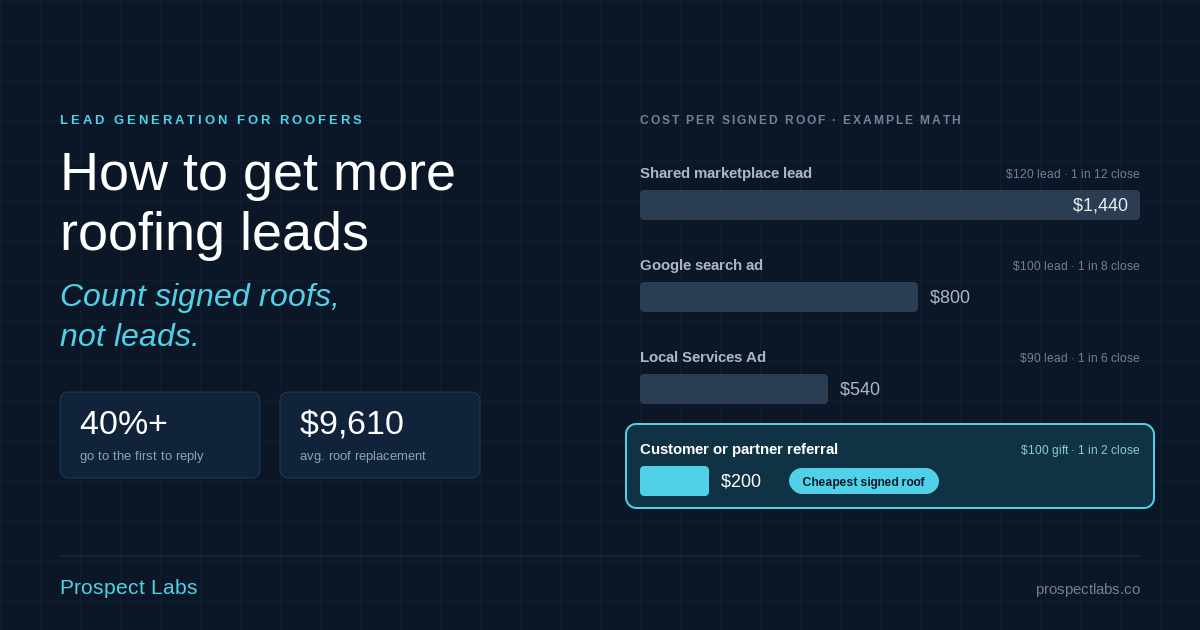
Roofr estimates roofing leads cost anywhere from about $15 to $300 depending on the source. The number that matters more is cost per signed roof: what you spent on a channel divided by the roofs it actually produced. A cheap lead you never reach is the most expensive lead there is.
Here’s a simple way to see it. The figures below are example math, not industry benchmarks. Swap in your own numbers from the last 90 days.
COST PER LEAD VERSUS COST PER SIGNED ROOF (EXAMPLE MATH)
| Lead source | Example cost per lead | Example close rate | Cost per signed roof |
|---|---|---|---|
| Shared marketplace lead | $120 | 1 in 12 | $1,440 |
| Google search ad | $100 | 1 in 8 | $800 |
| Local Services Ad | $90 | 1 in 6 | $540 |
| Customer or partner referral | $100 thank you gift | 1 in 2 | $200 |
Against an average replacement of around $9,610, even the most expensive row is a fraction of one job. What really changes the math is close rate, and close rate is mostly about speed, follow up and trust.
For context, Prospect Labs runs a full marketing system for roofers for one monthly price starting at $297 a month, month to month. That’s roughly 3% of one average roof. Simple arithmetic, not a promise of results.
Why do roofing leads go cold so fast?
Because homeowners keep calling until somebody answers. Roofr reports that over 40% of roofing leads go to the first contractor who responds, and the Harvard Business Review study The Short Life of Online Sales Leads found firms that replied within an hour were nearly seven times likelier to have a meaningful conversation than firms that waited even an hour longer.
You can’t answer a call in a harness on a 10/12 pitch, and nobody should try. That isn’t a work ethic issue. It’s a systems issue. Here’s how it looks from the homeowner’s side:
ANATOMY OF A LOST STORM LEAD
| Time | What happens | Where the lead leaks |
|---|---|---|
| 7:05 AM | Homeowner finds a water stain after overnight hail | Your Google profile shows 14 reviews, the newest from last spring |
| 7:09 AM | Taps through to your website | No storm damage page and no way to text a photo |
| 7:11 AM | Calls you | You’re loading the trailer. It rings out. No text goes back. |
| 7:14 AM | Calls the next roofer on Google | Their office answers and books a 10 AM inspection |
| 10:30 AM | You call back | “Thanks, we already have someone coming out.” |
Nine minutes from search to lost. You never knew the job existed.
The fix is a missed call text back that replies in your business name the moment a call goes unanswered, plus automatic follow ups if the homeowner goes quiet. We break down what really happens when you miss a call minute by minute. The same idea applies after the inspection: most replacements aren’t decided at the kitchen table, so a short sequence of friendly follow ups over two weeks wins jobs that would otherwise drift to a cheaper bid.
How many reviews does a roofing company need?
Enough to clear the trust bar, and fresh enough to look active. BrightLocal’s 2026 survey found 47% of consumers won’t use a business with fewer than 20 reviews, 74% only care about reviews from the last three months, and 31% now expect 4.5 stars or higher.
So the goal isn’t a burst of reviews once a year. It’s a steady trickle from every finished roof. The best moment to ask is right after cleanup, when the magnet sweep is done, the yard is spotless and the homeowner is looking up at a new roof. A text with a direct review link, plus a polite reminder a few days later, does most of the work. Our guide to getting more five star Google reviews has the exact wording.
Ask customers to mention their town and the work (“architectural shingles in Westfield after the May hailstorm”), and reply to every review. The same BrightLocal survey found 89% of consumers expect owners to respond.
How do you turn one roof into the next three?
The cheapest roofing lead is a customer who already trusts you. Past customers need gutters, ventilation and skylight work, and they know neighbors who need the same. A short message after every major storm (“We’re doing free post storm checks for past customers this week”) brings in work and referrals at almost no cost.
Email is underrated here. Roofr found that 25.5% of roofers who follow up by email after a job land repeat work, compared with 13.6% for phone calls and 4.1% for texts. Our guide to referral marketing for contractors shows how to set this up without feeling pushy.
How should roofers plan lead generation around the seasons?
Roofing demand follows the weather. Being ready before the busy window matters more than spending more during it.
A SEASONAL ROOFING LEAD CALENDAR
| Season | What drives leads | What to do |
|---|---|---|
| Spring (March to May) | Hail season across the Plains and Midwest; spring rain exposes winter damage | Publish your storm damage page, refresh Google photos, have an ad budget on standby |
| Summer (June to August) | Hail and thunderstorms; hurricane season starts June 1 on the Gulf and Atlantic coasts | Hold inspection slots for storm days and make same day replies the rule |
| Fall (September to November) | Homeowners want it done before winter; home sales close | Follow up on every unsigned estimate from the year and push partner referrals |
| Winter (December to February) | Ice dams, wind and snow load in northern states | Lead with emergency repair, email past customers, set up spring partnerships |
A simple 90 day plan to get more roofing leads
YOUR FIRST 90 DAYS
| Window | Focus | What to do |
|---|---|---|
| Days 1 to 30 | Get found and get answered | Complete your Google Business Profile, add 20+ real job photos, set up missed call text back, add a one tap text button and a storm damage page to your website |
| Days 31 to 60 | Build trust and partners | Send a review request after every job, reply to every review, meet three home inspectors and three agents, use yard signs and door hangers on every job |
| Days 61 to 90 | Grow and measure | Follow up on unsigned estimates from the last six months, test Local Services Ads, track leads, response time, inspections booked, roofs signed and new reviews |
If you’d rather not build all of that yourself, that’s exactly what our seven stage marketing system does for roofers, from getting found to bringing past customers back. You can see real builds before deciding anything.
Roofing leads FAQs
What is the fastest way to get roofing leads?
Neighbor marketing around active jobs and Google Local Services Ads can produce leads within days, and Google Business Profile improvements often show results within weeks. The fastest win of all is to stop losing the leads you already get by texting back every missed call within a minute.
How much do roofing leads cost?
Roofr estimates roofing leads cost roughly $15 to $300 each depending on the source, with referrals and organic search near the bottom and shared marketplace leads near the top. Track cost per signed roof instead of cost per lead, because close rates vary a lot between channels.
Should roofers buy leads from Angi or HomeAdvisor?
They can fill gaps, especially for newer companies. The catch is that leads are often shared, so you’re racing other roofers to reply. Use them alongside your own Google profile, website, reviews and referral partners, which keep working without a fee per lead.
How do I get roofing leads without door knocking?
Build a complete Google Business Profile, ask every customer for a review, publish a page for each service and storm type you handle, form relationships with home inspectors and real estate agents, and stay in touch with past customers by email after major storms.
How do I get more storm damage roofing leads?
Prepare before storm season. Publish a clear storm damage page, keep your Google photos fresh, hold inspection slots for storm days, build relationships with local insurance agents, and reply within minutes. Homeowners trust the local roofer who answers fast over an out of state crew.
Your next roof is already searching for you
Somewhere in your service area tonight, a homeowner is staring at a water stain on the ceiling, phone in hand, comparing three roofers. The one who shows up, looks trustworthy and answers first gets the inspection.
On a 60 minute call we’ll look at your Google profile, your website and how your calls are handled today, then show you the full system running on live client accounts. If it isn’t a fit, we’ll tell you straight.
| About Prospect Labs: Prospect Labs builds websites and marketing systems for contractors across the US, including roofers, electricians, flooring installers, remodelers and 20+ other trades. Every build includes local SEO, missed call text back, automated follow up and a five star review funnel, all month to month. |